
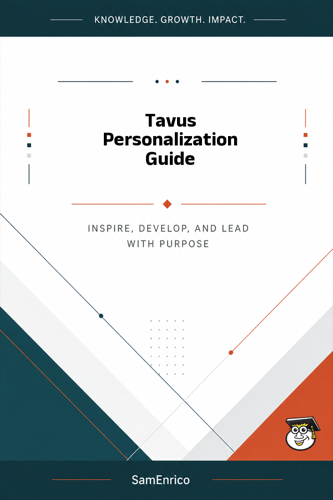
Non-FictionAI OperatorPersonalization
Tavus Personalization Guide eBook
Generate thousands of personalized video variation
Generate thousands of personalized video variations, changing names and details for each recipient.
Formats
Free sample
Chapter 1: The Mirror Neuron Sale...--It begins with a 47-second video.Not a Hollywood production. No studio lights, no teleprompter, no B-roll of smiling diverse professionals in a sunlit open-plan office. Just a founder sitting in front of a bookshelf, speaking into a laptop webcam. The lighting is slightly too warm. His collar is askew on one side.
In the background, a half-empty coffee mug sits next to a stack of sticky notes.The video says: "Hey Sarah, I noticed you started the onboarding flow for Cloud Save's automated savings feature but didn't complete it. I've set aside fifteen minutes tomorrow at 2 PM to walk you through it personally. No pressure. Just want to make sure you're not leaving money on the table."Sarah received that video at 9:14 AM. At 9:16 AM, she booked the meeting.
At 9:17 AM, she forwarded the video to her husband with a note that said, "These people are incredible."What Sarah did not know was that the founder did not record that video for her. He recorded a single 47-second master template. The name "Sarah," the reference to "onboarding flow," the specific time "2 PM," and the product name "Cloud Save" were all variables—data fields pulled from her CRM profile and injected into the video by an AI that had learned the founder's face, voice, and mannerisms.What Sarah experienced was not automation. She experienced attention. And in the modern economy, attention is the only currency that matters.The 95% Truth Let us begin with a number that should terrify you.The average retention rate for a standard, non-personalized explainer video—the kind you produce at great expense with a video agency, the kind with professional animation and a voice actor and a musical score that swells at the climax—is approximately 5% after 30 seconds.Let me rephrase that.
Ninety-five percent of your audience has stopped watching your carefully produced, expensively scripted, beautifully animated video before you have finished your second sentence.Now consider the alternative. Across thousands of campaigns analyzed by multiple Mar Tech platforms (including but not limited to Tavus, which is the primary platform referenced in this book), personalized variable videos—the kind where the viewer's name, company, product interest, or other data appears naturally within the video—achieve completion rates between 85% and 95%.Eighty-five to ninety-five percent of viewers watch until the end.That is not an incremental improvement. That is a category change. That is the difference between a direct mail campaign and email. Between a fax machine and the internet.
Between a map and GPS.The question is not whether personalized video works. The question is why more people are not using it. And the answer, as with most transformative technologies, is a combination of inertia, intimidation, and misinformation.This book exists to eliminate all three.What This Book Is (And Is Not)Before we go further, a clarification that will save you confusion later. This book is called The Tavus Personalization Guide, and it uses Tavus as its primary reference platform for demonstrating concepts. The principles, however, are largely platform-agnostic.
If you use a different variable video platform (and several now exist), the workflows for data preparation, script structuring, voice training, and quality assurance will translate directly. Where specific features are unique to Tavus—particularly the lip-sync architecture and micro-expression training discussed in Chapter 6—this will be clearly noted.This book is not a product manual. You will find no API documentation dumps, no exhaustive lists of configuration parameters, no marketing fluff about why one platform is superior to another. This book is a strategic and tactical guide for marketers, founders, revenue operations leaders, and anyone who has ever looked at a list of ten thousand customers and wished they could speak to each one individually.This book is organized into four parts. Part I (Chapters 1-3) establishes the foundation: why personalized video works, how to prepare your data, and how to script for variable logic.
Part II (Chapters 4-6) covers creative production: recording the master video, designing visual overlays, and training your AI voice clone. Part III (Chapters 7-9) addresses the operations engine: rendering pipelines, quality assurance, and delivery analytics. Part IV (Chapters 10-12) explores advanced tactics: multivariate campaigns, omnichannel distribution, and the future of real-time video.By the end of this book, you will have gone from zero knowledge to running a multivariate, omnichannel, thousand-video campaign with confidence.But first, you must understand the psychological mechanism that makes personalized video uniquely powerful. And that mechanism lives in a small cluster of neurons in your brain called the mirror neuron system.The Biology of Attention In the 1990s, a team of Italian neuroscientists at the University of Parma made a discovery that would fundamentally change our understanding of human connection. They were studying macaque monkeys, implanting electrodes in the premotor cortex to observe how neurons fired when the monkeys performed actions like grasping a peanut or breaking a shell.Then something unexpected happened.One of the researchers reached for his own peanut—he was eating lunch—and the monkey's neurons fired.
The same neurons that fired when the monkey grasped a peanut fired when the monkey watched the researcher grasp a peanut.The monkey's brain was mirroring the action it observed.These neurons were later named "mirror neurons," and their discovery has profound implications for everything from empathy to language acquisition to marketing. Because mirror neurons do not just fire for physical actions. They fire for emotions. They fire for intentions. When you watch someone smile, the same neurons that produce your own smile activate.
When you watch someone flinch in pain, your pain matrix lights up.You are, in a very real sense, simulating the experience of the person you are watching.This is why personalized video is not merely a tactical improvement over generic video. It is a different category of communication. When a viewer watches a video that says "Hey Sarah, I see you're interested in automated savings," their mirror neurons do not process this as a broadcast. They process it as a conversation. The speaker is not a disembodied voice addressing a faceless audience.
The speaker is a specific person, looking at the camera (which the viewer's brain interprets as eye contact), saying the viewer's name (which triggers an orienting response deeper and more ancient than conscious thought), and referencing something unique to the viewer's behavior (which signals genuine attention rather than automation).The viewer's brain does what it has evolved to do over millions of years: it pays attention to being paid attention to.The Four Pillars of Personalized Video Effectiveness Through analysis of hundreds of successful campaigns across industries, four distinct psychological mechanisms have been identified that explain why personalized video outperforms generic alternatives. Understanding these mechanisms will inform every tactical decision you make in subsequent chapters.Pillar One: The Name Effect The most basic variable is the most powerful. Hearing one's own name triggers a specific electrophysiological response measurable in the brain within 150 milliseconds. This is called the "orienting response"—a survival mechanism that prioritizes personally relevant stimuli over background noise. In a marketing context, this means that a video containing the viewer's name captures attention before the viewer has consciously decided to pay attention.However—and this is…
This is the end of the free sample. Get the eBook to keep going. Buy now
About this book
Details
- Author
- Mcnamara Dorene
- Publisher
- SamEnrico
- Language
- English
- Genre
- Non-Fiction, AI Operator, Personalization
- Released
- 2026-06-09
- Pages (approx.)
- 140
- Available as
- eBook, Audiobook

Read better in the ZLOADR app
Your eBooks on your phone or tablet. Sign in with your SamEnrico account and start reading.
More by Mcnamara Dorene
 Color Dream Symbolism HandbookMcnamara Dorene$11.99
 Germ Phobia CBT GuideMcnamara Dorene$11.99
 The High Functioning Alcoholic Recovery PlanMcnamara Dorene$11.99
 Meth Identity Reconstruction WorkbookMcnamara Dorene$11.99
 The Line in the Sand: How a Fishing Dispute Nearly Started a WarMcnamara Dorene$11.99
 How to Become a Mud BossMcnamara Dorene$11.99
 Ecommerce Regional Spending GuideMcnamara Dorene$12.99
 Academic Proofreading Side HustleMcnamara Dorene$12.99
 Understanding Indomethacin Antenatal InfectionMcnamara Dorene$17.99
 Apothecary AssistantMcnamara Dorene$11.99
You may also like
 Hong Kong Handover 1997Dunn Johnnie$11.99
 Zumba For Postnatal Recovery CourseNeal Christian$11.99
 Zumba for BeginnersLadner Nikia$11.99
 YouTube Comment Mining GuideHumes Pandora$12.99
 Worry Box MeditationCarlin Rudy$11.99
 Workplace Stress MeditationNguyen Lynn$11.99
 Workplace Stress and Sleep RepairHawley Ivory$11.99
 Workplace Perfectionism CureDelaney Jeffry$11.99
 Workplace Injustice Anger GuideWallen Isabelle$11.99
 Work Addiction and Burnout LinkGreenwood Ester$11.99
 Women in Yoga and WellnessBeattie Galina$11.99
 Women in Stand Up ComedyChun Evangeline$11.99