
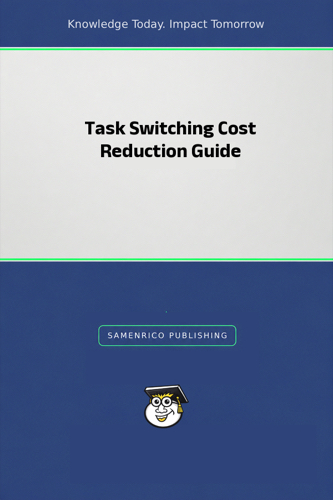
Non-FictionSelf-HelpCognitive Performance
Task Switching Cost Reduction Guide eBook
Minimize the productivity loss from constant inter
Minimize the productivity loss from constant interruptions using this practical cognitive focus handbook.
Formats
Free sample
Chapter 1: The 23-Minute Lie--–- It is 10:17 on a Tuesday morning. You have been at your desk for exactly eighty-three minutes. In that time, you have checked your email four times, responded to three Slack messages, attended a fifteen-minute stand-up meeting, drafted two sentences of a report, searched for a file you cannot find, answered a quick question from a colleague who stopped by your desk, and scrolled through Linked In for no particular reason. You feel exhausted. You feel like you have already failed.
And you have not even had lunch yet.Here is what no one has told you: you are not lazy, undisciplined, or broken. You are a normal human being trapped in a system designed to fragment your attention. The problem is not a lack of willpower. The problem is that you have been sold a lie—a lie so pervasive, so deeply embedded in workplace culture, that questioning it feels almost rebellious.The lie is this: multitasking works.We have been told for decades that the ability to do several things at once is a superpower. Job descriptions ask for “excellent multitasking abilities.” Resumes brag about “juggling multiple priorities.” Parents proudly describe themselves as masters of “wearing many hats.” The message is everywhere: if you can do more things at the same time, you are more valuable, more efficient, more successful.The truth is exactly the opposite.What we call multitasking is not simultaneous processing.
The human brain cannot perform two attention-heavy tasks at the same time. What actually happens is rapid sequential task-switching—and every single switch carries a cost. That cost is measured in lost time, depleted mental energy, increased errors, and a subtle but cumulative erosion of creative capacity. Researchers call this the “switch cost effect.” I call it the 23-Minute Lie, because that is roughly how long it takes to fully recover your focus after a single interruption.Yes, you read that correctly. One glance at an email notification can cost you twenty-three minutes of productive deep work.This chapter is going to make you uncomfortable.
It will force you to confront habits you have defended for years. It will ask you to stop pretending that you are the exception to the laws of cognitive neuroscience. And it will give you something far more valuable than permission to keep multitasking: it will give you a clear, evidence-based understanding of why you feel so exhausted all the time, and why doing less—not more—is the path to actually getting things done.The Myth That Refuses to Die Let us start with a simple experiment. Try this right now, while you are reading this page. Pat the top of your head with your right hand.
At the same time, rub your stomach in a circular motion with your left hand. Most people can do this. It feels a little awkward, but it is possible.Now try something harder. While continuing to pat your head and rub your stomach, silently recite the alphabet backward from Z to A. Keep patting.
Keep rubbing. Keep reciting.What happened? For almost everyone, one of those three tasks suffered. Either your hand movements became sloppy, or your recitation slowed down, or you lost track entirely. You were not multitasking.
You were switching rapidly between three tasks, and every switch degraded your performance on all of them.This is not a failure of effort. It is a feature of how the human brain evolved. The prefrontal cortex—the part of your brain responsible for executive function, decision-making, and attention—has a limited processing capacity. Think of it as a single-lane highway. When one car (one task) is on the highway, traffic flows smoothly.
When a second car tries to merge (a second task), the highway does not magically become two lanes. Instead, the cars take turns, each one stopping and starting, accelerating and braking. The total travel time increases for both. And when a third car tries to merge (a third task), the highway becomes a parking lot.This is not a metaphor. This is neuroscience.The Switch Cost Effect: What the Research Actually Says The most cited study on task-switching comes from the University of California, Irvine, where researchers Gloria Mark and her team spent years observing knowledge workers in their natural environments.
They found that the average worker switches tasks every three minutes and five seconds. That is roughly twenty switches per hour, or one hundred and sixty switches per eight-hour day.But the more disturbing finding was what happened after each switch. When a worker was interrupted—by an email, a chat message, a colleague stopping by—it took an average of twenty-three minutes and fifteen seconds to return to the original task at the same level of focus. Twenty-three minutes. For a single interruption.Think about the math of that for a moment.
If you are interrupted just four times in a morning, you have lost nearly ninety minutes of productive focus—not because you were working slowly, but because your brain was stuck in recovery mode. You were at your desk, staring at your screen, but your cognitive engine was still spooling up, over and over again, like a car that keeps stalling at every stoplight.Other studies have replicated and refined these findings. Researchers at Michigan State University found that even brief mental blocks—as short as 2.8 seconds—can double the error rate on complex tasks. A study from the University of London showed that participants who multitasked during cognitive tasks experienced IQ drops of fifteen points, putting them in the same range as someone who had stayed up all night. Fifteen points.
That is the difference between “above average” and “average.” That is the difference between catching a mistake and missing it entirely.Here is the part that should terrify every manager and executive reading this: the global economy loses an estimated $588 billion per year to task-switching costs. That is not a typo. Nearly six hundred billion dollars. Your organization is paying a fortune for the privilege of keeping you distracted.Attention Residue: The Ghost That Follows You The switch cost is only half the story. The other half is something psychologists call “attention residue.”When you switch from Task A to Task B, your brain does not fully let go of Task A.
Bits of it linger—the unsolved problem, the unfinished sentence, the open question. These lingering thoughts occupy working memory, reducing the cognitive capacity available for Task B. You are not fully present. You are not fully focused. You are, in a very real sense, mentally elsewhere.Sophie Leroy, a researcher at the University of Washington, coined the term “attention residue” after a series of experiments in which participants were interrupted during complex tasks.
She found that even when people believed they had completely switched their attention, measurable traces of the previous task remained in their cognitive processing. The only way to eliminate attention residue was to complete the original task before switching.Let that sink in. The only way to fully focus on Task B is to finish Task A first. Not pause it. Not put it in a folder for later.
Finish it.This is why your inbox feels like a weight on your chest. Every unanswered email is an open loop…
This is the end of the free sample. Get the eBook to keep going. Buy now
About this book
Details
- Author
- Guajardo Jamila
- Publisher
- SamEnrico
- Language
- English
- Genre
- Non-Fiction, Self-Help, Cognitive Performance
- Released
- 2026-06-10
- Pages (approx.)
- 115
- Available as
- eBook, Audiobook

Read better in the ZLOADR app
Your eBooks on your phone or tablet. Sign in with your SamEnrico account and start reading.
More by Guajardo Jamila
 Best Man Maid Of Honor GuideGuajardo Jamila$11.99
 Hidden Rewards of CaringGuajardo Jamila$11.99
 Self Hypnosis For OCD ThoughtsGuajardo Jamila$11.99
 CBT for PMS ManagementGuajardo Jamila$11.99
 The Great Bitcoin Heist: How a Rogue Insider Stole Millions in the DarkGuajardo Jamila$11.99
 Echoes of the Great Gathering: The Lost Festival of the SunGuajardo Jamila$11.99
 How to Become a Cardiopulmonary TechnologistGuajardo Jamila$11.99
 Deal AdministratorGuajardo Jamila$11.99
 Voiceover Commercial RightsGuajardo Jamila$12.99
 Russian Data Breach GuideGuajardo Jamila$12.99
 Understanding Ectodermal Dysplasia Arthrogryposis Diabetes MellitusGuajardo Jamila$17.99
You may also like
 Hong Kong Handover 1997Dunn Johnnie$11.99
 Zumba For Postnatal Recovery CourseNeal Christian$11.99
 Zumba for BeginnersLadner Nikia$11.99
 YouTube Comment Mining GuideHumes Pandora$12.99
 Worry Box MeditationCarlin Rudy$11.99
 Workplace Stress MeditationNguyen Lynn$11.99
 Workplace Stress and Sleep RepairHawley Ivory$11.99
 Workplace Perfectionism CureDelaney Jeffry$11.99
 Workplace Injustice Anger GuideWallen Isabelle$11.99
 Work Addiction and Burnout LinkGreenwood Ester$11.99
 Women in Yoga and WellnessBeattie Galina$11.99
 Women in Stand Up ComedyChun Evangeline$11.99