
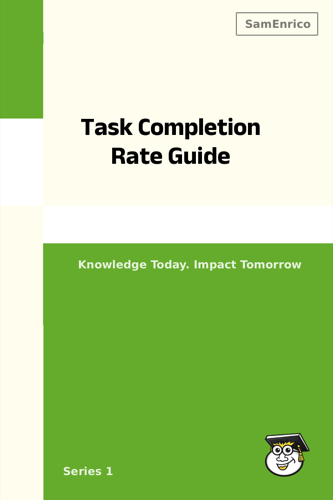
Task Completion Rate Guide eBook
Measures if users can finish key actions.
by Best Debroah
Measures if users can finish key actions.
Formats
Free sample
Chapter 1: The Beauty Trap--–- In 2018, a luxury fashion retailer launched a mobile app that cost $4.7 million to design, engineer, and market. The app featured cinematic product photography, silky smooth animations, and a pastel color palette that won a Webby Award. User satisfaction scores were stellar: 4.8 out of 5 stars on the i OS App Store. Customers wrote reviews saying the app was “gorgeous,” “a pleasure to use,” and “visually stunning.” The company’s Chief Marketing Officer declared it “the future of luxury e-commerce.”Three months after launch, the head of analytics pulled the team into a conference room with a single slide. It showed the app’s checkout completion rate: 62 percent.For every one hundred customers who added an item to their cart, thirty-eight of them gave up before completing the purchase.
Not because they changed their minds about the sweater or the handbag. Because they could not figure out how to pay for it. The “Place Order” button—that tiny, low-contrast, gray-on-white button tucked beneath an irrelevant promotional banner—was invisible to nearly two in five users.The company’s response was telling. The design team proposed a “comprehensive visual audit.” The product team asked for more user satisfaction surveys. The engineering team wanted to add animated loading spinners to “improve the experience.”Nobody asked the obvious question: can users actually complete the task?That question—simple, direct, and routinely ignored—is the subject of this book.
And the answer to it, measured as a single percentage called the task completion rate, is more valuable than any satisfaction score, any aesthetic rating, or any five-star review you will ever collect.This is the chapter where we dismantle the myths that keep teams focused on the wrong metrics. We will establish why task completion rate is not just another number on a dashboard but the single most diagnostic metric in user experience. We will define what a “key action” actually means and how to identify the five to ten user journeys that determine whether your digital product lives or dies. We will introduce the three pillars of UX—effectiveness, efficiency, and satisfaction—and show you why effectiveness must always come first. And we will begin a case study that follows a single company through the transformation from chasing beauty to measuring what matters.But before we go any further, we need to confront an uncomfortable truth about how most teams measure user experience today.The Satisfaction Delusion For the past fifteen years, the technology industry has been addicted to satisfaction metrics.
Net Promoter Score (NPS), Customer Satisfaction Score (CSAT), and the System Usability Scale (SUS) have become the default currencies of UX research. Product managers demand “high NPS.” Designers celebrate “positive feedback.” Executives boast about “award-winning experiences.”None of these metrics tell you whether users can actually do what they came to do.Consider a thought experiment. Imagine a banking app that is visually stunning. Every screen is a masterpiece of typography and negative space. The animations are buttery smooth.
When you open the app, you feel calm and delighted. Now imagine that same app buries the “transfer money” function three menus deep, requires you to re-enter your password for every transaction, and crashes every fifth time you try to confirm a payment. Your satisfaction score after failing to send money to your roommate might still be moderately positive—you liked the colors, after all. But the app has failed at its primary purpose.This is not a hypothetical. Research published in the Journal of Usability Studies found that satisfaction ratings and completion rates correlate at only r = 0.4 to 0.6 across hundreds of tests.
That means a product can have high satisfaction and low completion, or low satisfaction and high completion. The two metrics measure fundamentally different things. Satisfaction measures emotion. Completion measures behavior. And behavior is what drives business outcomes.The luxury fashion retailer from our opening story had stellar satisfaction scores.
Users genuinely enjoyed browsing the app. They left glowing reviews. But thirty-eight percent of those same users abandoned their carts because they could not find a gray button on a gray background. The satisfaction scores were not just unhelpful. They were actively misleading.
They created a false sense of security that delayed the identification of the real problem by three full months.The Three Pillars of UXTo understand why task completion rate matters, we need to step back and look at the full architecture of user experience measurement. Every interaction a user has with a digital product can be evaluated along three dimensions: effectiveness, efficiency, and satisfaction. These are not competing metrics. They are complementary pillars. But they are not equal in importance.Effectiveness answers the question: can the user achieve their goal?
This is binary. They either complete the task or they do not. Effectiveness is the gatekeeper. Without it, nothing else matters. A user who cannot check out, cannot reset their password, or cannot find a contact phone number will not care about your animations, your color palette, or your clever microcopy.
They will leave. Many will never return.Efficiency answers the question: how much effort did it take? This is continuous. It can be measured in time, clicks, cognitive load, or any unit of user exertion. Efficiency matters enormously, but only after effectiveness is established.
A user who completes a task in sixty seconds is better off than one who completes it in six minutes. But both are infinitely better off than the user who never completes it at all.Satisfaction answers the question: did the user enjoy the experience? This is subjective. It is measured through surveys, interviews, and emotional response metrics. Satisfaction is the most variable and least diagnostic of the three pillars.
A user can be satisfied with a product that fails them occasionally. A user can be dissatisfied with a product that works perfectly but feels clunky. Satisfaction matters for retention and brand loyalty, but it cannot compensate for broken core tasks.Here is the hierarchy that most teams get wrong. They measure satisfaction first because it is easy to collect. They measure efficiency second because analytics tools provide time-on-task data automatically.
They measure effectiveness last, if at all, because it requires deliberate test design and binary outcome coding.That hierarchy is backwards. You cannot optimize efficiency for a task that users cannot complete. You cannot trust satisfaction scores from users who abandoned their primary goal. Effectiveness is not one metric among equals. It is the foundation.
And task completion rate is how you measure it.Defining the Key Action Before you can measure task completion, you have to know what counts as completion. This sounds obvious, but in practice, teams routinely fail to define their key actions with enough precision to measure them reliably.A key action is a discrete user goal that has a clear beginning, a clear end state, and business value. It is not “use the app.” It is not “have a good experience.” It is specific, observable, and binary.For an e-commerce site, key actions might include:Add an item to the shopping cart Complete the checkout process Apply a discount code successfully Find the return policy page Reset a forgotten password For a software-as-a-service product, key actions might include:Create…
This is the end of the free sample. Get the eBook to keep going. Buy now
About this book
Details
- Author
- Best Debroah
- Publisher
- SamEnrico
- Language
- English
- Genre
- Non-Fiction, Self-Help, Usability Metrics
- Released
- 2026-06-05
- Pages (approx.)
- 144
- Available as
- eBook, Audiobook

Read better in the ZLOADR app
Your eBooks on your phone or tablet. Sign in with your SamEnrico account and start reading.
More by Best Debroah
 Combat Veteran Trigger GuideBest Debroah$11.99
 Postpartum Milk Supply ConcernsBest Debroah$11.99
 Cloud Infrastructure SpendingBest Debroah$11.99
 Ego Strengthening Script TemplatesBest Debroah$11.99
 Sheppard Case DNA AdvancesBest Debroah$11.99
 Closing With Impact GuideBest Debroah$11.99
 Dreaming for Academic ResearchBest Debroah$11.99
 Alcohol Recovery for PartnersBest Debroah$11.99
 The Icebound Pioneers: How Alpine Explorers Conquered the Arctic's Frozen PeaksBest Debroah$11.99
 Painkiller Profits: The Sackler Empire's Dark LegacyBest Debroah$11.99
 The Spice King of the Indian Ocean: The Rise of the Swahili Merchant PrincesBest Debroah$11.99
 CRS Points for GraduatesBest Debroah$12.99