
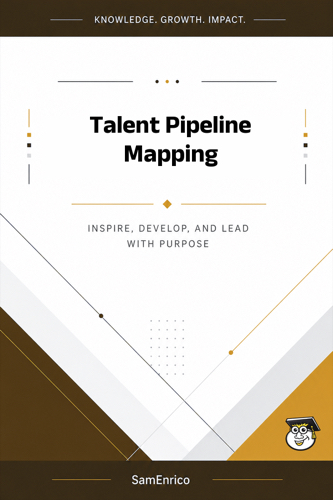
Non-FictionStrategic AtlasPipeline Strategy
Talent Pipeline Mapping
Track how hypergrowth firms build university and d
Track how hypergrowth firms build university and diversity pipelines years in advance.
Formats
About this book
Free sample
Chapter 1: The Demand Calculus--–- Most companies discover they have a talent pipeline problem on a Tuesday. Not a dramatic Tuesday—no explosions, no resignations, no boardroom coups. Just a routine Tuesday when a hiring manager submits a requisition for three entry-level engineers, and the recruiting team responds with empty hands. The university recruiting cycle closed four months ago. The diverse candidate slates are thin.
The only available graduates are the ones every other firm rejected. And somewhere in the C-suite, a quarterly business review reveals that the new product launch just got delayed because nobody thought to ask, eighteen months ago, who would build it.This is not a failure of effort. It is a failure of calculus.The central problem of hypergrowth talent acquisition is not that recruiters work slowly or that universities produce too few graduates. The problem is temporal: traditional recruiting operates on a reactive, requisition-driven timeline, while hypergrowth operates on a predictive, capacity-driven timeline. By the time a role is approved and a job description is written, the candidates you actually want—the high-potential, diversity-matrix, firm-specific human capital that separates market leaders from followers—have already accepted offers elsewhere.
They were cultivated, nurtured, and closed while you were still waiting for headcount approval.This chapter introduces the foundational calculus of talent pipeline mapping: the shift from annual hiring plans to rolling demand signals, the distinction between back mapping and forward forecasting, and the decision framework that determines which approach governs your pipeline strategy. By the end of this chapter, you will understand why most workforce planning fails, how to identify the critical business functions that cannot tolerate just-in-time hiring, and why the 36-month talent demand signal is the single most important metric your recruiting function is probably not tracking.The Illusion of Annual Hiring Plans Walk into any mid-sized company's HR department in October, and you will witness an annual ritual: the creation of next year's hiring plan. Spreadsheets are opened. Managers are surveyed. Headcount is negotiated.
Budgets are approved. And by February, the plan is obsolete.The annual hiring plan is a relic of stable, predictable business…
This is the end of the free sample. Get the eBook to keep going. Buy now
Contents
- Chapter 1
- Chapter 2
- Chapter 3
- Chapter 4
- Chapter 5
- Chapter 6
- Chapter 7
- Chapter 8
- Chapter 9
- Chapter 10
- Chapter 11
- Chapter 12
Details
- Author
- Barney Kimberely
- Publisher
- SamEnrico
- Language
- English
- Genre
- Non-Fiction, Strategic Atlas, Pipeline Strategy
- Released
- 2026-06-10
- Pages (approx.)
- 141
- Available as
- eBook, Audiobook

Read better in the ZLOADR app
Your eBooks on your phone or tablet. Sign in with your SamEnrico account and start reading.
More by Barney Kimberely
 The Complicated Grief Nature GuideBarney Kimberely$11.99
 Beginner Mindfulness for NightmaresBarney Kimberely$11.99
 Dietrich Bonhoeffer Martyr PastorBarney Kimberely$11.99
 The Asynchronous Communication GuideBarney Kimberely$11.99
 The Midnight Chants of the Vetalas: When the Dead Walk the StreetsBarney Kimberely$11.99
 Understanding Strychnine PoisoningBarney Kimberely$17.99
 Online English Tutoring Side HustleBarney Kimberely$12.99
 ASC Certification Export GuideBarney Kimberely$12.99
 Customer Development ManagerBarney Kimberely$11.99
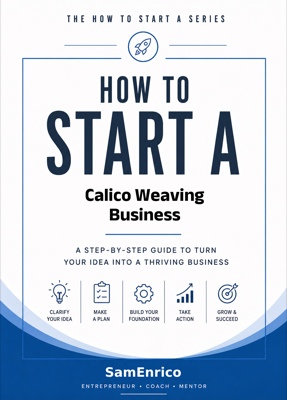 How to Start a Calico Weaving Business (Beginners Guide)Barney Kimberely$11.99
You may also like
 Hong Kong Handover 1997Dunn Johnnie$11.99
 Zumba For Postnatal Recovery CourseNeal Christian$11.99
 Zumba for BeginnersLadner Nikia$11.99
 YouTube Comment Mining GuideHumes Pandora$12.99
 Worry Box MeditationCarlin Rudy$11.99
 Workplace Stress MeditationNguyen Lynn$11.99
 Workplace Stress and Sleep RepairHawley Ivory$11.99
 Workplace Perfectionism CureDelaney Jeffry$11.99
 Workplace Injustice Anger GuideWallen Isabelle$11.99
 Work Addiction and Burnout LinkGreenwood Ester$11.99
 Women in Yoga and WellnessBeattie Galina$11.99
 Women in Stand Up ComedyChun Evangeline$11.99