
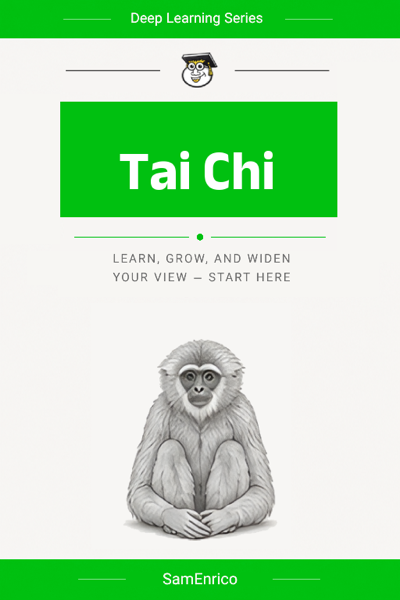
Non-FictionInformativeEducational
Tai Chi eBook
A Coursebook on Tai Chi
A Coursebook on Tai Chi
Formats
Free sample
Chapter 1: The Stillness Inside Motion--– The first mistake almost everyone makes is thinking that Tai Chi is about slow movement. You have been told, probably many times, that Tai Chi is “meditation in motion” or “exercise for people who don’t like exercise” or “that thing old people do in parks at sunrise.” None of these descriptions are wrong, exactly. But they are all incomplete in a way that matters. Because Tai Chi is not primarily about the movement at all. Tai Chi is about what happens between the movements.
It is about the pause, the transition, the breath, the intention that precedes every physical action. If you learn only the choreography of Tai Chi—the sequence of postures, the names of the forms, the way the hands sweep and the feet step—you have learned a hollow shell. You have learned a dance without music, a sentence without meaning. The essence of Tai Chi is not in the positions you hold but in the way you arrive at them and the way you leave them. And that essence begins with a single, radical, counterintuitive instruction: do nothing.The Unlearning Curve Every other physical discipline you have ever encountered—yoga, Pilates, weight training, running, Cross Fit, even physical therapy—starts by asking you to do something.
Engage your core. Straighten your spine. Lift your knee higher. Breathe into your belly. Squeeze your glutes.
These are instructions of action, of effort, of muscular engagement. They are useful instructions. They have their place. But Tai Chi begins with an instruction of non-action. It begins with the art of doing nothing.This is not laziness.
This is not collapse. This is not the limp floppiness of exhaustion. The relaxation required in Tai Chi—a state the Chinese call Song (鬆)—is an active, alert, intelligent relaxation. It is the relaxation of a cat waiting for a mouse to emerge from its hole: completely still, completely soft, and completely ready to explode into motion at the exact right instant. It is the relaxation of a professional sprinter in the starting blocks: every muscle prepared, nothing wasted, no tension held that does not serve the next movement.
Song is the difference between a rope and a chain. A rope, when relaxed, falls into a heap—limp, useless, without structure. A chain, when relaxed, still holds its links in relationship to one another. It can be coiled, it can be draped, it can be gathered, but it never loses its essential connectedness. Your body in Tai Chi must become a chain, not a rope.Most people walk around with chronic, low-grade muscular tension that they have forgotten they are holding.
This tension lives in the shoulders (hunched toward the ears), the jaw (clenched, even during sleep), the lower back (locked in a perpetual slight arch), the neck (craned forward toward screens). This tension is not serving you. It is not making you stronger or more stable. It is simply a habit—a learned pattern of holding that your nervous system has mistaken for normal. The first week of Tai Chi practice is not about learning movements.
It is about unlearning these patterns. It is about discovering where you are holding unnecessary tension and, one breath at a time, learning to let it go.The Standing Meditation That Changes Everything You are going to begin with an exercise that looks like absolutely nothing. A passerby would think you were simply standing still, perhaps waiting for a bus or staring into space. But you will know, and this book will teach you, that you are doing one of the most difficult and transformative practices in the entire Tai Chi tradition.Find a place where you can stand undisturbed for five minutes. It can be any surface that is relatively flat and not slippery.
You do not need special clothing, though tight jeans or a belt that digs into your waist will distract you. Bare feet are ideal, but socks or thin-soled shoes are fine. Stand with your feet approximately shoulder-width apart, toes pointing straight ahead, not turned out like a ballet dancer or in like a pigeon. Now, very slowly, shift your weight forward and backward until you find the place where your weight is distributed evenly between the balls of your feet and your heels. Most people habitually stand too far back on their heels (which locks the knees) or too far forward on the balls of their feet (which engages the calves unnecessarily).
The sweet spot is when you can feel your weight settling into the arch of each foot, as if the sole of your foot were a tripod: the heel, the base of the little toe, and the base of the big toe all in equal contact with the floor.Now soften your knees. Not a deep squat—nothing that will strain your quadriceps. Simply unlock them. If you look down at your knees, they should be directly above your ankles, not pushed forward beyond your toes. Imagine that your spine is a string of pearls, each vertebra stacked gently on the one below it.
Your pelvis should be neither tucked under (which flattens the lower back) nor tilted forward (which creates a swayback). Imagine that your pelvis is a bowl full of water. Tilt it forward and the water spills out the front. Tilt it back and the water spills out the back. The neutral position—the one you want—is when the water is level with the rim.Your shoulders: let them drop.
Not by forcing them down, which creates tension in the upper trapezius, but by allowing them to fall under their own weight. Imagine that someone has placed a heavy coat on your shoulders. You are not holding the coat up; the coat is simply resting there. Your arms hang at your sides, fingers gently extended but not rigid, as if you were holding a raw egg in each palm without breaking it. Your chin tucks slightly—not enough to look at the floor, just enough to lengthen the back of your neck.
Your tongue rests gently against the roof of your mouth, behind your front teeth. This is a traditional Tai Chi instruction with a physiological basis: it completes a circuit of fascia and encourages salivation, which aids digestion and signals the parasympathetic nervous system.Now close your eyes. Or leave them half-open, gazing softly at the floor about three feet in front of you. Whichever allows you to turn your attention inward without becoming dizzy.And then: stand. Do nothing.
For five minutes.What You Will Notice (And What It Means)The first time you try this, your mind will rebel. Within thirty seconds, you will feel an urgent need to check your phone, adjust your posture, scratch an itch, or abandon the entire exercise. This is not a failure of your concentration. This is simply your brain doing what brains evolved to do: seek novelty, avoid stillness, and solve problems. Standing still is not a problem to be solved, so your brain interprets it as boredom or discomfort.
The practice is not to eliminate these sensations but to notice them without reacting.You will also notice physical sensations. Your…
This is the end of the free sample. Get the eBook to keep going. Buy now
About this book
Details
- Author
- Waggoner Piedad
- Publisher
- SamEnrico
- Language
- English
- Genre
- Non-Fiction, Informative, Educational
- Released
- 2026-05-07
- Pages (approx.)
- 149
- Available as
- eBook, Audiobook

Read better in the ZLOADR app
Your eBooks on your phone or tablet. Sign in with your SamEnrico account and start reading.
More by Waggoner Piedad
 Walsh Raoul Errol FlynnWaggoner Piedad$11.99
 Burnout In Creative Professions WorkbookWaggoner Piedad$11.99
 Alopecia Totalis Self Esteem GuideWaggoner Piedad$11.99
 Adopted Child Sleep GuideWaggoner Piedad$11.99
 The Difficult Health Diagnosis DiscussionWaggoner Piedad$11.99
 The Bridge That Roared: The Unseen Collapse of the Tacoma NarrowsWaggoner Piedad$11.99
 Product Backlog Refinement PromptsWaggoner Piedad$12.99
 Mexico AML Labor OutsourcingWaggoner Piedad$12.99
 Understanding Mesomelia SynostosesWaggoner Piedad$17.99
You may also like
 Hong Kong Handover 1997Dunn Johnnie$11.99
 Zumba For Postnatal Recovery CourseNeal Christian$11.99
 Zumba for BeginnersLadner Nikia$11.99
 YouTube Comment Mining GuideHumes Pandora$12.99
 Worry Box MeditationCarlin Rudy$11.99
 Workplace Stress MeditationNguyen Lynn$11.99
 Workplace Stress and Sleep RepairHawley Ivory$11.99
 Workplace Perfectionism CureDelaney Jeffry$11.99
 Workplace Injustice Anger GuideWallen Isabelle$11.99
 Work Addiction and Burnout LinkGreenwood Ester$11.99
 Women in Yoga and WellnessBeattie Galina$11.99
 Women in Stand Up ComedyChun Evangeline$11.99