
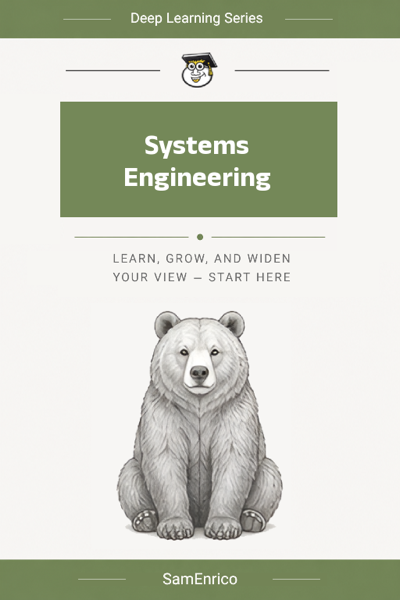
Systems Engineering Audiobook
A Coursebook on Systems Engineering
A Coursebook on Systems Engineering
Formats
Free sample
Chapter 1: The Edges of Order--–- In the summer of 1994, a gleaming new terminal opened at Denver International Airport. It was a monument to human ambition—glass spires rising from the Colorado prairie like frozen mountains, automated baggage carts humming through miles of underground tunnels, a computerized sorting system that promised to route luggage from check-in to any aircraft in less than fifteen minutes. The airport cost five billion dollars. It opened sixteen months late. And on its first day of operation, the baggage system ate suitcases.Not metaphorically.
Bags jammed in conveyor chutes. Luggage carts collided in tunnels. The system's 4,000 independent vehicles, controlled by more than 1,000 computers running 2.5 million lines of custom code, could not reliably tell a duffel bag from a child's car seat. In one notorious incident, a bag destined for a United Airlines flight ended up at a Continental gate, then back to check-in, then underground, then lost entirely—never to be seen again by its owner. The airport eventually ripped out the automated system and hired hundreds of baggage handlers to do by hand what machines could not.
The total cost of the failure, including lawsuits, redesigns, and permanent manual labor, exceeded three hundred million dollars.What went wrong? Not the conveyors. Not the software in isolation. Not the individual vehicles. What failed was the integration of these pieces into a whole.
The baggage system worked perfectly in component tests. The software passed unit tests. The carts moved correctly on empty tracks. But when you connected the check-in counters to the conveyors to the sorting algorithms to the carts to the aircraft loading docks—when you closed the loop and let real passengers with oddly shaped bags and late arrivals and misprinted tags enter the system—the emergent behavior was chaos. The whole was not the sum of its parts.
The whole was dysfunctional.That dysfunction has a name in engineering. It is called system failure, and it is almost never caused by a single broken component. It is caused by broken relationships between components. The Denver baggage system is not an exception. It is a monument to a universal truth that every engineer eventually learns the hard way: you cannot build complex things by assembling perfect pieces and hoping they will work together.
You must design the between—the interfaces, the flows, the feedback loops, the unintended consequences. You must design the system.This book is…
This is the end of the free sample. Get the Audiobook to keep going. Buy now
About this book
Details
- Author
- Quintanilla Hilde
- Publisher
- SamEnrico
- Language
- English
- Genre
- Non-Fiction, Informative, Educational
- Released
- 2026-05-11
- Pages (approx.)
- 147
- Available as
- eBook, Audiobook

Listen in the VoxFlicks app
Audiobooks and audio dramas wherever you go. Sign in with your SamEnrico account and press play.
More by Quintanilla Hilde
 Alcoholism and Loneliness Recovery HandbookQuintanilla Hilde$11.99
 TVPI Database GuideQuintanilla Hilde$11.99
 Parenting Resentment ReleaseQuintanilla Hilde$11.99
 Work Addiction for Construction WorkersQuintanilla Hilde$11.99
 The Druids of the Mist: Keepers of Celtic WisdomQuintanilla Hilde$11.99
 How to Produce Ammonia CleanerQuintanilla Hilde$11.99
 Cross Border Returns Policy HandbookQuintanilla Hilde$12.99
 How to Become a Glue-spreading-machine OperatorQuintanilla Hilde$11.99