
Non-FictionStrategic AtlasSWOT Analysis
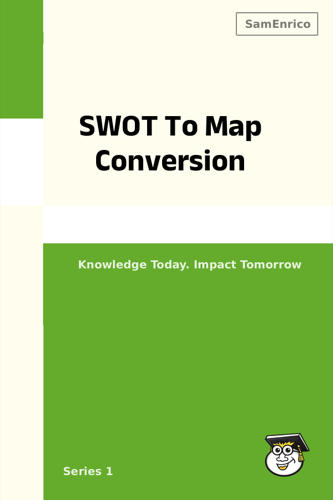
SWOT To Map Conversion eBook
Transform traditional SWOT findings into actionabl
by Sipes Genia
Transform traditional SWOT findings into actionable visual market maps.
Formats
Free sample
Chapter 1: The Inventory Lie--–- The first lie we tell ourselves in strategy is that a list is a plan. Walk into any corporate boardroom, and you will find them: four quadrants, twenty sticky notes, thirty minutes of energetic debate, and a collective sigh of relief. The SWOT analysis has been completed. Another strategic crisis has been averted—or so the fiction goes. But here is the truth that no consultant will shout from the back of the room: a SWOT analysis is not a strategy.
It is not even a diagnosis. It is an inventory. And an inventory, no matter how beautifully formatted, does not tell you where to go. It only tells you what you have in the warehouse.The problem is not that SWOT is useless. The problem is that we have mistaken the act of listing for the act of thinking.
For decades, the SWOT matrix has been the default tool for strategic planning in thousands of organizations, from small non-profits to Fortune 500 giants. Its appeal is obvious: it is simple, intuitive, and democratic. Anyone can list Strengths, Weaknesses, Opportunities, and Threats. But that very simplicity is the trap. Because once the lists are written, the hard work of strategy—deciding where to move, what to build, what to kill, and when to act—remains entirely untouched.
The lists sit on a slide deck. The slide deck sits on a server. And the organization continues exactly as before, except now it feels vaguely strategic.This chapter dismantles the illusion of the four lists. It explains why SWOT leads to what we call Strategy Decay—the slow, quiet erosion of strategic intent caused by static, disconnected observations. It introduces the critical distinction between Observations and Dependencies, and it establishes the first two of twelve conversion rules that will transform your static lists into dynamic, actionable visual maps.
By the end of this chapter, you will never look at a SWOT matrix the same way again. More importantly, you will have a concrete method to escape its gravity.The Strategy Decay Problem The term Strategy Decay describes a specific phenomenon: the gradual loss of strategic coherence that occurs when a static analysis tool is used to inform a dynamic, competitive environment. Think of it like leaving fresh fruit on a counter. The moment you complete a SWOT analysis, it begins to rot. Not because you did anything wrong, but because the world moves and your list does not.Consider a typical annual strategic planning offsite.
A leadership team spends four hours generating a SWOT. They list "strong brand recognition" as a Strength, "legacy IT infrastructure" as a Weakness, "emerging AI tools" as an Opportunity, and "new low-cost competitor" as a Threat. They feel satisfied. The lists are comprehensive. The facilitator takes a photo.
The slide deck is circulated. And then—nothing. For the next twelve months, those four lists sit frozen while the market shifts, competitors launch products, supply chains fracture, and customer preferences evolve. The "emerging AI tools" opportunity becomes a commodity. The "new low-cost competitor" becomes an existential crisis.
But the list does not update. That is Strategy Decay.The root cause of Strategy Decay is not laziness. It is structural. SWOT items lack three essential properties that any strategic tool must have: temporal markers (when is this true?), causal relationships (how does this affect that?), and positional anchors (where is this relative to the user?). Without these properties, a SWOT item is not a strategic input.
It is a hypothesis at best, a prejudice at worst.Confirmation bias accelerates the decay. Because the lists are static and disconnected, teams can selectively emphasize the items that support their pre-existing agenda. A product manager who wants funding for a new feature will point to the "innovation culture" Strength. A CFO who wants cost cuts will point to the "margin pressure" Threat. The same SWOT analysis can justify diametrically opposite strategies.
That is not a tool. That is a mirror reflecting whatever the user wants to see.The most insidious effect of Strategy Decay is that it creates the illusion of progress. After a SWOT exercise, teams feel they have done "strategy work." They check the box. They move on. And because the lists are never formally retired, they accumulate year after year, creating a graveyard of outdated observations that no one deletes but no one uses.
The average Fortune 500 company has at least seven generations of SWOT analyses sitting on internal servers, each one contradicting the last, none of them actionable.Observations Versus Dependencies To escape Strategy Decay, we must first understand what a strategic item actually is. Most SWOT items are Observations. An Observation is a statement about a state of affairs. "We have great engineers." "Our supply chain is vulnerable." "The market is growing." These are all Observations. They may be true.
They may be false. But in either case, they are static. An Observation does not tell you how the business works. It only tells you how the business appears, from a particular vantage point, at a particular moment.A Dependency, by contrast, is a relationship between two or more components. "Our great engineers (Strength) rely on a legacy codebase (Weakness) to deploy features, which slows our response to competitor moves (Threat)." That is a Dependency.
It connects the dots. It reveals causality. It tells you not just what you have, but how what you have interacts with what else you have—and what the market has.Here is the fundamental insight of this book: strategy is not about managing a portfolio of observations. Strategy is about managing a network of dependencies. A Strength that is not connected to a user need is irrelevant.
A Threat that does not depend on any component you control is just weather. The power of mapping—the entire purpose of converting SWOT to a visual map—is to transform a flat list of observations into a dynamic model of dependencies.Let us take a concrete example. A retail company completes a SWOT and lists "loyal customer base" as a Strength. That is an Observation. It might be true.
But it does not tell the company what to do. Now convert that Observation into Dependencies. Ask: What does the loyal customer base depend on? Perhaps it depends on personalized email marketing, which depends on customer data, which depends on a CRM system, which depends on a third-party vendor. Suddenly, the simple Strength "loyal customer base" reveals a chain of dependencies.
And within that chain, you may discover Weaknesses: the CRM contract expires in six months, the third-party vendor has a history of downtime, the email marketing team is understaffed. The Strength is not monolithic. It is a fragile tower of dependencies.Now ask the second Dependency question: What depends on the loyal customer base? Perhaps upsell revenue depends on it, which depends on product recommendations, which depends on an algorithm, which depends on data scientists. Again, the chain reveals itself.
The Strength is not just an asset; it is a node in a network. Changing one dependency ripples through the others.This is the shift that traditional SWOT does not require and therefore does not enable. Observations are cheap. Dependencies…
This is the end of the free sample. Get the eBook to keep going. Buy now
About this book
Details
- Author
- Sipes Genia
- Publisher
- SamEnrico
- Language
- English
- Genre
- Non-Fiction, Strategic Atlas, SWOT Analysis
- Released
- 2026-06-10
- Pages (approx.)
- 148
- Available as
- eBook, Audiobook

Read better in the ZLOADR app
Your eBooks on your phone or tablet. Sign in with your SamEnrico account and start reading.
More by Sipes Genia
 Paper Prototyping GuideSipes Genia$11.99
 Oppositional Defiant Parent GuideSipes Genia$11.99
 Customer Service LayoffSipes Genia$11.99
 Remote Town Hall GuideSipes Genia$11.99
 Mormon Missionary ActorsSipes Genia$11.99
 The Salary Negotiation TalkSipes Genia$11.99
 Creative Environment DesignSipes Genia$11.99
 Shadows Over the Sahara: The Secret War for the Lost City of GoldSipes Genia$11.99
 The Desert’s Last Stand: Rommel’s Green War in North AfricaSipes Genia$11.99
 How to Start a Corsetiere (retail) Business (Beginners Guide)Sipes Genia$11.99
 How to Produce Other Measuring and Analysing InstrumentsSipes Genia$11.99
 Food Pop Up Retail HandbookSipes Genia$12.99
You may also like
 Hong Kong Handover 1997Dunn Johnnie$11.99
 Zumba For Postnatal Recovery CourseNeal Christian$11.99
 Zumba for BeginnersLadner Nikia$11.99
 YouTube Comment Mining GuideHumes Pandora$12.99
 Worry Box MeditationCarlin Rudy$11.99
 Workplace Stress MeditationNguyen Lynn$11.99
 Workplace Stress and Sleep RepairHawley Ivory$11.99
 Workplace Perfectionism CureDelaney Jeffry$11.99
 Workplace Injustice Anger GuideWallen Isabelle$11.99
 Work Addiction and Burnout LinkGreenwood Ester$11.99
 Women in Yoga and WellnessBeattie Galina$11.99
 Women in Stand Up ComedyChun Evangeline$11.99