
Non-FictionBusiness BriefSWIFT CodesWire Transfers
SWIFT Codes and BIC Guide eBook
Use correct SWIFT BIC codes for international wire
by Andrew Randy
Use correct SWIFT BIC codes for international wire transfers to avoid rejected payments and delayed settlements for African exporters.
Formats
Free sample
Chapter 1: The DNA Decoder--The average African exporter loses $847 per year to rejected wire transfers—not because their buyer is dishonest, not because their bank is incompetent, but because they have never been taught how a SWIFT payment actually works. That changes now.Every international wire transfer that moves across borders, from a buyer in London to a supplier in Lagos, from a distributor in Dubai to a farmer in Nairobi, travels through a hidden system that operates like a global postal service for money. That system is called SWIFT—the Society for Worldwide Interbank Financial Telecommunication. And at the heart of every single transaction lies a small, seemingly random string of letters and numbers: the SWIFT/BIC code.Most exporters treat this code like a magical incantation. They copy it from an old invoice, paste it into a payment form, and hope for the best.
When the payment fails—and it fails far more often than it should—they assume the code was wrong. But here is the truth that separates successful exporters from the frustrated ones: the SWIFT/BIC code is not a mystery. It is a language. And once you learn to read it, you will never lose another payment to a coding error.This chapter is your decoder ring. By the time you finish reading, you will understand exactly what those eight or eleven characters mean, why banks organized them that way, and how to spot a fatal error before your buyer ever hits "send."The Architecture of a SWIFT/BIC Code Every SWIFT/BIC code is constructed according to a rigid international standard, ISO 9362, which has been in use since the 1970s.
The code is never random. It is never arbitrary. It is a precise addressing system designed to route money to a specific financial institution, in a specific country, at a specific location.A SWIFT/BIC code can be either eight characters or eleven characters long. The eight-character version identifies a bank at the city or regional level. The eleven-character version adds a three-digit branch code that can pinpoint a specific office, sometimes down to a single building in a busy commercial district.Let us decode a real example.
Consider the code AFRIBFBFXXX. This is the SWIFT/BIC for Afriland Bank in Burkina Faso. Break it into its four components:Positions 1–4: The Bank Code AFRI identifies Afriland Bank specifically. Every bank has a unique four-letter code. For Standard Bank in South Africa, it is SBZA.
For Equity Bank in Kenya, it is EQBL. For the United Bank for Africa in Nigeria, it is UNAF. These codes are registered with SWIFT and cannot be used by any other institution. If the first four letters do not match your bank's official code, the payment will never arrive.Positions 5–6: The Country Code BF is the ISO 3166-1 alpha-2 code for Burkina Faso. Every country has a two-letter code.
Nigeria is NG. Kenya is KE. South Africa is ZA (from the Dutch Zuid-Afrika). Ghana is GH. Senegal is SN.
This pair of letters tells the SWIFT network which country's banking system should receive the payment. An error here—NG instead of KE—would send your money to a completely different nation.Positions 7–8: The Location Code BF (again, in this example) identifies the specific city or region. Location codes are often alphanumeric. A digit 0 in this position indicates a test environment, not a live bank. Digits 1 through 9 indicate live systems.
Letters are also common. For example, 2A might indicate a specific financial district in a major city. This code helps route the payment to the correct metropolitan area.Positions 9–11: The Branch Code XXX is a special code that means "head office" or "primary office." If the SWIFT/BIC is only eight characters long, it is implicitly XXX at the end. Banks use the final three positions to identify specific branches. For example, EQBLKENA082 might indicate Equity Bank's Karen branch in Nairobi.
But here is the critical insight that most guides get wrong: you almost never need the branch-specific code.The Great XXX Debate – Resolved There is a persistent myth in international trade that you must always use the most specific SWIFT/BIC code available—the eleven-character version that includes the branch code. This myth has caused countless rejected payments and delayed settlements. It is time to kill it.The truth, confirmed by SWIFT's own technical documentation and the operational practices of major correspondent banks, is this: the eight-character code (or the eleven-character code ending in XXX) is sufficient for the vast majority of international wire transfers. Here is why.When a bank receives a payment addressed to its head office (XXX), its internal systems examine the beneficiary's account number. That account number contains routing information embedded within its structure.
In Nigeria, the first three digits of a NUBAN account number identify the bank. In Kenya, the first few digits often indicate the branch. The receiving bank's systems automatically forward the payment to the correct branch using this embedded information. The XXX code is not a blind drop box; it is a smart router.There is, however, a narrow exception. A small number of banks—particularly in Kenya and Nigeria—operate decentralized processing systems where certain branches maintain separate settlement accounts with correspondent banks.
For these institutions, the branch-specific BIC is required to avoid a manual processing delay of 24 to 72 hours. But and this is crucial—this is the exception, not the rule.How do you know which category your bank falls into? You ask them directly. Call your bank's treasury or international payments department and ask this exact question: "For incoming international wire transfers, should our buyers use our branch-specific SWIFT code or the head office XXX code?" Write down their answer. If they say "either is fine," default to XXX.
If they provide a specific branch code, use that one exclusively. But never, ever guess. The cost of guessing is a rejected payment.The Anatomy of a Fatal Typo SWIFT/BIC codes are case-insensitive—AFRIBFBFXXX is the same as afribfbfxxx—but they are unforgiving when it comes to character substitutions. The most common fatal errors involve confusing visually similar characters.The letter O and the number 0 are the most frequent offenders. A SWIFT/BIC code should never contain the number zero.
If you see what looks like a zero, it is almost certainly the letter O. The same rule applies to the letter I and the number 1. SWIFT codes use letters almost exclusively; digits appear only in the location code (positions 7–8) and the branch code (positions 9–11) for some banks. When copying a code from a PDF, a scanned document, or an email signature, these lookalike characters are easily misread.The letter S and the number 5 cause similar confusion, as do B and 8, Z and 2, and G and 6. Professional SWIFT operators develop a skill called "visual parsing"—they look at a code and mentally verify each character against its expected position before entering it into a system.Here is a practical exercise.
Which of the following codes is invalid?EQBLKENAXXXEQBLKENA082EQBLKENA0B2EQBLKENAXXXThe third code, EQBLKENA0B2, is invalid because it contains both the number 0 (in the branch code position) and the letter B (which is likely a mistyped 8). A trained eye spots…
This is the end of the free sample. Get the eBook to keep going. Buy now
About this book
Details
- Author
- Andrew Randy
- Publisher
- SamEnrico
- Language
- English
- Genre
- Non-Fiction, Business Brief, SWIFT Codes, Wire Transfers
- Released
- 2026-05-29
- Pages (approx.)
- 122
- Available as
- eBook, Audiobook

Read better in the ZLOADR app
Your eBooks on your phone or tablet. Sign in with your SamEnrico account and start reading.
More by Andrew Randy
 Bone Broth Gut HealthAndrew Randy$11.99
 Smoke Free Life Identity GuideAndrew Randy$11.99
 African Talent Diaspora ReturnAndrew Randy$11.99
 The Parent Death Heart AttackAndrew Randy$11.99
 Cleopatra Death by Asp Historical DebateAndrew Randy$11.99
 Breaking the Floor: The Unseen Revolution of Dance in the Digital AgeAndrew Randy$11.99
 The Last Broadcast: The Mysterious Silence of KHJ RadioAndrew Randy$11.99
 Financial Dashboard Design With AIAndrew Randy$12.99
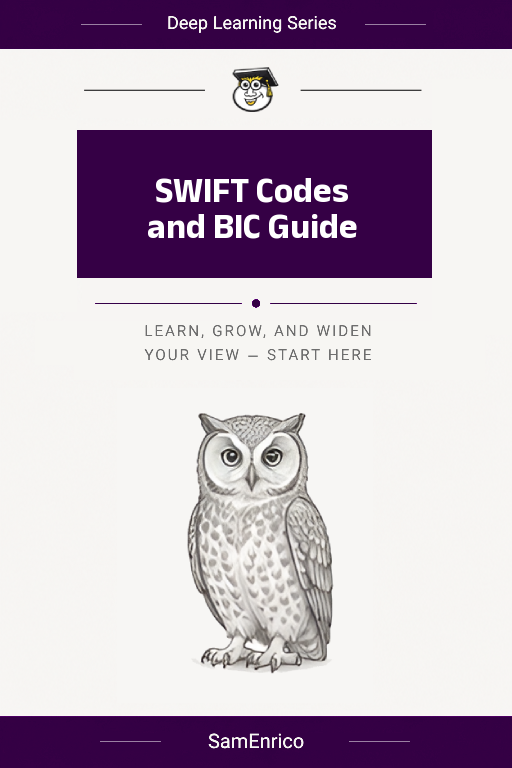 SWIFT Codes and BIC GuideAndrew Randy$12.99
 How to Start a Cutting Machine for Bookbinding Business (Beginners Guide)Andrew Randy$11.99
 Understanding Benign Familial HematuriaAndrew Randy$17.99
 Medical Device TechnicianAndrew Randy$11.99
You may also like
 Hong Kong Handover 1997Dunn Johnnie$11.99
 Zumba For Postnatal Recovery CourseNeal Christian$11.99
 Zumba for BeginnersLadner Nikia$11.99
 YouTube Comment Mining GuideHumes Pandora$12.99
 Worry Box MeditationCarlin Rudy$11.99
 Workplace Stress MeditationNguyen Lynn$11.99
 Workplace Stress and Sleep RepairHawley Ivory$11.99
 Workplace Perfectionism CureDelaney Jeffry$11.99
 Workplace Injustice Anger GuideWallen Isabelle$11.99
 Work Addiction and Burnout LinkGreenwood Ester$11.99
 Women in Yoga and WellnessBeattie Galina$11.99
 Women in Stand Up ComedyChun Evangeline$11.99