
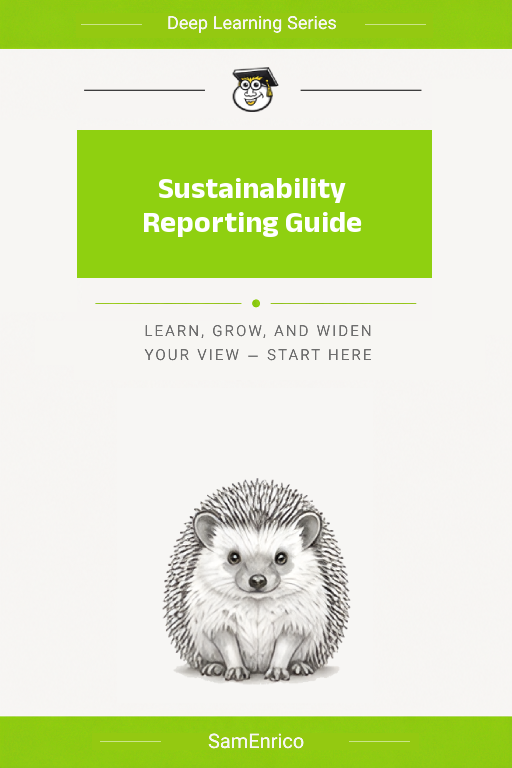
Non-FictionForecast & OutlookESG Skills
Sustainability Reporting Guide eBook
Analyze ESG disclosure, carbon accounting, and GRI
by Pena Audrey
Analyze ESG disclosure, carbon accounting, and GRI framework proficiency demand.
Formats
Free sample
Chapter 1: The $40 Trillion Wake-Up Call--–- On a Tuesday morning in March 2023, a mid-tier portfolio manager at a London-based asset management firm received a memo that would change her career trajectory. The firm’s largest institutional client, a European pension fund with €47 billion under management, had quietly updated its investment mandate. Buried on page 34, under a section titled “Non-Negotiable Reporting Requirements,” was a single sentence: “Effective January 1, 2024, any investment vehicle failing to provide audited Scope 1, 2, and material Scope 3 emissions data in alignment with the GHG Protocol and GRI Universal Standards 2021 will be subject to automatic divestment within 90 days of reporting deadline.”The portfolio manager had spent fifteen years mastering discounted cash flow models, beta calculations, and earnings per share forecasts. She had never opened a GRI Content Index. She did not know the difference between location-based and market-based Scope 2 accounting.
And she had certainly never run a Monte Carlo simulation for data uncertainty. By Friday of the same week, three of her colleagues—two analysts and one associate—had quietly enrolled in GHG Protocol certification courses at their own expense. The salary premium for ESG proficiency, which had been a whispered topic at industry conferences, was now a line item in their personal financial planning.This chapter is not about saving the planet. This chapter is about saving your career. It is about understanding why $40 trillion of capital is moving toward mandatory sustainability disclosure, why 77 percent of companies cannot find the talent they need, and why professionals who master GRI, GHG Protocol, and double-materiality are now commanding salaries 20 to 35 percent higher than their peers.
If you are a CFO, controller, FP&A analyst, sustainability professional, auditor, product manager, or engineer, the next sixty minutes of reading will fundamentally change how you view your role in the global economy.The Great Capital Reallocation Let us begin with a number that defies easy comprehension: 40trillion.Accordingtothe Global Sustainable Investment Alliance,assetsundermanagementthatincorporate ESGcriteriasurpassed40 trillion. According to the Global Sustainable Investment Alliance, assets under management that incorporate ESG criteria surpassed 40trillion.Accordingtothe Global Sustainable Investment Alliance,assetsundermanagementthatincorporate ESGcriteriasurpassed40 trillion in 2022 and are projected to exceed 50trillionby2030.Toputthisinperspective,theentire GDPofthe United Statesin2023wasapproximately50 trillion by 2030. To put this in perspective, the entire GDP of the United States in 2023 was approximately 50trillionby2030.Toputthisinperspective,theentire GDPofthe United Statesin2023wasapproximately27 trillion. The value of all gold ever mined is approximately 12 trillion. The combined market capitalization of every company on the S&P 500 is roughly 40 trillion.
The capital flowing into sustainability-linked investments is equivalent to buying every public company in America, plus a few trillion in change.This is not a niche movement of environmentally conscious investors. This is the largest capital reallocation in financial history, exceeding the shift from defined benefit to defined contribution pensions in the 1980s, exceeding the dot-com boom of the late 1990s, and arguably exceeding the post-2008 regulatory restructuring of global banking. The difference is that this reallocation is not driven by a single event or a single regulator. It is driven by a convergence of forces: institutional investor mandates, regulatory requirements across multiple jurisdictions, consumer pressure, and a growing recognition that climate risk is financial risk.Drawing from the market data synthesized in Practical Sustainability Strategies (Wiley, 2023), we can trace this reallocation to three distinct but overlapping sources. First, asset owners—pension funds, sovereign wealth funds, insurance companies—have begun demanding ESG data from their asset managers.
The reasoning is simple: if you cannot tell me how my portfolio is exposed to carbon pricing, physical climate risks, or transition risks, then you cannot claim to understand my portfolio’s risk profile. Second, banks are increasingly incorporating ESG factors into their lending decisions. The European Central Bank has explicitly stated that banks failing to manage climate risk will face higher capital requirements. Third, regulators have moved from issuing voluntary guidelines to enacting mandatory disclosure laws with legal liability attached.The Regulatory Tsunami: A Brief History To understand where sustainability reporting is headed, we must understand how we arrived at the current moment. The journey from voluntary corporate social responsibility reports to mandatory financial disclosure has been surprisingly short.In 2010, fewer than 20 percent of the world’s largest companies published any form of sustainability report.
Those that did publish often produced glossy booklets filled with photographs of planting trees and anecdotes about employee volunteering. There were no common standards. There was no assurance. There was no legal liability for getting the numbers wrong because, frankly, there were rarely any numbers to get wrong.In 2015, two events accelerated the trajectory. First, the Paris Agreement committed nations to limiting global warming to well below 2 degrees Celsius above pre-industrial levels.
Second, the Financial Stability Board, the international body that monitors the global financial system, established the Task Force on Climate-related Financial Disclosures (TCFD). The TCFD’s insight was revolutionary: climate change should be treated not as an environmental issue but as a financial risk issue requiring disclosure to investors.By 2020, the TCFD framework had been endorsed by more than 1,500 companies representing $12 trillion in market capitalization. More importantly, it had been incorporated into the regulatory frameworks of the United Kingdom, New Zealand, Switzerland, and Japan. The era of voluntary climate disclosure was ending.In 2021, the International Sustainability Standards Board (ISSB) was launched at the COP26 climate conference. The ISSB’s mandate was to create a global baseline for sustainability disclosure, analogous to the International Accounting Standards Board’s role in financial reporting.
In June 2023, the ISSB issued its first two standards: IFRS S1 (General Requirements for Disclosure of Sustainability-related Financial Information) and IFRS S2 (Climate-related Disclosures). These standards are effective for annual reporting periods beginning on or after January 1, 2024, with early adoption permitted.In parallel, the European Union enacted the Corporate Sustainability Reporting Directive (CSRD), which replaced the earlier Non-Financial Reporting Directive. The CSRD expands the scope of mandatory sustainability reporting from approximately 11,000 companies to more than 50,000 companies, including non-EU companies with substantial operations in the EU. The CSRD requires double materiality—the assessment of both how sustainability issues affect the company (financial materiality) and how the company affects society and the environment (impact materiality). It also requires third-party assurance, moving from limited assurance to reasonable assurance over time.What This Means for You: The Compliance Deadlines Let us make this concrete.
If you are reading this book, chances are you work for a company that will be required to produce a mandatory sustainability report within the next two to five years. The specific deadline depends on your jurisdiction and company size.For companies subject to the CSRD, the timeline is as follows. Companies already subject to the Non-Financial Reporting Directive (large EU public interest entities with more than 500 employees) must report under the CSRD for financial years beginning on or after January 1, 2024. That means the first CSRD reports will be published in 2025. Other large EU companies (meeting two of three criteria: more than 250 employees, more than €40 million in net turnover, more than €20 million in total assets) must report for financial years beginning on or after January 1, 2025.
Listed small and medium-sized enterprises must report for financial years beginning on or after January 1, 2026. Non-EU companies with significant EU operations (net turnover exceeding €150 million in the EU and…
This is the end of the free sample. Get the eBook to keep going. Buy now
About this book
Details
- Author
- Pena Audrey
- Publisher
- SamEnrico
- Language
- English
- Genre
- Non-Fiction, Forecast & Outlook, ESG Skills
- Released
- 2026-05-30
- Pages (approx.)
- 157
- Available as
- eBook, Audiobook

Read better in the ZLOADR app
Your eBooks on your phone or tablet. Sign in with your SamEnrico account and start reading.
More by Pena Audrey
 Coen Brothers Quirky AmericaPena Audrey$11.99
 Health And Wellness PriorityPena Audrey$11.99
 Uber Driver Vehicle Selection GuidePena Audrey$11.99
 Reciprocity in ActionPena Audrey$11.99
 Valorant Rank Climb FixPena Audrey$11.99
 Tangaroa’s Wrath: The Storm That Split the WorldPena Audrey$11.99
 Ultimate Handbook Guide to Yangquan : (China) Travel GuidePena Audrey$11.99
 Resm-i Arusane TaxPena Audrey$11.99
 Project Management For Marketing TeamsPena Audrey$12.99
 Understanding Meningeal Angiomatosis Cleft Hypoplastic Left HeartPena Audrey$17.99
You may also like
 Hong Kong Handover 1997Dunn Johnnie$11.99
 Zumba For Postnatal Recovery CourseNeal Christian$11.99
 Zumba for BeginnersLadner Nikia$11.99
 YouTube Comment Mining GuideHumes Pandora$12.99
 Worry Box MeditationCarlin Rudy$11.99
 Workplace Stress MeditationNguyen Lynn$11.99
 Workplace Stress and Sleep RepairHawley Ivory$11.99
 Workplace Perfectionism CureDelaney Jeffry$11.99
 Workplace Injustice Anger GuideWallen Isabelle$11.99
 Work Addiction and Burnout LinkGreenwood Ester$11.99
 Women in Yoga and WellnessBeattie Galina$11.99
 Women in Stand Up ComedyChun Evangeline$11.99