
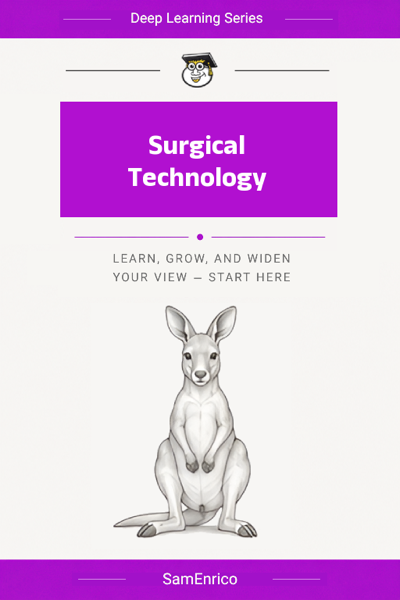
Non-FictionInformativeEducational
Surgical Technology eBook
A Coursebook on Surgical Technology
A Coursebook on Surgical Technology
Formats
Free sample
Chapter 1: Beyond the Pass--In the summer of 1917, a young Army private named John Benjamin Murphy stood at the back of a muddy field hospital in France, holding a tray of bloody clamps. He had no formal training. He had never been inside an operating room before the war. But the surgeons were exhausted, the nurses were overwhelmed, and someone needed to hand the next instrument before being asked. Murphy did not know it then, but he was becoming the first modern surgical technologist—long before the title existed.More than a century later, the role has evolved from battlefield necessity to a recognized, certified, and essential profession.
Yet a strange misconception persists among patients, hospital administrators, and even some healthcare colleagues: that the surgical technologist simply “passes instruments.” This chapter exists to shatter that myth.The surgical technologist is not a passive assistant. You are not a tray carrier, a glorified gopher, or a pair of hands at the end of a surgeon’s arm. You are a critical thinker, a patient advocate, an infection control specialist, and—on your best days—the quiet heartbeat of the operating room. Before you learn to load a scalpel or count a sponge, you must understand who you are becoming, where you fit in the surgical team, and what ethical and legal weight your future badge carries.This chapter traces the improbable history of your profession, maps the three distinct roles you will play in the OR, introduces the certifications that separate a technician from a professional, and grounds you in the legal and ethical responsibilities that will protect both your patients and your career. By the final page, you will understand a simple truth: You do not just work in surgery.
You safeguard it.The Accidental Origins of a Profession The story of surgical technology begins not with a textbook or a certificate but with a crisis. Before World War I, operating rooms were simple affairs. Surgeons operated in their street clothes—sometimes with a clean apron overtop—and nurses handled all instruments. The concept of a dedicated, sterile scrub person did not exist.But the Great War changed everything. Battlefield casualties arrived in waves measured in hundreds per hour.
Surgeons could not stop to reorganize instrument trays. Nurses were pulled into anesthesia and wound packing. Someone needed to stand at the table, anticipate the next clamp, and keep the field organized. That someone was often a young soldier pulled from the line, given a quick demonstration, and told to “keep up.”These early “operating room orderlies” developed a new kind of skill: predictive intelligence. They learned to watch a surgeon’s eyes, read the rhythm of a procedure, and place the right instrument into a waiting hand before a word was spoken.
By World War II, the role had formalized slightly. The Army trained “surgical technicians” in six-week crash courses. They were not certified. They were not licensed. But they were effective.After the war, returning technicians brought their skills to civilian hospitals.
By the 1960s, hospitals began recognizing that trained, dedicated scrub personnel reduced surgical times, lowered infection rates, and improved outcomes. In 1969, a small group of technicians gathered in Chicago and founded the Association of Surgical Technologists (AST). The profession had a voice.Today, more than 80,000 certified surgical technologists work in the United States alone. The role has expanded from battlefield triage to every surgical specialty imaginable: from beating-heart bypasses to robotic prostatectomies to in-utero fetal surgery. You are joining a profession built on competence, not chance.The Three Hats You Will Wear One of the most confusing aspects of surgical technology for new students is the number of roles they might be asked to fill.
Depending on the facility, the staffing model, the state’s scope of practice laws, and the day’s case mix, you could perform three distinctly different functions. Understanding these roles is not optional—it is the foundation of your professional identity.Role One: The Scrub Person The scrub person is what most people picture when they think of a surgical technologist. You stand at the sterile field. You wear a sterile gown and gloves. Your domain includes the back table, the Mayo stand, and the area immediately surrounding the operative site.
Your job is to maintain the integrity of that sterile field, organize instruments in a predictable sequence, and pass exactly what the surgeon needs, exactly when it is needed.But “scrub” is not passive. A skilled scrub person anticipates. You watch the surgery unfold. You see the bleed before the surgeon asks for a clamp. You know that after the #15 blade comes the Adson forceps, then the Metzenbaum scissors, then the hemostat.
You do not wait for commands—you listen to the surgery itself.You are also the guardian of the count. Every sponge, every sharp, every instrument that enters the wound must leave it. You track each item obsessively. You speak up when the count is off, even if it means delaying closure and annoying the surgeon. Patient safety is not a popularity contest.The scrub person is also the first line of defense against contamination.
Did the surgeon’s glove brush the unsterile light handle? Did the circulating nurse drop a peel-pack too close to the edge? You see it. You call it. You protect the patient.Role Two: The Circulating Person The circulating role is unsterile, but it is no less critical.
The circulator is the bridge between the sterile field and the rest of the hospital. When the scrub person needs an extra box of sutures, the circulator retrieves it. When the anesthesia provider needs the patient’s lab results, the circulator pulls them. When the surgeon asks for the C-arm, the circulator coordinates with radiology.Crucially, the circulator performs the surgical counts together with the scrub person. This is not a solo activity.
The scrub person calls out each sponge as it is added to the field; the circulator verifies and documents. The two voices must match. If they do not, surgery does not proceed.The circulator also documents the procedure: what implants were used, how many needles were discarded, when antibiotics were given, who was present. This record is a legal document. If an error occurs five years later, the circulator’s notes will be examined in court.Not every surgical technologist will circulate.
In some states, state law or hospital policy prohibits STs from taking this role, reserving it for registered nurses. In other facilities, STs circulate routinely. Your program will teach you the principles, but your clinical site will determine what you are allowed to do. Always check your state’s scope of practice.Role Three: The Second Assistant The second assistant is the most advanced role. Under the direct supervision of the surgeon, the second assistant provides wound exposure, controls bleeding, and helps with closure.
This might mean holding a retractor for two hours while the surgeon works deep in the abdomen. It might mean using suction to keep the field clear. It might mean tying sutures or clipping small vessels.The second assistant is always a sterile team member. This role typically requires additional certification—the Certified Surgical First Assistant (CSFA)—and is often compensated…
This is the end of the free sample. Get the eBook to keep going. Buy now
About this book
Details
- Author
- Dodson Carina
- Publisher
- SamEnrico
- Language
- English
- Genre
- Non-Fiction, Informative, Educational
- Released
- 2026-05-06
- Pages (approx.)
- 152
- Available as
- eBook, Audiobook

Read better in the ZLOADR app
Your eBooks on your phone or tablet. Sign in with your SamEnrico account and start reading.
More by Dodson Carina
 The Body Scan for MusiciansDodson Carina$11.99
 Executive Kidnap Travel Security BriefingDodson Carina$11.99
 BPH Acute Urinary Retention GuideDodson Carina$11.99
 Congress Member Online FundraisingDodson Carina$11.99
 Tariff Classification Appeals GuideDodson Carina$11.99
 Miles Beyond the Sky: The Cosmic Jazz Odyssey of Miles DavisDodson Carina$11.99
 The Last Dive of the Deepstar Africa: A Submersible's Descent into the UnknownDodson Carina$11.99
 Dubai Arabic Language GuideDodson Carina$12.99
 Supply Chain KPI Reset GuideDodson Carina$12.99
 Understanding Congenital Sucrose Isomaltose MalabsorptionDodson Carina$17.99
 How to Become a Motor-power ConnectorDodson Carina$11.99
You may also like
 Hong Kong Handover 1997Dunn Johnnie$11.99
 Zumba For Postnatal Recovery CourseNeal Christian$11.99
 Zumba for BeginnersLadner Nikia$11.99
 YouTube Comment Mining GuideHumes Pandora$12.99
 Worry Box MeditationCarlin Rudy$11.99
 Workplace Stress MeditationNguyen Lynn$11.99
 Workplace Stress and Sleep RepairHawley Ivory$11.99
 Workplace Perfectionism CureDelaney Jeffry$11.99
 Workplace Injustice Anger GuideWallen Isabelle$11.99
 Work Addiction and Burnout LinkGreenwood Ester$11.99
 Women in Yoga and WellnessBeattie Galina$11.99
 Women in Stand Up ComedyChun Evangeline$11.99