
Non-FictionInformativeEducational
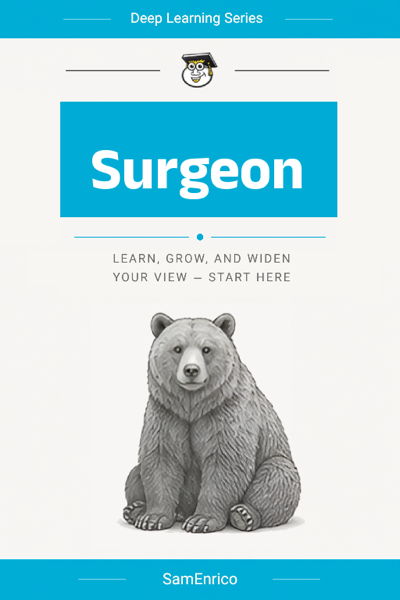
Surgeon eBook
A Coursebook on Surgeon
by Parrott Chu
A Coursebook on Surgeon
Formats
Free sample
Chapter 1: The First Cut...--The first time you hold a scalpel, your hand will tremble. Not from fear—though that will come later—but from the sheer weight of what you are about to do. You are about to cut living human flesh with the intention of healing, and that is not a natural act. It is a privilege granted by society, earned through years of study, and secured by a patient’s trust. The trembling is normal.
The trembling means you understand the magnitude of the moment. The surgeon who does not tremble on their first day is either lying or dangerous.This book is not a reference text. You will not find every rare complication or every exotic procedure between these pages. Nor is this a memoir, though you will encounter stories—some triumphant, some tragic, all true in the way that surgical stories must be true, because the consequences are measured in blood and breath. Instead, this is a coursebook.
It is designed to be read in order, one chapter at a time, as you progress from medical student to junior resident to senior resident to attending. Each chapter assumes you have mastered the previous one. If you skip ahead, you will drown. If you read carefully, you will learn to swim in waters that have drowned many before you.The central argument of this book is simple but profound: Surgery is not a collection of procedures. Surgery is a way of thinking.
The technical skills—the knot tying, the suturing, the dissection—are necessary but not sufficient. Without surgical judgment, technical skill is just elaborate butchery. Without resilience, judgment crumbles under the weight of complications. Without self-awareness, resilience becomes denial. This first chapter is about the foundation upon which everything else rests: you.Before you learn to tie a two-handed knot, before you learn the difference between a Crile and a Kelly clamp, before you step into an operating room and introduce yourself to the scrub nurse, you must ask yourself a question that no one else can answer for you: Is surgery your calling?Not your career.
Not your job. Your calling.A career is something you do for money and status. A job is something you do to pay bills. A calling is something you do because you cannot imagine doing anything else, even on the days when it breaks you. Surgery will break you.
Not maybe. Not possibly. It will. The question is whether you will be able to put yourself back together and return to the operating room the next morning.This chapter is an honest mirror. It will show you the traits that predict surgical success, the dark side that predicts burnout and depression, and the tools to assess whether you are a Surgical Innovator, a Technical Master, or something in between.
By the end, you will have no excuse for choosing surgery blindly. And if you choose it anyway, knowing what you now know, you will have taken the first step toward becoming a surgeon worth remembering.The Cognitive Architecture of a Surgeon Let us begin with the mind. Every surgical procedure, from a simple skin biopsy to a Whipple pancreaticoduodenectomy, requires a specific set of cognitive abilities. These are not the same abilities that make a great internist or a brilliant psychiatrist. They are distinct, measurable, and to some extent, innate.
The good news is that they can be trained. The bad news is that if you lack them entirely, no amount of training will compensate.Visuospatial reasoning is the ability to mentally rotate three-dimensional objects and to understand how they relate to each other in space. When you look at a CT scan of the abdomen, you are seeing a series of two-dimensional slices. Your brain must reconstruct those slices into a three-dimensional map of the patient's anatomy. Then, when you insert a laparoscope through a small incision, you must translate that map into a two-dimensional video screen, while your hands move in a different plane than your eyes are viewing.
This is not easy. It is, in fact, cognitively unnatural. Some people learn it quickly. Others struggle for years. A very small number never learn it at all.How do you know if you have adequate visuospatial reasoning?
You probably already know. Were you good at geometry in high school? Can you assemble furniture from a diagram without swearing? When you look at an anatomical drawing, can you imagine what the structure looks like from the back, or from underneath, or after being rotated ninety degrees? If these tasks come easily to you, you have a head start.
If they do not, do not despair—visuospatial reasoning can be trained with deliberate practice, such as mental rotation exercises, video games that require spatial navigation, and spending extra time in the anatomy lab dissecting without looking at the atlas.Task-switching efficiency is the ability to move rapidly between different cognitive tasks without losing focus or making errors. In the operating room, you will be asked to monitor the patient's vital signs (while the anesthesiologist speaks to you), adjust your instrument position (while the scrub nurse hands you a new tool), think two steps ahead (while the first assist asks a question), and remember the patient's history (while the circulator reads the allergy list). This is not multitasking—true multitasking is a myth, the brain can only focus on one thing at a time. This is rapid sequential task-switching, and it requires working memory, attention control, and the ability to suppress irrelevant information.Surgeons who struggle with task-switching are the ones who freeze when the unexpected happens. The bleeding starts, and they cannot stop thinking about how the bleeding started long enough to clamp the vessel.
The monitor alarms, and they cannot hear the anesthesiologist because they are still focused on the anastomosis. These surgeons are dangerous not because they are stupid, but because their cognitive architecture cannot keep up with the demands of the operating room.Comfort with high-consequence decisions is the most difficult trait to teach. Some people are naturally able to make decisions under uncertainty, with incomplete information, knowing that a wrong decision could kill the patient. Other people freeze. Still others make decisions impulsively, without gathering enough information, and then double down when evidence contradicts them.
The ideal surgeon lives in the middle: they gather information efficiently, make a timely decision, execute it, and then reassess based on the results. They do not fall in love with their own decisions. They do not freeze. They do not panic.This trait is often called "decisiveness," but that is not quite right. Decisiveness implies speed.
What matters more is calm. The calm to look at a patient in hemorrhagic shock, calculate the probability of survival with surgery versus without, and then act—not frantically, not hesitantly, but with the quiet confidence that comes from knowing you have done everything you can. Calm is not the absence of fear. Calm is the ability to function despite fear.The Dark Side: Burnout, Imposter Syndrome, and the God Complex Now we must talk about what no one talks about in medical school. The statistics are brutal, and they should be known before…
This is the end of the free sample. Get the eBook to keep going. Buy now
About this book
Details
- Author
- Parrott Chu
- Publisher
- SamEnrico
- Language
- English
- Genre
- Non-Fiction, Informative, Educational
- Released
- 2026-06-02
- Pages (approx.)
- 155
- Available as
- eBook, Audiobook

Read better in the ZLOADR app
Your eBooks on your phone or tablet. Sign in with your SamEnrico account and start reading.
More by Parrott Chu
 Depressed Parent ImpactParrott Chu$11.99
 Alcohol Recovery and Career ChangeParrott Chu$11.99
 SEAL Maritime InterdictionParrott Chu$11.99
 Trazodone Withdrawal GuideParrott Chu$11.99
 The Pioneers of Pay: The 1970s Battle for Women's Football Equality in EuropeParrott Chu$11.99
 How to Produce a CleanserParrott Chu$11.99
 Poland Architecture and CAD RemoteParrott Chu$12.99
 A Beginners Guide to Acquire (Volume 1)Parrott Chu$11.99
You may also like
 Hong Kong Handover 1997Dunn Johnnie$11.99
 Zumba For Postnatal Recovery CourseNeal Christian$11.99
 Zumba for BeginnersLadner Nikia$11.99
 YouTube Comment Mining GuideHumes Pandora$12.99
 Worry Box MeditationCarlin Rudy$11.99
 Workplace Stress MeditationNguyen Lynn$11.99
 Workplace Stress and Sleep RepairHawley Ivory$11.99
 Workplace Perfectionism CureDelaney Jeffry$11.99
 Workplace Injustice Anger GuideWallen Isabelle$11.99
 Work Addiction and Burnout LinkGreenwood Ester$11.99
 Women in Yoga and WellnessBeattie Galina$11.99
 Women in Stand Up ComedyChun Evangeline$11.99