
Non-FictionAnnual CheckupAnalyticsData
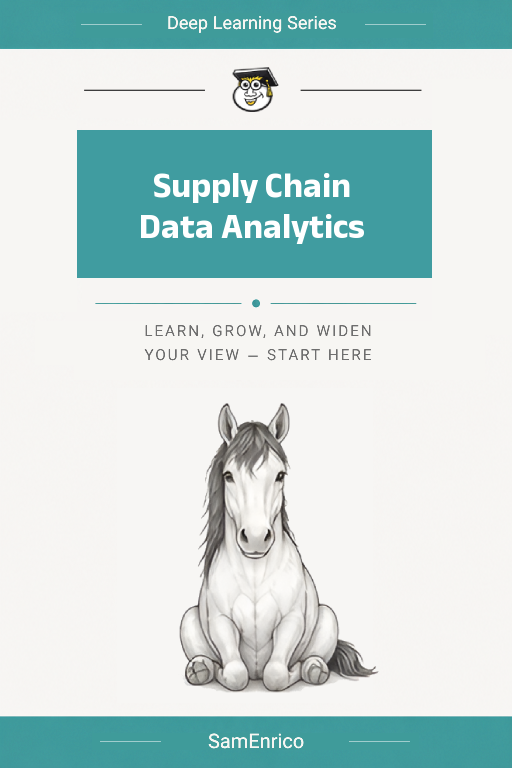
Supply Chain Data Analytics eBook
Leverage supply chain data analytics to identify d
Leverage supply chain data analytics to identify disruption patterns and optimize response strategies.
Formats
Free sample
Chapter 1: The Fragility Illusion--–- On a Tuesday morning in June 2021, the supply chain director of a mid-sized automotive parts manufacturer walked into his office, poured a cup of coffee, and opened his dashboard. Every metric was green. On-time delivery: 96 percent. Supplier performance: 92 percent. Inventory turnover: 4.2.
The head of procurement had signed off on all quarterly reviews. The risk register, updated just two weeks earlier, listed no active threats above “low probability.” By all conventional measures, this was a well-run supply chain. Three weeks later, the company missed its earnings forecast by 40 percent. A single supplier in Malaysia—Tier 2, unknown to the director, buried three layers deep in the bills of material—had been forced to shut down due to a COVID-19 outbreak. That supplier provided a specialized resin used in sealing the company’s brake systems.
Without it, the company could not ship finished goods. The dashboard had never turned red. The risk register had no row for “pandemic in a country we don’t directly buy from.” The annual supplier audit had never visited a Tier 2 site. And yet, the disruption had been foreseeable—not the exact timing or location, but the pattern. Data existed.
Shipping manifests showed unusual delays from Malaysian ports four weeks earlier. Payment terms to a Tier 1 supplier had shifted, a quiet signal of cash flow problems downstream. Social media chatter about factory closures in the region had appeared on news feeds. But no one was watching. No system was listening.
No algorithm was looking for the subtle precursors because no one had asked the right question: What would we see if a disruption were already forming, hidden in plain sight?This book is about that question. It is about why modern supply chains break, why traditional risk management offers a false sense of security, and how data analytics—done correctly—can transform fragility into resilience. The argument is simple but radical: your supply chain is not vulnerable because you lack data. It is vulnerable because you lack intelligence. And intelligence begins with admitting that everything you think you know about risk is probably wrong.The Great Misunderstanding For decades, supply chain risk management has operated on a seductively simple premise: if you can identify potential threats, assign them probabilities, and create contingency plans, you will be prepared.
This premise underpins every risk register, every annual supplier audit, and every probability-impact matrix hanging on the walls of corporate headquarters. It is also dangerously, catastrophically wrong.The problem is not that these tools are useless. It is that they assume a world that no longer exists. They assume stability: that the future will resemble the past, that correlations will hold, that risks are independent and can be managed in isolation. They assume known probabilities—that you can say with some confidence that a port strike has a 3 percent chance of occurring in any given year.
They assume linear causality: a single cause leads to a single effect, which can be traced and contained.Consider the difference between two types of failure. A delayed ship is a linear failure. A storm slows a vessel, it arrives three days late, and a factory idles for three days. The cause is traceable, the effect is proportional, and the solution is straightforward: add buffer time or choose a different carrier. Now consider a non-linear failure.
A drought in Taiwan reduces water levels at a semiconductor fabrication plant. That plant produces 60 percent of the world’s advanced logic chips. The drought slows production by 10 percent. But because automotive manufacturers operate on just-in-time inventory with minimal buffers, that 10 percent reduction creates a 100 percent production halt for car companies thousands of miles away. A 10 percent input reduction causes a 100 percent output collapse.
That is non-linear. That is the world we now inhabit.The semiconductor crisis of 2020-2023 is not an anomaly. It is a template. A single fire at a chemical plant in Japan, a labor strike at a port in California, a geopolitical dispute in Eastern Europe—each can propagate through the global supply network in ways that no linear risk model can predict. The failure is not in the data but in the framework used to interpret it.
And the first step toward resilience is admitting that you are operating with a framework designed for a world that no longer exists.Deep Uncertainty: The Territory Beyond Risk In traditional risk management, there is a helpful distinction between three states of knowledge. The first is certainty: you know exactly what will happen. Very few supply chain decisions fall into this category. The second is risk: you do not know what will happen, but you know the probability distribution of possible outcomes. A coin flip is risk: you do not know whether it will land heads or tails, but you know each has a 50 percent probability.
Many financial models and inventory formulas operate in this domain. The third is uncertainty: you do not know the outcomes, and you do not know the probabilities. A new market entrant, a novel virus, a political realignment—these are uncertainties.But there is a fourth state, deeper and more disturbing, that conventional frameworks rarely acknowledge. It is called deep uncertainty. In deep uncertainty, you cannot even agree on the set of possible outcomes, the relationships between variables, or the appropriate models for prediction.
Different experts look at the same data and see completely different futures. The COVID-19 pandemic was deep uncertainty. Not only did no one know the probability of a global lockdown, but no one could even agree on the list of possible scenarios in January 2020. Climate change, geopolitical fragmentation, cascading cyberattacks—these are not risks. They are deep uncertainties.Here is the uncomfortable truth that most supply chain leaders avoid: you cannot quantify deep uncertainty.
You cannot put a number on it, feed it into a spreadsheet, and calculate expected value. Anyone who claims to have a precise probability for a “once-in-a-century” disruption is engaging in a comforting fiction. The tools of risk management—value at risk, Monte Carlo simulation, decision trees—all require known probability distributions. When those distributions are unknown, the tools produce the illusion of precision rather than genuine insight.This book does not pretend to solve deep uncertainty. No book can.
But it does offer a different approach: scenario-based adaptive management. Instead of pretending you can predict the probability of a port strike, you build a digital twin that simulates the consequences of a port strike across a range of severities. Instead of calculating a single “optimal” inventory level based on questionable assumptions, you identify a set of robust strategies that perform adequately across many plausible futures. Instead of searching for the one correct forecast, you build systems that sense changes in real time and adapt continuously. The goal is not to eliminate uncertainty—an impossible ambition—but to build supply chains that can respond intelligently when uncertainty resolves into disruption.The Hidden Culprit: Data Silos If deep uncertainty is the philosophical problem, data silos are the practical one.
They are also the most underappreciated driver of supply chain fragility.A data silo is exactly what it sounds like: a collection of information that is accessible only to one part of…
This is the end of the free sample. Get the eBook to keep going. Buy now
About this book
Details
- Author
- Mireles Diego
- Publisher
- SamEnrico
- Language
- English
- Genre
- Non-Fiction, Annual Checkup, Analytics, Data
- Released
- 2026-06-01
- Pages (approx.)
- 159
- Available as
- eBook, Audiobook

Read better in the ZLOADR app
Your eBooks on your phone or tablet. Sign in with your SamEnrico account and start reading.
More by Mireles Diego
 Kidnap Response Time Compression DrillsMireles Diego$11.99
 The Body Scan for TeachersMireles Diego$11.99
 Hypnotic Pain Spiral StopMireles Diego$11.99
 Travel Comparison Social Media FixMireles Diego$11.99
 Echoes of the Deep: The AI That Decoded the Titanic’s Final WhispersMireles Diego$11.99
 The Great Spruce Moose Chase: Logging Legends of the Alaskan FrontierMireles Diego$11.99
 Understanding Congenital Stenosis of Cervical Medullary CanalMireles Diego$17.99
 Dubai Language Requirement GuideMireles Diego$12.99
 How to Become a Die AttacherMireles Diego$11.99
 Support SpecialistMireles Diego$11.99
You may also like
 Hong Kong Handover 1997Dunn Johnnie$11.99
 Zumba For Postnatal Recovery CourseNeal Christian$11.99
 Zumba for BeginnersLadner Nikia$11.99
 YouTube Comment Mining GuideHumes Pandora$12.99
 Worry Box MeditationCarlin Rudy$11.99
 Workplace Stress MeditationNguyen Lynn$11.99
 Workplace Stress and Sleep RepairHawley Ivory$11.99
 Workplace Perfectionism CureDelaney Jeffry$11.99
 Workplace Injustice Anger GuideWallen Isabelle$11.99
 Work Addiction and Burnout LinkGreenwood Ester$11.99
 Women in Yoga and WellnessBeattie Galina$11.99
 Women in Stand Up ComedyChun Evangeline$11.99