
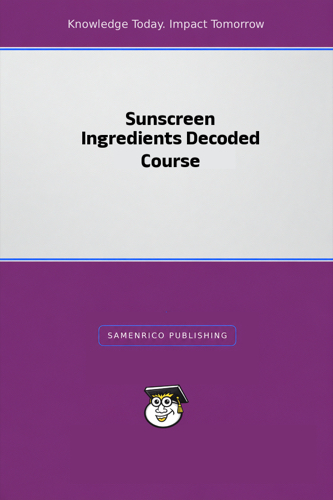
Non-FictionHealth & WellnessSunscreen Chemistry
Sunscreen Ingredients Decoded Course eBook
Choose between mineral zinc oxide and chemical fil
Choose between mineral zinc oxide and chemical filters for optimal protection.
Formats
Free sample
Chapter 1: The Invisible Assassin--The first crack in the illusion appears not in a laboratory or a dermatologist’s office, but on a beach in Australia in 2015. A forty-two-year-old woman named Sarah has done everything right. She has applied SPF 50 every two hours. She has worn a wide-brimmed hat. She has stayed under an umbrella during peak hours.
And yet, six months later, a dermatologist delivers a diagnosis of melanoma on her left shoulder—the exact spot where her sunscreen was applied most diligently.The oncologist asks a question that will haunt Sarah for years: “Was your sunscreen broad-spectrum?”She doesn’t know. She only knows the big number on the front of the bottle. SPF 50. That meant protection, didn’t it?This chapter is not about fear. It is about the single most important truth in all of sun protection: the difference between what you think you are buying and what you are actually getting.
The SPF number on the front of your sunscreen is not a lie, but it is a profound half-truth. And half-truths, when it comes to cancer and aging, are indistinguishable from lies.Let us begin at the beginning. Not with marketing, not with brands, but with the sun itself—the invisible assassin that has been targeting your skin since the day you were born.The Electromagnetic Spectrum: Your Skin’s Daily Assault The sun produces an astonishing range of electromagnetic radiation, from radio waves to gamma rays. The only portions that reach the Earth’s surface and affect your skin are ultraviolet radiation (UV) and visible light. Understanding these wavelengths is not optional—it is the foundation of every decision you will make about sunscreen for the rest of your life.Think of your skin as a building.
UVB is a wrecking ball that smashes the outer walls. UVA is a slow, silent termite infestation that eats the structural supports from the inside. Visible light, specifically blue light, is like a graffiti artist who paints the same spot every day until the pigment becomes permanent.Let us meet each assassin individually.UVB: The Burning Ray UVB radiation occupies the wavelength range of 290 to 320 nanometers. It is called the “burning ray” for a reason: UVB directly damages the DNA in the epidermis, the outermost layer of your skin. When UVB photons strike your skin, they are absorbed by the DNA molecules inside your skin cells.
This energy creates abnormal bonds between adjacent pyrimidine bases—specifically thymine-thymine dimers. These dimers, if not repaired by your body’s natural enzymes, cause mutations in tumor suppressor genes like p53, the so-called “guardian of the genome.”This is not theoretical. One severe sunburn in childhood doubles the risk of melanoma later in life. Five blistering sunburns between ages fifteen and twenty increases melanoma risk by eighty percent.UVB has a few telling characteristics. Its intensity varies dramatically by time of day and season—peak hours are 10 AM to 4 PM, with the highest intensity in summer.
UVB does not penetrate glass or clouds effectively. This is why you rarely burn through a car window or on an overcast day. And crucially, UVB causes visible redness within hours of exposure. That redness is your skin screaming at you: damage has occurred.But here is the trap. Because UVB causes immediate, visible consequences, people assume it is the dangerous one.
They are wrong. UVB is dangerous, yes. But UVA is the silent assassin.UVA1 and UVA2: The Aging and Oxidative Ray UVA radiation spans 320 to 400 nanometers, divided into UVA2 (320-340nm) and UVA1 (340-400nm). Unlike UVB, UVA penetrates deep into the dermis, the layer of skin where collagen and elastin live. It does not cause immediate redness.
It does not cause visible burns. But it destroys your skin from the inside out.How does UVA do this? Through oxidative stress. When UVA photons enter the dermis, they interact with chromophores (light-absorbing molecules) inside your cells. This interaction generates reactive oxygen species (ROS)—unstable molecules that tear through cellular structures like a wildfire.
ROS damage mitochondrial DNA, fragment collagen fibers, cross-link elastin (creating the leathery texture of photodamaged skin), and suppress the immune system’s ability to detect and destroy precancerous cells.The immune suppression piece is particularly insidious. Your body is constantly producing abnormal cells, and your immune system is constantly hunting them down. UVA exposure temporarily blinds those immune cells. In the hours and days after UVA exposure, your skin is effectively immunocompromised, unable to mount a defense against the very mutations the sun itself caused.UVA does not care about time of day, season, or weather. It is constant year-round, from sunrise to sunset.
It penetrates clouds. It penetrates glass. This is why truck drivers develop more skin cancers on their left side—the side facing the window. This is why office workers who sit near windows accumulate aging on the left side of their faces. The sun is not your enemy only at the beach.
It is your enemy every day, even indoors.A 2013 study in the journal Clinical, Cosmetic and Investigational Dermatology quantified the damage: UVA exposure is responsible for approximately eighty percent of visible skin aging, including wrinkles, loss of elasticity, and pigmentation irregularities. Yet the SPF number on your sunscreen ignores UVA entirely.UVC: The Blocked Threat UVC radiation (100-290nm) is the most dangerous wavelength—it is even more energetic than UVB and causes catastrophic DNA damage. However, the Earth’s ozone layer absorbs UVC completely. You will never encounter UVC from the sun. The only reason UVC appears in this chapter is to warn you about artificial sources: welding torches, mercury vapor lamps, and some germicidal ultraviolet lights.
In those contexts, UVC protection is essential. For everyday sun exposure, ignore UVC.HEV/Blue Light: The New Frontier High Energy Visible (HEV) light, also called blue light, occupies 400 to 500 nanometers. It is visible light—specifically the blue end of the spectrum. For decades, dermatologists ignored HEV because it is not ultraviolet. They were wrong.Recent research, particularly from the Journal of Investigative Dermatology, has demonstrated that HEV induces pigmentation that lasts up to three months—significantly longer than UV-induced pigmentation.
In darker skin types (Fitzpatrick IV-VI), HEV triggers melanogenesis (pigment production) through a different pathway than UV, one involving opsin-3 receptors on melanocytes.For patients with melasma, the clinical implications are profound. Melasma is the “mask of pregnancy”—brown patches on the cheeks and forehead that resist treatment. The single most effective intervention for melasma is not a laser or a cream. It is tinted sunscreen containing iron oxides, which block HEV. A 2018 study found that adding iron oxides to sunscreen reduced melasma recurrence by more than sixty percent compared to the same sunscreen without iron oxides.HEV also comes from digital screens.
Before you panic: the amount of HEV from a computer screen is approximately one thousand times lower than from sunlight. Screen exposure is not harmless—it may contribute to subtle pigmentation over years—but sunlight remains the dominant source.The Biological Toll: What Actually Happens to Your Skin Understanding the wavelengths is necessary, but understanding the biological consequences is what will change your behavior. Let us walk through a single day of unprotected sun exposure…
This is the end of the free sample. Get the eBook to keep going. Buy now
About this book
Details
- Author
- Mayhew Karina
- Publisher
- SamEnrico
- Language
- English
- Genre
- Non-Fiction, Health & Wellness, Sunscreen Chemistry
- Released
- 2026-06-07
- Pages (approx.)
- 151
- Available as
- eBook, Audiobook

Read better in the ZLOADR app
Your eBooks on your phone or tablet. Sign in with your SamEnrico account and start reading.
More by Mayhew Karina
 6G Technology InvestmentMayhew Karina$11.99
 MBSR for Remote WorkersMayhew Karina$11.99
 Triggers and Suicidal IdeationMayhew Karina$11.99
 Postpartum Thrush Treatment GuideMayhew Karina$11.99
 Physical Anger Warning SignsMayhew Karina$11.99
 Postdrome Migraine GuideMayhew Karina$11.99
 IBS Post Infectious RecoveryMayhew Karina$11.99
 LaGuardia New YorkMayhew Karina$11.99
 Lost Cities of the Coral Sea: The Deep-Sea Archaeologists Who Rediscovered Ancient OceaniaMayhew Karina$11.99
 The Kami’s Last Stand: The Fall of the Thunder God RaijinMayhew Karina$11.99
 Silk Road Unraveled: The Rise and Fall of the Dark Web's Drug EmpireMayhew Karina$11.99
 How to Start a Asset Management Business (Beginners Guide)Mayhew Karina$11.99
You may also like
 Hong Kong Handover 1997Dunn Johnnie$11.99
 Zumba For Postnatal Recovery CourseNeal Christian$11.99
 Zumba for BeginnersLadner Nikia$11.99
 YouTube Comment Mining GuideHumes Pandora$12.99
 Worry Box MeditationCarlin Rudy$11.99
 Workplace Stress MeditationNguyen Lynn$11.99
 Workplace Stress and Sleep RepairHawley Ivory$11.99
 Workplace Perfectionism CureDelaney Jeffry$11.99
 Workplace Injustice Anger GuideWallen Isabelle$11.99
 Work Addiction and Burnout LinkGreenwood Ester$11.99
 Women in Yoga and WellnessBeattie Galina$11.99
 Women in Stand Up ComedyChun Evangeline$11.99