
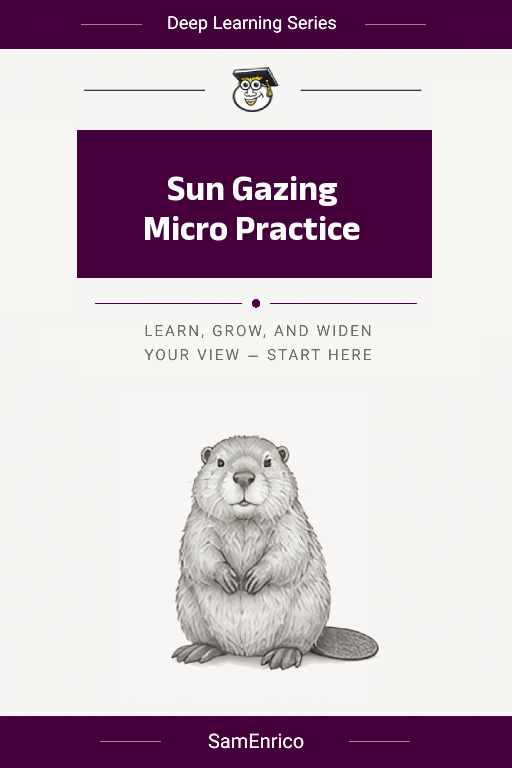
Sun Gazing Micro Practice eBook
Look at morning or evening sun for 60 seconds to r
Look at morning or evening sun for 60 seconds to regulate circadian rhythm and mood.
Formats
Free sample
Chapter 1: The Retina’s Secret...--–- Imagine for a moment that your eyes are not just windows to the world, but also the master switches for every cell in your body. Most people believe that vision exists solely to see—to recognize faces, read words, and navigate space. But hidden within the back of each eye lies a recently discovered system that has nothing to do with sight and everything to do with health. This system does not care whether you are looking at a beautiful sunset or a blank wall. It does not require focus, clarity, or even conscious attention.
What it requires is light—specifically, the right kind of light at the right time of day. And here is the astonishing part: it responds within seconds.This chapter will fundamentally change how you think about sunlight, your morning routine, and the tiny habits that produce outsized effects. You are about to learn why 60 seconds of morning light is more powerful for your internal clock than two hours of afternoon sun. You will discover the specific cells in your retina that act like a light switch for your brain. And you will understand why timing matters infinitely more than duration.
By the end of this chapter, the phrase “sun gazing micro practice” will no longer sound like wellness jargon. It will sound like basic biology.The Circadian Crisis You Did Not Know You Had Before we dive into the biology, let us take an honest look at modern life. The average person in a developed country spends 90 percent of their waking hours indoors. Offices, homes, cars, subways, gyms, and shopping malls—all of them lit by artificial sources that emit a fraction of the intensity of natural sunlight. A typical office desk receives 300 to 500 lux of light.
Lux is the unit of measurement for illuminance, or how much light falls on a surface. By comparison, a cloudy morning outdoors delivers 10,000 to 20,000 lux. A sunny morning delivers 50,000 to 100,000 lux. In other words, you are getting one-fiftieth to one-two-hundredth of the light your ancestors received every single day.This is not a minor inconvenience. It is a biological emergency that your body cannot adapt to because evolution moves slowly and light bulbs moved fast.
Your circadian rhythm—the internal 24-hour clock that governs sleep, wakefulness, hormone release, body temperature, digestion, immune function, and even mood—expects a massive signal of light at dawn and a gradual dimming at dusk. Instead, it gets a dim, constant, blue-rich glow from screens and LEDs from morning until midnight. The consequences are staggering: epidemic rates of insomnia, depression, metabolic syndrome, obesity, and burnout. These are not separate problems. They are symptoms of a single root cause.
Your clock is broken because your light is wrong.But here is the good news. You do not need to move to a cabin in the woods or spend hours outside every day. The circadian system, for all its complexity, has an achilles heel. It responds most powerfully to the first light it receives after a period of darkness. And it responds within seconds.
This is the foundational insight of the sun gazing micro practice. Sixty seconds of correctly timed light is not a compromise. It is a biological shortcut.The Discovery That Changed Chronobiology Until the late 1990s, scientists believed that the only light-sensing cells in the mammalian eye were rods and cones. Rods handle low-light vision. Cones handle color and detail.
Both send signals to the visual cortex, where the brain constructs images. But researchers noticed something puzzling. Blind mice—genetically modified to lack rods and cones—could still reset their circadian rhythms when exposed to light. Their pupils still constricted in bright light. Something else was sensing light, and it was not involved in vision.The breakthrough came in 1999 when a team led by Dr.
David Berson at Brown University identified a third class of photoreceptor in the retina. These cells are called intrinsically photosensitive retinal ganglion cells, or ip RGCs for short. They contain a photopigment called melanopsin, which is most sensitive to blue wavelengths of light around 480 nanometers—the exact wavelength that is abundant in morning sunlight and absent from most indoor lighting. Unlike rods and cones, which send signals to the visual cortex, ip RGCs send signals directly to the suprachiasmatic nucleus, or SCN, the master clock in the hypothalamus. This is the brain region that synchronizes every other clock in your body.Here is what makes ip RGCs revolutionary for the micro practice.
They do not require image formation. They do not need you to stare at the sun. They do not need focus, clarity, or even open eyes—although open eyes are more effective. They simply need to detect light intensity and color. And they respond within milliseconds, saturating their signal within 60 seconds.
After that point, additional light exposure produces diminishing returns. This is the scientific reason why 60 seconds is enough. It is not a mystical number. It is the saturation point of the melanopsin system.Why Duration Matters Less Than Timing The most common question people ask when they first hear about sun gazing is, “Shouldn’t I do it for longer? Wouldn’t ten minutes be better?” The answer, based on the neuroscience of ip RGCs, is no.
Not for circadian resetting. Let me explain why.The ip RGCs are not like solar panels that collect more energy the longer they are exposed. They are more like a light switch that flips on and then stays on. Research shows that melanopsin activation peaks within the first 30 to 60 seconds of light exposure and then plateaus. A 2010 study published in the journal Neuron found that ip RGCs exhibit what scientists call “sustained responses” to light, meaning they fire continuously during illumination, but the initial firing rate is the most significant for signaling the SCN.
In practical terms, your brain gets the message “it is daytime” within one minute. Additional minutes do add some benefit—they reinforce the signal and help with mood and vitamin D—but they do not add proportionally to circadian timing. This is the law of diminishing returns applied to your retina.Contrast this with timing. If you miss the morning window—the first hour after waking—the effect of light on your circadian phase drops dramatically. A 2014 study by Dr.
Kenneth Wright at the University of Colorado found that light exposure in the late morning or early afternoon shifts the circadian clock by less than half the amount of dawn light. Similarly, light exposure in the evening (after 8 PM) delays the clock, making it harder to fall asleep. So the hierarchy is clear: timing first, duration second, and intensity third. A perfectly timed 60-second gaze beats a poorly timed 20-minute walk every single time.The Cortisol Connection (What Morning Light Actually Does)To understand why morning light is so powerful, we need to talk about cortisol. Cortisol has a bad reputation because it is called the stress hormone.
But this is an oversimplification. Cortisol is also the wake-up hormone, the energy hormone, and the attention hormone. In a healthy circadian rhythm, cortisol naturally surges in the morning, peaking 30 to 45 minutes after waking. This is…
This is the end of the free sample. Get the eBook to keep going. Buy now
About this book
Details
- Author
- Swafford Mozella
- Publisher
- SamEnrico
- Language
- English
- Genre
- Non-Fiction, Mental Wealth
- Released
- 2026-05-30
- Pages (approx.)
- 141
- Available as
- eBook, Audiobook

Read better in the ZLOADR app
Your eBooks on your phone or tablet. Sign in with your SamEnrico account and start reading.
More by Swafford Mozella
 Vegan Selenium GuideSwafford Mozella$11.99
 The Dealership Visit by AgeSwafford Mozella$11.99
 Square BreathingSwafford Mozella$11.99
 SAD Prevention PlanSwafford Mozella$11.99
 Networking for ArchitectsSwafford Mozella$11.99
 Anger De escalation with AutismSwafford Mozella$11.99
 Workplace Failure RecoverySwafford Mozella$11.99
 The Last Emperor of the West: The Rise and Fall of Romulus AugustulusSwafford Mozella$11.99
 Scalable Creative FrameworksSwafford Mozella$11.99
 The Last Flight of the Miracle on the Hudson: A Captain's Impossible DecisionSwafford Mozella$11.99
 How to Produce Leather Cleaner and ConditionerSwafford Mozella$11.99
 How to Produce a Waffle IronSwafford Mozella$11.99
You may also like
 Hong Kong Handover 1997Dunn Johnnie$11.99
 Zumba For Postnatal Recovery CourseNeal Christian$11.99
 Zumba for BeginnersLadner Nikia$11.99
 YouTube Comment Mining GuideHumes Pandora$12.99
 Worry Box MeditationCarlin Rudy$11.99
 Workplace Stress MeditationNguyen Lynn$11.99
 Workplace Stress and Sleep RepairHawley Ivory$11.99
 Workplace Perfectionism CureDelaney Jeffry$11.99
 Workplace Injustice Anger GuideWallen Isabelle$11.99
 Work Addiction and Burnout LinkGreenwood Ester$11.99
 Women in Yoga and WellnessBeattie Galina$11.99
 Women in Stand Up ComedyChun Evangeline$11.99