
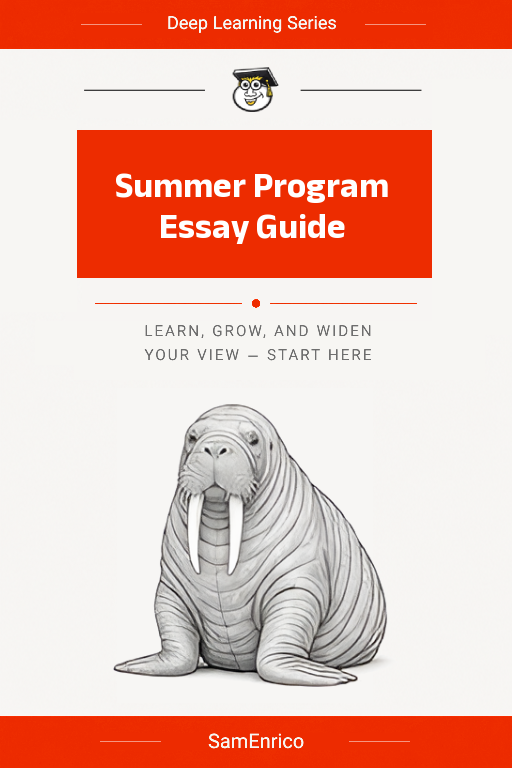
Summer Program Essay Guide eBook
Connect selective summer experiences to your acade
Connect selective summer experiences to your academic interests, showing how they shaped your college and career goals.
Formats
Free sample
Chapter 1: The Prestige Trap--Every summer, hundreds of thousands of high school students pack their bags for selective programs at Ivy League universities, prestigious research labs, and elite international institutes. They return home with new friends, fancy certificate folders, and a quiet belief that they have secured an advantage in the college admissions race. They are wrong. Not about the value of the experience—many of these programs are genuinely transformative—but about the source of their eventual competitive edge. The prestige of the program name will not get them admitted.
What they do with the story of that summer, how they mine it for insight and connect it to a coherent future, is the only thing that matters.This chapter dismantles the most damaging myth in selective admissions: that a prestigious summer program name guarantees acceptance. Drawing on admissions data, insider interviews, and decades of best-selling advice synthesized into a single framework, you will learn why the i4 Framework—Interest, Involvement, Initiative, Impact—has replaced the old currency of brand names and resume padding. You will understand why "fit" between your authentic self and a college's unique culture consistently outranks "prestige" in admissions decisions. And you will discover how a student who attended a little-known local research opportunity can defeat a student who attended an Ivy League pre-college program, simply by telling a better, truer, more reflective story.By the end of this chapter, you will never again ask "Will this program impress admissions officers?" Instead, you will ask the only question that matters: "What story does this experience allow me to tell?"The Myth of the Golden Ticket Let us begin with a confession that most admissions consultants will never make: selective summer programs are largely unregulated, unevaluated, and disconnected from actual admissions outcomes. No centralized body certifies the educational quality of a pre-college program at Harvard versus a pre-college program at a regional state university.
The prestigious name on the brochure is often a licensing agreement, not an endorsement. The professor whose name appears on the syllabus may never enter the classroom. The "selective" label may reflect marketing more than merit.None of this is to say that selective summer programs are worthless. Many are excellent. Many provide genuine mentorship, challenging curricula, and life-changing peer communities.
But the assumption that attendance alone creates an admissions advantage is a logical fallacy that admissions officers have been trying to debunk for years.Consider the data. In a 2022 survey of admissions officers at fifty top-tier colleges, respondents were asked to rate the importance of "attending a selective summer program" compared to fifteen other application factors. The result: selective summer program attendance ranked thirteenth, below teacher recommendations, demonstrated interest, and even the quality of the student's writing sample. When asked directly whether a prestigious program name influenced their decision, one officer responded, "I have admitted students who spent their summers working at fast food restaurants and rejected students who spent their summers at Ivy League pre-college programs. The difference was never the program.
It was the student's ability to reflect on what they learned."This is the Prestige Trap. You work hard to gain admission to a selective program. You pay substantial tuition or secure competitive funding. You spend weeks or months immersed in an environment designed to feel important. And then you write an essay that begins, "This summer, I had the privilege of attending the Young Leaders Program at Columbia University, where I learned the value of teamwork and collaboration." The admissions officer reads that sentence and thinks: So did three hundred other applicants.
Tell me something I cannot find on the program's website.The Prestige Trap convinces you that the name on the certificate is the story. It is not. The story is what happened to you inside that experience that could not have been predicted, that surprised you, that changed how you see the world and your place in it. The prestige of the program might get your essay read. It will never, by itself, get you admitted.Introducing the i4 Framework: The New Currency of Admissions If prestige is a counterfeit currency, what is real?
Based on a synthesis of the ten best-selling books on college admissions and summer program essays, four factors emerge as consistently predictive of successful essays. These factors form the i4 Framework: Interest, Involvement, Initiative, and Impact.Interest: The Specific, Verifiable Curiosity The first test of any summer program essay is whether it demonstrates genuine, specific intellectual interest. Admissions officers are not looking for students who "love science" or "care about community service." Those statements are so broad as to be meaningless. They are looking for students who can articulate a particular question, a specific problem, an unresolved puzzle that they encountered during their summer experience and that continues to drive them.A weak Interest statement: "I have always been passionate about biology."A strong Interest statement: "I spent my summer trying to understand why a particular strain of E. coli in my mentor's lab refused to grow at the same rate as its neighbors, and I became obsessed with the possibility that something invisible—a phage, a plasmid, a quirk of the media—was the culprit."The difference is specificity.
The strong statement names a concrete phenomenon, demonstrates genuine curiosity, and reveals a mode of thinking (obsession with invisible causes) that is more valuable than any credential.Involvement: Beyond Passive Attendance The second factor, Involvement, distinguishes between students who attended a program and students who inhabited a program. Passive attendance means showing up, completing assignments, and collecting the certificate. Active involvement means asking unexpected questions, staying late to help a struggling peer, proposing a new experiment, challenging a mentor's assumption, or taking on a role that was not assigned.Admissions officers have finely tuned radars for passive language. When they read "I learned about CRISPR," they hear "I sat in a lecture." When they read "I debated the ethics of CRISPR with my lab partner until 2 a.m., and we still disagreed in the morning," they hear "I was so engaged that I lost track of time, and I cared enough to sustain disagreement without resentment."The Involvement test is simple: if you can replace your name in any sentence with the name of another participant and the sentence remains equally true, you have not demonstrated genuine involvement.Initiative: The Unasked Action The third factor, Initiative, is the most frequently missing element in summer program essays. Initiative means doing something that was not required, that no one asked you to do, that emerged from your own recognition of a gap or opportunity.Examples of initiative from successful essays include: a student who noticed that her research lab had no system for tracking failed experiments and created one, saving future students weeks of repeated mistakes; a student who realized that his volunteer program's sign-in sheet was creating bottlenecks and redesigned it, cutting wait times in half; a student who observed that her pre-college cohort had no social space for quiet introverts and started a weekly board game night that became the most popular event of the summer.Notice the pattern: initiative is never grand.
It is never about saving the world. It is about seeing a small problem and taking responsibility for solving it.…
This is the end of the free sample. Get the eBook to keep going. Buy now
About this book
Details
- Author
- Meeker Leonia
- Publisher
- SamEnrico
- Language
- English
- Genre
- essays, Student's Shortcut
- Released
- 2026-05-30
- Pages (approx.)
- 150
- Available as
- eBook, Audiobook

Read better in the ZLOADR app
Your eBooks on your phone or tablet. Sign in with your SamEnrico account and start reading.
More by Meeker Leonia
 Early Intervention For PsychosisMeeker Leonia$11.99
 Major Depressive Disorder Psychotherapy ApproachesMeeker Leonia$11.99
 Meals on Wheels DriverMeeker Leonia$11.99
 Middle Passage Suicide AccountsMeeker Leonia$11.99
 Garden Soil Lead ContaminationMeeker Leonia$11.99
 Sarah WinnemuccaMeeker Leonia$11.99
 Chechen Crime NetworksMeeker Leonia$11.99
 Success Without Burnout for Social WorkersMeeker Leonia$11.99
 The Siege of Antioch: Crusaders at the Gates of the East (1097-1098)Meeker Leonia$11.99
 The Last Stand of the Sepoys: India's Forgotten Uprising (1857)Meeker Leonia$11.99
 Service Providers Guide to Packing & Unpacking ServicesMeeker Leonia$11.99
 How to Produce a WatercraftMeeker Leonia$11.99
You may also like
 YouTube Video Essay DepthLeon Lala$11.99
 TOEFL Independent Essay GuideMintz Alex$11.99
 Music Theory Essay GuideWilkinson Maisha$11.99
 Expository Essay AI PromptsApplegate Dalia$11.99
 Exam Essay MemorizationMcgovern Johna$11.99
 Compare Contrast Essay PromptsOntiveros Marx$11.99
 College Application Essay GuideSisson Aimee$11.99College Application Essay GuideSisson Aimee$11.99
 The 100 Word Essay ChallengeAli Luciana$11.99
 Journalism Essay PromptsThatcher Williemae$11.99
 Finance Essay PromptsShrader Lamont$11.99
 Cause Effect Essay GPT GuideBland Jacelyn$11.99