
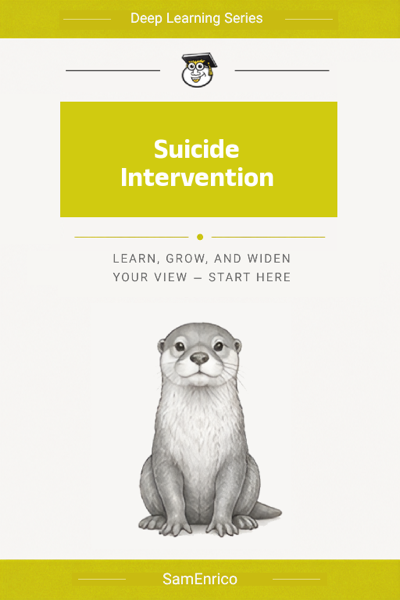
Non-FictionInformativeEducational
Suicide Intervention eBook
A Coursebook on Suicide Intervention
A Coursebook on Suicide Intervention
Formats
Free sample
Chapter 1: The Unspoken Reality…--– The call comes at 11:47 on a Tuesday night. You recognize the number. It’s a client you’ve been seeing for eight months—someone who has never mentioned suicide, never hinted at darkness beyond what you both labeled “mild adjustment difficulties.” Their voice is flat, eerily calm. “I just wanted to say thank you. You tried.
But I can’t do this anymore.” Your heart pounds. Your mouth goes dry. In that moment, years of training evaporate, and you are left with nothing but fear and the desperate instinct to say the right thing. What do you say? What if you say the wrong thing?
What if silence is worse?This scene, or something like it, is the nightmare that haunts every mental health professional—from the newly licensed social worker to the psychiatrist with thirty years of experience. And yet, for all the fear it generates, suicide remains one of the most avoidably misunderstood topics in clinical training. We learn about depression, anxiety, trauma, and personality disorders with systematic precision. But when it comes to the one outcome that can permanently end every other clinical concern—the client’s very life—we are often taught to whisper, to hedge, to document defensively, and to hope it doesn’t happen on our watch.This chapter is an invitation to stop hoping and start acting.The Epidemic We Pretend We Don’t See Let us begin with uncomfortable numbers. Globally, more than 700,000 people die by suicide each year, according to the World Health Organization.
That is one person every forty seconds. For every death, there are an estimated twenty-five attempts—meaning nearly 18 million people each year reach a point of such profound despair that they attempt to end their lives. In the United States alone, suicide rates have increased by approximately 36 percent since the turn of the millennium. It is now the eleventh leading cause of death overall and the second leading cause among individuals aged ten to thirty-four.These statistics are not abstractions. They are your future clients, your neighbors, your family members, and perhaps—if you are willing to be honest—parts of yourself.Yet despite the scale of this crisis, suicide remains shrouded in taboo.
We discuss heart disease and cancer openly. We fund research for Alzheimer’s and diabetes with public campaigns. But suicide carries a stigma so potent that even mental health professionals—the very people trained to sit with suffering—often avoid the topic. A 2019 survey of clinicians found that 42 percent reported feeling “unprepared” to assess suicide risk, and 31 percent admitted to avoiding direct questions about suicide because of their own anxiety.We cannot afford this avoidance any longer. Suicide intervention is not an innate gift possessed by a few naturally gifted therapists.
It is a learnable clinical competency—a set of skills that can be taught, practiced, mastered, and maintained. This book exists because that truth must become the foundation of every clinician’s identity.The Hidden Epidemic Among Clinicians Themselves Before we go any further, we need to address an uncomfortable reality that most textbooks ignore: the emotional toll this work takes on you. Research consistently shows that approximately 25 percent of mental health professionals will lose a client to suicide at some point in their career. Let that statistic sink in. One in four.
If you are reading this in a classroom of twenty future clinicians, five of you will experience the death of a client by suicide. If you are already practicing, the odds are that you either have already lost someone or will.This is not said to frighten you into inaction. It is said to normalize the possibility. To remove the shame. To prepare you.The aftermath of a client suicide is profoundly painful.
Clinicians report guilt, self-doubt, fear of litigation, intrusive thoughts about the client’s final moments, and a persistent questioning of their own competence. Many leave the field entirely. Others stay but practice defensively—over-hospitalizing, under-connecting, prioritizing documentation over relationship.There is another way. The clinicians who weather these losses best are not those who never make mistakes or who perfectly predict every outcome. They are those who have prepared emotionally and practically for the possibility.
They have supervision structures in place. They have processed their own relationship with death and suicide. They have learned to separate responsibility (what they control) from outcome (what they do not fully control). And they return to the work not broken, but deepened.This chapter, and this book, is your preparation.The Myths That Kill: What You Think You Know Is Wrong If we are going to intervene effectively, we must first clear the ground of dangerous misconceptions. Suicide is surrounded by a thicket of myths—some ancient, some surprisingly modern—that directly interfere with life-saving action.
Let us examine the most dangerous ones.Myth 1: “Asking about suicide plants the idea.”This is perhaps the most pervasive and harmful myth in all of mental health. The logic seems intuitive: if someone has never considered suicide, and you bring it up, won’t you introduce the possibility? The research is unequivocal: no. Dozens of studies have shown that asking about suicide does not increase suicidal ideation or behavior. In fact, the opposite is true.
Direct, compassionate inquiry reduces distress because it communicates that the clinician can handle the topic, that the client’s darkest thoughts are not too shameful to share, and that help is available. People who are asked about suicide directly are more likely to disclose, more likely to accept help, and no more likely to attempt than those who are not asked.The myth persists because it feels protective. It allows clinicians to avoid an uncomfortable conversation under the guise of being careful. But avoidance is not care. It is abandonment dressed in clinical language.Myth 2: “People who talk about suicide won’t actually do it.”This myth has a grain of tragic irony: it is most often repeated by people who have lost someone to suicide.
Because the logic is reversed. The truth is that the majority of people who die by suicide have communicated their intent—directly or indirectly—in the weeks or days beforehand. They tell friends, family members, coworkers, therapists, doctors. They post on social media. They write notes they never send.
They make statements like “I won’t be a problem for much longer” or “You’d be better off without me.”The problem is not that they don’t talk. The problem is that we don’t listen—or we listen but don’t know what we’re hearing. Every verbalization of suicidal thoughts, no matter how casual or seemingly manipulative, should be taken seriously and assessed.Myth 3: “Suicide is always an impulsive act.”For a subset of suicides—particularly among young people and those under the influence of alcohol or drugs—impulsivity does play a role. But for the majority, suicide is the endpoint of a long, painful process. Studies of suicide notes, psychological autopsies, and survivors of near-lethal attempts reveal that most people have been thinking about suicide for weeks, months, or even years before the act.
The stereotype of the “sudden, inexplicable suicide” is a comforting fiction. It allows survivors to believe there were no warning…
This is the end of the free sample. Get the eBook to keep going. Buy now
About this book
Details
- Author
- Garrison Florinda
- Publisher
- SamEnrico
- Language
- English
- Genre
- Non-Fiction, Informative, Educational
- Released
- 2026-05-04
- Pages (approx.)
- 155
- Available as
- eBook, Audiobook

Read better in the ZLOADR app
Your eBooks on your phone or tablet. Sign in with your SamEnrico account and start reading.
More by Garrison Florinda
 Sleep Meditation ChallengeGarrison Florinda$11.99
 Rosalind Franklin Coal Research PrimerGarrison Florinda$11.99
 The Death Road DownhillGarrison Florinda$11.99
 Astronaut Space Stress GuideGarrison Florinda$11.99
 The Cancer Caregiver Stress GuideGarrison Florinda$11.99
 The Silk Road's Phantom: The Double Life of Marco Polo's Lost SpyGarrison Florinda$11.99
 The Last Human Hand: George Devol and the Birth of the Industrial RobotGarrison Florinda$11.99
 Understanding FibrosarcomaGarrison Florinda$17.99
 Ghanaian Talent Recruitment ManualGarrison Florinda$12.99
 ROI Based Promotion ArgumentGarrison Florinda$12.99
 How to Become a Cigarette-filter-making-machine OperatorGarrison Florinda$11.99
You may also like
 Hong Kong Handover 1997Dunn Johnnie$11.99
 Zumba For Postnatal Recovery CourseNeal Christian$11.99
 Zumba for BeginnersLadner Nikia$11.99
 YouTube Comment Mining GuideHumes Pandora$12.99
 Worry Box MeditationCarlin Rudy$11.99
 Workplace Stress MeditationNguyen Lynn$11.99
 Workplace Stress and Sleep RepairHawley Ivory$11.99
 Workplace Perfectionism CureDelaney Jeffry$11.99
 Workplace Injustice Anger GuideWallen Isabelle$11.99
 Work Addiction and Burnout LinkGreenwood Ester$11.99
 Women in Yoga and WellnessBeattie Galina$11.99
 Women in Stand Up ComedyChun Evangeline$11.99