
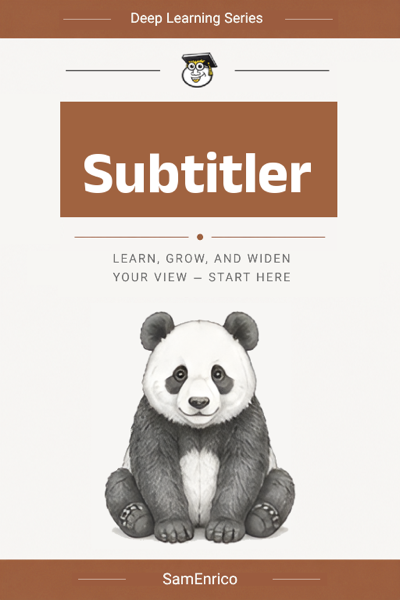
Non-FictionInformativeEducational
Subtitler Audiobook
A Coursebook on Subtitler
by Damron Audie
A Coursebook on Subtitler
Formats
Free sample
Chapter 1: The First Lie...--The first commercially successful "talkie" contained no subtitles whatsoever. When The Jazz Singer premiered in 1927, deaf audiences across America arrived at theaters expecting what they had always received during the silent era: intertitles — full-screen cards displaying dialogue and narration between scenes. Instead, they encountered the future of cinema: synchronized sound, spoken words, and absolute silence for anyone who could not hear. In at least two documented screenings — one in New York, another in Chicago — frustrated viewers walked out. In a third, according to a contemporary newspaper account, a small group remained seated, watching the actors' lips move without comprehension, until a theater employee wrote key lines on a chalkboard and held it up beside the screen.No one rioted.
But the near-riot that almost happened would have been justified. The arrival of sound cinema had, in a single technological leap, erased an entire audience from consideration. Silent films, for all their limitations, had been accessible by default: intertitles were visual, universal, and readable. Talkies introduced a barrier that would require a new solution — not dubbing, which was expensive and artistically controversial, not live interpreters, which were impractical for mass distribution, but something smaller, cheaper, and more precise: a few lines of text at the bottom of the screen, appearing and disappearing in perfect synchronization with the human voice.That solution, which we now call subtitling, was not born from artistic ambition. It was born from necessity, from economics, and from a forgotten patent war between two competing projection systems.
And the people who would eventually master this new craft — the subtitlers themselves — were not initially seen as translators or artists or accessibility advocates. They were seen as technicians, as ghosts, as the invisible writers whose names would never appear on screen.This chapter dismantles the first and most persistent lie about subtitling: that it is simply "writing down what you hear." It traces the technological evolution from silent film intertitles to the first optical subtitle projectors, defines the three major typologies that every practicing subtitler must master, and introduces the core concept that underpins everything else in this book: subtitling is a vulnerable translation, an act of linguistic and semiotic negotiation that cannot hide its mistakes behind footnotes, glossaries, or apologies. If a subtitler gets it wrong, millions of viewers see the error instantly. There is no second chance.The Silent Origins: Intertitles and the Universal…
This is the end of the free sample. Get the Audiobook to keep going. Buy now
About this book
Details
- Author
- Damron Audie
- Publisher
- SamEnrico
- Language
- English
- Genre
- Non-Fiction, Informative, Educational
- Released
- 2026-05-11
- Pages (approx.)
- 143
- Available as
- eBook, Audiobook

Listen in the VoxFlicks app
Audiobooks and audio dramas wherever you go. Sign in with your SamEnrico account and press play.
More by Damron Audie
 Teen Depression HandbookDamron Audie$11.99
 Citation Rules for Retracted Articles CourseDamron Audie$11.99
 Essay Exam Writing GuideDamron Audie$11.99
 Career Transition for Healthcare WorkersDamron Audie$11.99
 Chuck Yeager BiographyDamron Audie$11.99
 Financial Independence Without HustleDamron Audie$11.99
 Twelve Step Recovery Foundations GuideDamron Audie$11.99
 Sherman Tank Modifications for NormandyDamron Audie$11.99
 Disappointment In BodyDamron Audie$11.99
 The Phantom of the Grand Palais: The Haunting Legacy of Black BallerinasDamron Audie$11.99
 The Silk and the Steel: How a Spy’s Love Betrayed a NationDamron Audie$11.99
 Steel and Shadows: The Collapse of the I-35W Mississippi River BridgeDamron Audie$11.99
You may also like
 Hong Kong Handover 1997Dunn Johnnie$11.99
 Zumba For Postnatal Recovery CourseNeal Christian$11.99
 Zumba for BeginnersLadner Nikia$11.99
 YouTube Comment Mining GuideHumes Pandora$12.99
 Worry Box MeditationCarlin Rudy$11.99
 Workplace Stress MeditationNguyen Lynn$11.99
 Workplace Stress and Sleep RepairHawley Ivory$11.99
 Workplace Perfectionism CureDelaney Jeffry$11.99
 Workplace Injustice Anger GuideWallen Isabelle$11.99
 Work Addiction and Burnout LinkGreenwood Ester$11.99
 Women in Yoga and WellnessBeattie Galina$11.99
 Women in Stand Up ComedyChun Evangeline$11.99