
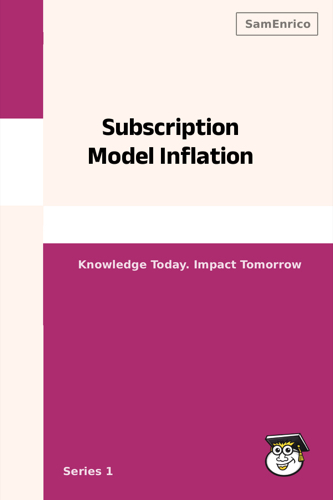
Non-FictionBusiness BriefSubscription Pricing
Subscription Model Inflation eBook
Smooth price increases across annual commitments.
by Roller Agnus
Smooth price increases across annual commitments.
Formats
Free sample
Chapter 1: The Fairness Trap--–- In the winter of 2022, a mid-sized B2B Saa S company called Logi Flo did what most rational subscription businesses would do. Inflation had hit 7.1 percent. Their cloud infrastructure costs had risen 12 percent. Their support team had demanded cost-of-living adjustments. So the CEO made a decision that seemed not just reasonable but morally defensible: he sent an email to every customer announcing a 7 percent price increase, effective in 60 days.
He included a chart showing CPI data. He used the word "fair" seven times. He even offered a 30-day grace period for anyone who wanted to cancel without penalty.Within 90 days, Logi Flo had lost 22 percent of its annual recurring revenue. The CEO was baffled. "We were just passing through what everyone else was paying," he told me in a post-mortem interview.
"We thought customers would understand."They did not understand. And that single misunderstanding—the belief that "fair" price increases rooted in inflation would be accepted—has destroyed more subscription businesses than almost any other pricing mistake.This chapter will dismantle what I call the Fairness Trap: the dangerous assumption that customers will accept a price increase simply because it is tied to objective, external factors like inflation. We will explore the neurology of bill shock, contrast two very different corporate case studies, and establish the foundational distinction that guides this entire book: the difference between reactive Inflationary Pass-through and proactive Value-based Uplift. By the end of this chapter, you will understand why fair contracts fail and how to reframe every price change as an alignment of value rather than a transfer of cost.The Neurology of Bill Shock Let us begin with the biology of surprise. When a customer receives an unexpected price increase notification, the brain does not process it in the prefrontal cortex—the region responsible for rational analysis and long-term planning.
Instead, the information travels first to the amygdala, a small almond-shaped cluster of nuclei deep within the temporal lobe that functions as the brain's threat detection center.The amygdala evolved to prioritize survival over reason. It cannot distinguish between a predator and a price hike. When activated, it triggers a cascade of physiological responses: increased heart rate, elevated cortisol, narrowed attention. In this state, the customer is literally incapable of evaluating whether the price increase is "fair" or "reasonable." The only question the amygdala answers is: fight, flight, or freeze?In the context of subscription billing, "flight" means cancellation. "Fight" means a hostile call to customer support.
"Freeze" means passive non-renewal—the customer simply ignores the renewal notice and lets the subscription lapse without ever articulating a complaint. All three outcomes produce the same financial result: churn.This neurological reality explains a consistent finding across dozens of churn studies: the single best predictor of whether a customer will accept a price increase is not the size of the increase, not the customer's income level, not even the quality of the product. The best predictor is whether the customer expected the increase.Expected price changes—even large ones—are processed by the prefrontal cortex. The customer can evaluate them rationally. Unexpected price changes—even small ones—trigger the amygdala.
The customer reacts emotionally before they ever think logically.Consider the data. A 2019 study of 47 subscription businesses found that price increases announced with 60 days or more of advance notice generated 40 percent less churn than increases announced with 30 days or less, even when the magnitude of the increase was identical. The difference was not the number. The difference was the surprise.This is the first and most important lesson of this chapter: you cannot negotiate with the amygdala. Once the threat response is activated, no amount of rational explanation—no chart, no CPI data, no inflation graph—will de-escalate the customer.
The only winning move is to never activate the amygdala in the first place.The Fairness Fallacy: Why Transparency Backfires The Logi Flo CEO believed he was doing the right thing. He was transparent. He was data-driven. He was fair. And he was catastrophically wrong.The Fairness Fallacy is the belief that customers will accept a price increase if they understand and agree with the underlying rationale.
This belief is intuitively appealing. It feels honest. It feels respectful. It is also completely contradicted by the evidence.Let us examine two real-world case studies that illustrate the difference between effective and ineffective price increase communication.Case Study A: Netflix, 2019In January 2019, Netflix announced a price increase across all plans. The standard plan rose from $10.99 to $12.99—an 18 percent increase.
The premium plan rose from $13.99 to $15.99—a 14 percent increase. The announcement was made via email and blog post, with approximately 30 days' notice. The rationale was straightforward: "We're updating our prices so that we can continue to offer a wide variety of TV shows and movies."The response was immediate and brutal. Netflix added only 0.27 million US subscribers in the first quarter of 2019, far below the 1.6 million analysts had projected. The stock dropped 4.5 percent in a single day.
The company had fundamentally misjudged the relationship between price and perceived value.But here is what is interesting. Netflix's content library in 2019 was arguably stronger than ever. They had just released "Bird Box," "The Crown" season two, and "Stranger Things" season three was on the horizon. The objective value of the product had increased. The price increase was objectively justified.
None of that mattered. Because the increase was unexpected and framed as a cost transfer rather than a value exchange, customers reacted with their amygdalas, not their prefrontal cortices.Case Study B: Userful, 2021Now consider a very different approach. Userful, a desktop virtualization company, faced the same inflationary pressures as everyone else in 2021. But instead of announcing a surprise price increase, they introduced something called the "Fair Contract Commitment."The commitment worked like this: every contract would automatically include a price adjustment clause tied to the Consumer Price Index plus one percent, capped at 4 percent annually. The clause was presented at the very beginning of the sales process, not buried in fine print.
Customers signed it as part of the initial agreement. When the first automatic adjustment arrived, there was no announcement, no email blast, no blog post. There was simply an invoice reflecting the pre-agreed formula.The result? Userful reported renewal rates above 90 percent for customers under the Fair Contract Commitment. Customer support calls about pricing dropped to near zero.
The company successfully raised prices every single year without losing a single major customer to price-related churn.What explains the difference? Netflix triggered the amygdala. Userful never gave the amygdala a reason to activate. Because the price adjustment was pre-negotiated and contractual—not announced as a surprise—customers processed it as a continuation of existing terms rather than a new threat.This is the fundamental insight that will echo throughout this book: the best price increase is the one the customer never notices.Inflationary Pass-through vs. Value-based Uplift The distinction between Logi Flo and Userful, between Netflix and companies that execute price increases smoothly, can be reduced to two opposing frameworks.
Let us define them clearly.Inflationary Pass-through is a reactive pricing strategy in which the vendor raises prices in response to external cost increases (inflation, labor, infrastructure)…
This is the end of the free sample. Get the eBook to keep going. Buy now
About this book
Details
- Author
- Roller Agnus
- Publisher
- SamEnrico
- Language
- English
- Genre
- Non-Fiction, Business Brief, Subscription Pricing
- Released
- 2026-06-09
- Pages (approx.)
- 149
- Available as
- eBook, Audiobook

Read better in the ZLOADR app
Your eBooks on your phone or tablet. Sign in with your SamEnrico account and start reading.
More by Roller Agnus
 DoorDash Tax Deduction GuideRoller Agnus$11.99
 Historical Ratio TrendsRoller Agnus$11.99
 TikTok Algorithm ResistanceRoller Agnus$11.99
 The Community Garden StartRoller Agnus$11.99
 Anxiety Relationship Management GuideRoller Agnus$11.99
 The Hidden UFO Tapes ReleasedRoller Agnus$11.99
 Growth Mindset for Social WorkersRoller Agnus$11.99
 The Phantom of Marignano: Ghosts of the Italian WarsRoller Agnus$11.99
 The 1933 Victorian Football League Scandal: A Fight for the Soul of Australian RulesRoller Agnus$11.99
 Service Providers Guide to Entertainment & PartiesRoller Agnus$11.99
 A Collector's Handbook to the Jensen IiiRoller Agnus$11.99
 Open Banking for Ecommerce GuideRoller Agnus$12.99
You may also like
 Hong Kong Handover 1997Dunn Johnnie$11.99
 Zumba For Postnatal Recovery CourseNeal Christian$11.99
 Zumba for BeginnersLadner Nikia$11.99
 YouTube Comment Mining GuideHumes Pandora$12.99
 Worry Box MeditationCarlin Rudy$11.99
 Workplace Stress MeditationNguyen Lynn$11.99
 Workplace Stress and Sleep RepairHawley Ivory$11.99
 Workplace Perfectionism CureDelaney Jeffry$11.99
 Workplace Injustice Anger GuideWallen Isabelle$11.99
 Work Addiction and Burnout LinkGreenwood Ester$11.99
 Women in Yoga and WellnessBeattie Galina$11.99
 Women in Stand Up ComedyChun Evangeline$11.99