
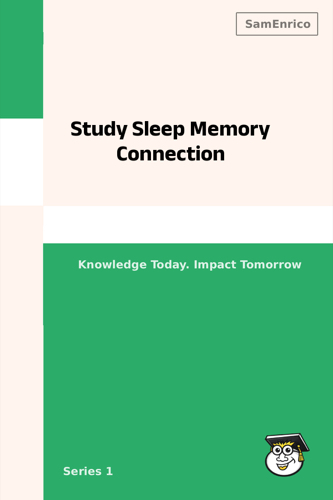
Non-FictionSelf-HelpSleep Science
Study Sleep Memory Connection Audiobook
Optimizes rest for memory consolidation.
Optimizes rest for memory consolidation.
Formats
Free sample
Chapter 1: The Leaky Bucket--–- It is 10:00 on a Tuesday night. You have just spent four hours studying for a Friday exam. Your highlighter is dry. Your notes are密密麻麻. You feel a familiar, smug satisfaction.
You close the book and think, I’ve got this.Twenty-four hours later, you sit down to review. You stare at the first page. The words look familiar, like the face of a stranger you met at a party. You know you have seen them before, but you cannot remember their name, where they work, or why they matter. Panic whispers: Did I even study at all?You did.
You studied hard. And then you forgot almost everything.This is not a personal failing. It is not a sign of low intelligence, a bad memory, or laziness. It is the single most predictable feature of the human brain, described by a 19th-century psychologist named Hermann Ebbinghaus, and it has ruined more test scores, wasted more study hours, and caused more late-night cramming sessions than any other cognitive phenomenon. He called it the Forgetting Curve.
I call it the Leaky Bucket.Here is what Ebbinghaus discovered. If you learn something new—a list of vocabulary words, a set of historical dates, a mathematical formula—and you do absolutely nothing with that information, you will forget roughly fifty percent of it within the first hour. Within twenty-four hours, you will forget up to seventy percent. Within a week, if you never review, you will be left with a miserable twenty to thirty percent of what you originally learned. You pour water into a bucket, and the bucket has holes.
The water drains out whether you want it to or not.Most students and professionals respond to this reality by doing exactly the wrong thing. They study longer. They highlight more aggressively. They re-read the same paragraph three times. They assume that if they just expose themselves to the material enough times, the material will stick.
This is the illusion of familiarity. Your brain is very good at recognizing something you have seen before. It is very bad at distinguishing between recognition and recall. Recognition says, “Oh yes, I have seen that term before.” Recall says, “I can define that term, use it in a sentence, and explain how it connects to three other concepts.” The difference between recognition and recall is the difference between walking past a…
This is the end of the free sample. Get the Audiobook to keep going. Buy now
About this book
Details
- Author
- Pinson Cristobal
- Publisher
- SamEnrico
- Language
- English
- Genre
- Non-Fiction, Self-Help, Sleep Science
- Released
- 2026-06-08
- Pages (approx.)
- 147
- Available as
- eBook, Audiobook

Listen in the VoxFlicks app
Audiobooks and audio dramas wherever you go. Sign in with your SamEnrico account and press play.
More by Pinson Cristobal
 Assertiveness and AngerPinson Cristobal$11.99
 PGT After Loss GuidePinson Cristobal$11.99
 Crooked Teeth Childhood ShamePinson Cristobal$11.99
 Cocaine Baby SyndromePinson Cristobal$11.99
 Franchising Your Local Brand Across Borders Cultural TrainingPinson Cristobal$11.99
 Small Talk for College StudentsPinson Cristobal$11.99
 Antioxidant ProtocolPinson Cristobal$11.99
 The Library of Alexandria: Beacon of the Ancient WestPinson Cristobal$11.99
 The Battle of Mohi: The Mongols Crush the Last European Kingdom (1241)Pinson Cristobal$11.99
 How to Start a offshore Support Vessel Business (Beginners Guide)Pinson Cristobal$11.99
 How to Produce SpreadersPinson Cristobal$11.99
 Mastering The Art of Bare-knuckle Boxing (London Prize Ring Rules)Pinson Cristobal$11.99
You may also like
 Hong Kong Handover 1997Dunn Johnnie$11.99
 Zumba For Postnatal Recovery CourseNeal Christian$11.99
 Zumba for BeginnersLadner Nikia$11.99
 YouTube Comment Mining GuideHumes Pandora$12.99
 Worry Box MeditationCarlin Rudy$11.99
 Workplace Stress MeditationNguyen Lynn$11.99
 Workplace Stress and Sleep RepairHawley Ivory$11.99
 Workplace Perfectionism CureDelaney Jeffry$11.99
 Workplace Injustice Anger GuideWallen Isabelle$11.99
 Work Addiction and Burnout LinkGreenwood Ester$11.99
 Women in Yoga and WellnessBeattie Galina$11.99
 Women in Stand Up ComedyChun Evangeline$11.99