
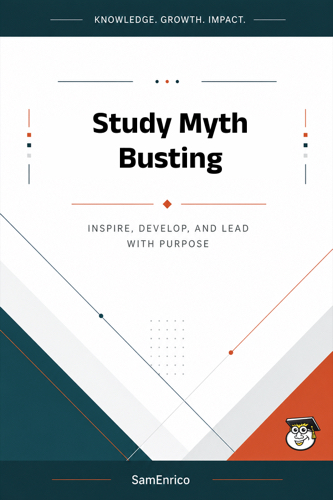
Free sample
Chapter 1: The Learning Styles Lie--–- Maria was a straight-A student until she hit organic chemistry. She reread every chapter three times. She color-coded her notes with six different highlighters. She even recorded herself reading the textbook and listened to it while driving. After fourteen hours of studying for the final exam, she felt exhausted and confident.
She failed. Not because she wasn't smart. Not because she didn't work hard. But because she believed she was a "visual learner" who needed to see diagrams—and her study methods were built entirely on that belief.Maria's story is not unusual. It is the story of millions of students who have been sold a seductive, comforting, and entirely false idea: that each person has a dominant learning style, and that matching instruction to that style unlocks effortless learning.
This chapter dismantles that myth completely. It is the first and most important myth to bust because it shapes every other study decision a student makes. If you believe you are a "visual learner," you will spend hours making diagrams instead of doing retrieval practice. If you believe you are an "auditory learner," you will listen to recordings instead of testing yourself. The learning styles lie is not harmless.
It is a productivity trap that has wasted billions of dollars and millions of hours.The Birth of a Myth The idea that people have distinct learning styles is surprisingly old. In 1910, a psychologist named Maria Montessori developed teaching methods that emphasized hands-on, sensory-rich learning. She never claimed that children had fixed "styles," but her successors extrapolated her ideas into something she would not recognize. By the 1970s, the concept of "learning styles" had exploded into education, psychology, and corporate training. Dozens of competing models emerged: VARK (Visual, Auditory, Reading/Writing, Kinesthetic), Kolb's Learning Styles, Honey and Mumford's Learning Styles Questionnaire, and Gardner's Multiple Intelligences (often mistakenly conflated with learning styles).The most popular model today is VARK, developed by Neil Fleming in 1987.
Fleming asked students to reflect on how they preferred to receive information. He noticed that some students said they liked diagrams, others said they liked lectures, and others said they liked hands-on activities. From these self-reports, he built a questionnaire that classified students into four categories. The questionnaire went viral in education circles. Soon, schools were spending thousands of dollars on VARK assessments, teachers were redesigning lesson plans to accommodate "visual learners" and "kinesthetic learners," and students were proudly announcing their learning styles as if they were astrological signs.There is just one problem.
Fleming's questionnaire asked students what they preferred, not what actually worked. And as we will see throughout this book, what feels good and what actually produces learning are almost never the same thing.Why We Want to Believe Before we examine the scientific evidence, we must understand why the learning styles myth is so sticky. It persists not because it is true, but because it satisfies deep psychological needs.First, it offers a flattering label for our struggles. If you are bad at math, it is painful to attribute that to lack of effort or poor strategy. But if you can say "I am a kinesthetic learner, and math is taught visually," then the problem is not you.
The problem is the system. The learning styles myth transforms failure from a character flaw into a mismatch. That feels good. That feels true. But feeling good is not the same as being right.Second, it promises a personalized shortcut to success.
The myth suggests that if you can just discover your "style," learning will become easy. You will no longer have to struggle through boring textbooks or confusing lectures. You will unlock a secret key that makes knowledge flow effortlessly into your brain. This is the same psychological appeal as the ten percent brain myth (Chapter 2) and the Mozart Effect (Chapter 7). All of these myths promise that you are secretly a genius who just needs the right "hack."Third, it creates a booming commercial industry.
There are thousands of learning styles assessments, workshops, workbooks, and training programs for sale. Teachers are required to take continuing education courses on learning styles. Schools purchase expensive software that claims to adapt instruction to each student's style. Once an industry is built around a myth, the myth becomes very difficult to kill.Fourth, it is intuitively appealing. It feels obvious that different people learn differently.
After all, some people love reading, and others hate it. Some people can follow verbal directions, while others need a map. These observations are real. The mistake is concluding from these observations that matching instruction to a "style" improves outcomes. That leap is not supported by evidence.What the Science Actually Says The landmark study in this field was published in 2008 by Harold Pashler, Mark Mc Daniel, Doug Rohrer, and Robert Bjork—four of the most respected cognitive psychologists in the world.
Their review, titled "Learning Styles: Concepts and Evidence," examined decades of research and reached a devastating conclusion: there is no empirical evidence that tailoring instruction to a preferred learning style improves learning outcomes.Let me repeat that to be clear. After reviewing every well-designed study they could find, Pashler and his colleagues discovered that exactly zero studies met the basic scientific standards needed to prove that learning styles work. To prove that learning styles are real, you would need to run an experiment that does three things:Assess students to determine their "style" (e.g., visual or auditory).Randomly assign them to one of two conditions: instruction matched to their style or instruction mismatched to their style.Show that students in the matched condition learn significantly more than students in the mismatched condition.No such study has ever produced positive results. None. The few studies that have attempted this design have found that matching instruction to style makes no difference.
Students learn just as well from mismatched instruction. In some cases, they learn better.The most comprehensive recent review, published in 2015 by a team of psychologists led by Doug Rohrer, examined every study cited by learning styles proponents as "evidence." When they re-analyzed the data, they found that virtually none of the studies actually tested the core claim. Most studies simply asked students what their preferred style was and then measured how well they learned from a single type of instruction. That design cannot prove that matching works. At best, it proves that some students prefer certain methods.
Preference is not effectiveness.The Multimodal Reality Why does matching instruction to style fail? Because the human brain is not a single-processor machine that can only learn through one channel. The brain is a massively parallel, multimodal learning system that integrates information from all senses simultaneously.Consider how you learn a new city. Do you learn best by looking at a map (visual), by listening to someone give directions (auditory), or by walking the streets (kinesthetic)? The answer is all of the above.
A map gives you the big picture. Verbal directions give you sequence. Walking gives you landmarks and muscle memory. Each mode provides different, complementary information. No one mode is "your style." The best learning happens when you combine all of them.This is the central insight…
This is the end of the free sample. Get the eBook to keep going. Buy now
About this book
Details
- Author
- Ford Virgil
- Publisher
- SamEnrico
- Language
- English
- Genre
- Non-Fiction, Self-Help
- Released
- 2026-06-06
- Pages (approx.)
- 157
- Available as
- eBook, Audiobook

Read better in the ZLOADR app
Your eBooks on your phone or tablet. Sign in with your SamEnrico account and start reading.
More by Ford Virgil
 Academic Researcher Distraction GuideFord Virgil$11.99
 Listening Without Interrupting GuideFord Virgil$11.99
 Bipolar ECT GuideFord Virgil$11.99
 Small Talk for Doctors and NursesFord Virgil$11.99
 The Happiness FearFord Virgil$11.99
 IFTTT Reminder RecipesFord Virgil$11.99
 EQ for Negotiation SkillsFord Virgil$11.99
 The Sea Between UsFord Virgil$11.99
 The Scandal That Shook the Regency: The Secret Letters of Lady Caroline LambFord Virgil$11.99
 The Enlightenment's Arsenal: How Western Thinkers Defeated PlagueFord Virgil$11.99
 Gold Rush Ghosts: The Phantom Fortunes of the KlondikeFord Virgil$11.99
 Video Podcast Distribution StrategiesFord Virgil$11.99
You may also like
 Workplace Stress MeditationNguyen Lynn$11.99
 Volcano Monitoring ScientistCox Alexis$11.99
 The Tech Professional NetAguiar Nevada$11.99
 The Morning Metta RitualCanales Anya$11.99
 The Chunking Memory TechniqueClanton Hyacinth$11.99
 The Beginner Mistake FixAmmons Cassondra$11.99
 Surrendering to What IsGrimm Reatha$11.99
 Self Hypnosis for Fear of FireBillups Eli$11.99
 Road Rage for Professional DriversBrackett Janise$11.99
 Psychiatric Ward Nurse StressDunning Wyatt$11.99
 Observation vs Evaluation NVCTimmons Alda$11.99
 Networking for Nonprofit ProfessionalsPoole Jesse$11.99