
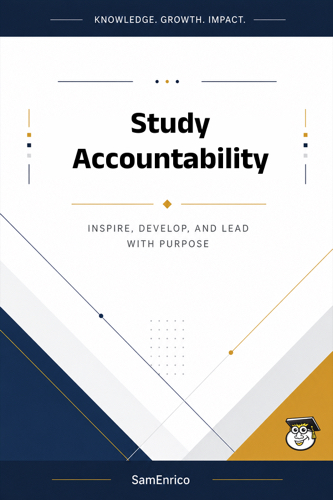
Study Accountability eBook
undefined
undefined
Formats
Free sample
Chapter 1: Beyond the Punishment...--For most students, the word “accountability” lands like a small stone dropped into still water. The ripples spread outward in predictable directions: deadlines, grades, late penalties, disappointed professors, awkward conversations with parents, the cold silence of a study partner who stopped texting back. If you asked a hundred college students to finish the sentence “Accountability is when someone…” nearly all of them would use words like “catches you,” “punishes you,” “checks up on you,” or “makes you pay the price.”This is not a small misunderstanding. It is a fundamental category error that ruins academic careers before they begin.The standard model of accountability—the one that operates in most classrooms, most families, and most student dorms—is a backward-looking trap. Something goes wrong.
A deadline passes. A paper remains unwritten. An exam score arrives like a verdict. Only then does accountability appear, wearing the face of consequences. Late penalties.
Grade reductions. Mandatory meetings. The cold arithmetic of points deducted.This model has a name, though almost no one calls it that. Philosopher C. Stephen Evans, in his groundbreaking work Living Accountably, identifies it as retroactive accountability.
It is accountability as aftermath. Accountability as punishment. Accountability as the thing that happens to you after you have already failed.And it is completely backward.What if accountability could show up before the missed deadline? What if it could function not as a stick to beat yourself with after stumbling, but as a lantern to light the path before you trip? What if the most accountable students in any classroom are not the ones who fear consequences the most, but the ones who have learned to own their learning process so thoroughly that consequences become almost irrelevant?This book exists to answer those questions.
But before we build any systems, before we audit any habits, before we recruit a single accountability partner, we have to perform an operation that is both simple and brutally difficult. We have to cut the word “accountability” loose from its moorings in fear, punishment, and shame. We have to drag it into the light and see it for what it actually is: not a cage, but a key.The Myth of the Naturally Accountable Student Walk onto any college campus and ask students to describe their most academically successful peer. You will hear a predictable set of descriptors. Smart.
Disciplined. Organized. Maybe even “lucky” or “gifted.” What you almost never hear is the truth: that the top students are not necessarily the smartest, the most disciplined, or the most organized. They are the ones who have learned to hold themselves accountable before external pressure arrives.This distinction matters more than almost any other factor in academic success.A massive body of research on self-regulated learning—pioneered by educational psychologists like Barry Zimmerman and Paul Pintrich—has demonstrated that the single strongest predictor of academic achievement is not innate intelligence, not hours studied, not even the quality of instruction. It is the student’s ability to set goals, monitor progress, adapt strategies, and maintain commitment over time.
In other words: accountability directed at the future, not the past.But here is the problem that every student knows and almost no syllabus acknowledges. Accountability skills are almost never taught. Schools demand accountability. They reward it with grades and punish its absence with penalties. But they rarely provide any systematic instruction in how to become accountable.
It is as if a swimming coach threw students into the deep end, praised those who didn’t drown, and called the survivors “naturally talented swimmers.”The result is a generation of students who experience accountability only as trauma. They miss a deadline. They feel terrible. They promise to do better. They miss another deadline.
The cycle repeats. Each iteration reinforces the belief that accountability is something that happens to them when they fail, not something they can wield for themselves before failure occurs.This book is the antidote to that cycle.The Forward-Looking Revolution Let us return to the philosopher C. Stephen Evans, whose work provides the intellectual foundation for everything that follows. Evans draws a crucial distinction that most students—and, frankly, most professors—have never considered. He distinguishes between backward-looking accountability (accountability as answerability for past actions) and forward-looking accountability (accountability as responsibility for future outcomes).Backward-looking accountability asks: What did you do?
Did you meet the standard? If not, what penalty applies? This is the accountability of grade books, conduct codes, and disappointed sighs. It has its place. Societies cannot function without some mechanism for evaluating past performance.
But as a primary model of accountability, it is disastrous for learning.Why? Because backward-looking accountability arrives too late to change anything. By the time you receive your penalty, the learning opportunity has passed. The paper is already graded. The exam is already scored.
The semester is already over. You have learned that failure hurts, but you have not learned how to prevent failure from happening again.Forward-looking accountability asks a completely different set of questions: What do you intend to do? What systems will support that intention? Who needs to know about your plan? How will you track progress?
What will you do when you inevitably stumble?Notice the shift in time orientation. Forward-looking accountability lives entirely in the present and future. It does not deny the reality of past failures—those are valuable data—but it refuses to let them define the student’s identity or limit their possibilities. A backward-looking system says, “You failed the last exam, so you are a failure.” A forward-looking system says, “You failed the last exam. What did you learn about your study process?
What will you change for the next one?”The difference is not semantic. It is existential.External Compliance Versus Internal Commitment Every accountable act exists somewhere on a spectrum between two poles. At one end lies external compliance: doing the right thing because someone else demands it, because penalties loom, because you are being watched. At the other end lies internal commitment: doing the right thing because you have chosen to, because it aligns with your values, because you respect your future self too much to let yourself down.Here is what the research on motivation—particularly the work of Edward Deci and Richard Ryan on Self-Determination Theory—reveals with remarkable consistency. External compliance produces behavior, but it rarely produces lasting change.
The moment the external pressure disappears, the behavior disappears with it. A student who studies only to avoid a professor’s disapproval will stop studying the moment the semester ends. A student who completes assignments only to escape late penalties will complete nothing in a course without strict deadlines.Internal commitment, by contrast, generates durable, self-sustaining behavior. When you study because you have committed to becoming a competent professional in your field, you do not need a professor hovering over your shoulder. When you complete assignments because you respect your own word, you do not need a syllabus threatening point deductions.The entire arc of this book is designed to move you from external compliance toward internal commitment.
Not because external structures are worthless—they are essential scaffolds for beginners—but because they are means, not ends. The goal is…
This is the end of the free sample. Get the eBook to keep going. Buy now
About this book
Details
- Author
- Beckett Cristopher
- Publisher
- SamEnrico
- Language
- English
- Genre
- Non-Fiction, Self-Help
- Released
- 2026-06-07
- Pages (approx.)
- 133
- Available as
- eBook, Audiobook

Read better in the ZLOADR app
Your eBooks on your phone or tablet. Sign in with your SamEnrico account and start reading.
More by Beckett Cristopher
 Stress and Resentment CleanseBeckett Cristopher$11.99
 Gratitude Breath MeditationBeckett Cristopher$11.99
 The Conflict ApproachBeckett Cristopher$11.99
 Listening In Agile TeamsBeckett Cristopher$11.99
 Monitoring Mental Health AccessBeckett Cristopher$11.99
 Gratitude for Parents GuideBeckett Cristopher$11.99
 The Melody of the MandolinBeckett Cristopher$11.99
 Billie Jean King BattleBeckett Cristopher$11.99
 The Lost Victory of Melos: What If Athens Had Won the Peloponnesian War?Beckett Cristopher$11.99
 The Iron Crown and the Imperial Dream: Maximilian I and the Birth of Habsburg PowerBeckett Cristopher$11.99
 Zero-Day Protocol: The Stuxnet SabotageBeckett Cristopher$11.99
 The Mineral Guide to LevyneBeckett Cristopher$11.99
You may also like
 Hong Kong Handover 1997Dunn Johnnie$11.99
 Zumba For Postnatal Recovery CourseNeal Christian$11.99
 Zumba for BeginnersLadner Nikia$11.99
 YouTube Comment Mining GuideHumes Pandora$12.99
 Worry Box MeditationCarlin Rudy$11.99
 Workplace Stress MeditationNguyen Lynn$11.99
 Workplace Stress and Sleep RepairHawley Ivory$11.99
 Workplace Perfectionism CureDelaney Jeffry$11.99
 Workplace Injustice Anger GuideWallen Isabelle$11.99
 Work Addiction and Burnout LinkGreenwood Ester$11.99
 Women in Yoga and WellnessBeattie Galina$11.99
 Women in Stand Up ComedyChun Evangeline$11.99