
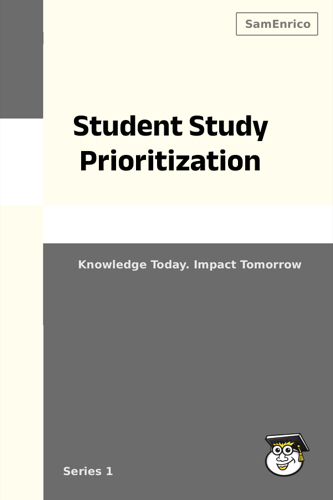
Student Study Prioritization
Rank assignments and exam prep using ABCDE to impr
by Swenson Miss
Rank assignments and exam prep using ABCDE to improve grades without burnout.
Formats
About this book
Free sample
Chapter 1: The Leverage Lie--Most students believe that grades are a direct reward for hours worked. Show up, put in the time, suffer appropriately, and the transcript will reflect your sacrifice. This is the single most destructive myth in education. It convinces hardworking students to grind themselves into exhaustion while watching peers who study half as much earn better grades. The difference is not intelligence.
The difference is leverage.Welcome to the first chapter of Student Study Prioritization. Before we discuss the ABCDE method, before we talk about time blocking or active recall, we must first diagnose the disease that brings most students to this book: the belief that trying harder is the same as trying smarter.The Infinite Effort Fallacy Imagine two students preparing for the same organic chemistry final. Student A studies for ten hours straight on the day before the exam. She drinks three energy drinks, rereads her textbook chapters twice, rewrites her notes in neat colors, and falls asleep at 3:00 AM feeling exhausted but virtuous. Student B studies for six hours spread across three days, sleeps eight hours each night, spends most of her study time testing herself with flashcards, and goes to bed at 10:00 PM the night before the exam.
Who performs better?If you answered Student B, you are correct. But here is the question that stumps most students: why? Both students worked. Both wanted to succeed. Both put in significant effort.
The difference is not motivation or intelligence. The difference is cognitive science.The Infinite Effort Fallacy is the assumption that academic output scales linearly with time invested. If two hours produces a C, then four hours should produce a B, and eight hours should produce an A. This makes intuitive sense in physical labor—digging a ditch for eight hours moves twice as much dirt as digging for four hours. But studying is not digging.
The brain has physiological limits, and once you exceed them, additional hours do not just fail to help—they actively harm your performance.Cognitive Load Theory: Your Brain Is Not a Muscle Cognitive Load Theory, developed by educational psychologist John…
This is the end of the free sample. Get the eBook to keep going. Buy now
Contents
- Chapter 1
- Chapter 2
- Chapter 3
- Chapter 4
- Chapter 5
- Chapter 6
- Chapter 7
- Chapter 8
- Chapter 9
- Chapter 10
- Chapter 11
- Chapter 12
Details
- Author
- Swenson Miss
- Publisher
- SamEnrico
- Language
- English
- Genre
- Non-Fiction, Self-Help, Study Skills
- Released
- 2026-06-09
- Pages (approx.)
- 151
- Available as
- eBook, Audiobook

Read better in the ZLOADR app
Your eBooks on your phone or tablet. Sign in with your SamEnrico account and start reading.
More by Swenson Miss
 Parental Anger Time Out GuideSwenson Miss$11.99
 Carb Cycling Tracking GuideSwenson Miss$11.99
 Addiction and Attachment PrimerSwenson Miss$11.99
 Franchising Your Local Brand Across Borders Joint VenturesSwenson Miss$11.99
 Summit of Shadows: The Untold Story of Arlene Blum and the First All-Women's Ascent of AnnapurnaSwenson Miss$11.99
 Empress of the Purple: Theodora’s Rise from the ShadowsSwenson Miss$11.99
 Understanding D Ercole SyndromeSwenson Miss$17.99
 How to Start a Hobby in Making PaperSwenson Miss$11.99
 Green Tariff Energy GuideSwenson Miss$12.99
 Testing Plan One PageSwenson Miss$12.99
 Cyber Security ConsultantSwenson Miss$11.99
You may also like
 Spaced Repetition ScienceStratton Jed$11.99
 Anki For SAT StudyForbes Dusty$11.99
 Study Then Sleep ProtocolMarch Tisa$11.99
 Procrastination Overcoming WorkbookDowns Gianna$11.99
 Flow State for StudentsEutsey Anjelica$11.99
 Flow in Learning StudyingGaskin Easter$11.99
 Flow for Students GuideGamble Breanna$11.99
 Anki For PhysicsPinkerton Kerstin$11.99
 Anki For MCAT PrepBoynton Remedios$11.99
 Anki For Language LearningManess Ka$11.99
 Anki For AviationBurnside Prince$11.99
 Active Recall Study GuideWooden Luciana$11.99