
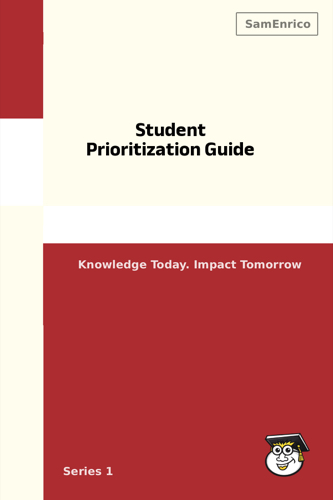
Student Prioritization Guide eBook
Teaches applying ABCDE to assignments, exams, and
Teaches applying ABCDE to assignments, exams, and extracurriculars.
Formats
Free sample
Chapter 1: The A+ Illusion--–- It is Sunday night, 11:47 PM. The dorm hallway is quiet except for the muffled sound of someone crying two doors down—probably the freshman who just realized her midterm is tomorrow and she has not opened the textbook since the first week. You are sitting at your desk, or maybe on your bed with a laptop balanced on a pillow, and your heart is doing that uncomfortable thing where it races and sinks at the same time. On your screen, three tabs are open: a half-finished calculus problem set due at 8 AM, a blank document where your English essay is supposed to live, and a group chat where your project teammates are frantically messaging about a meeting you forgot was happening in nine hours. Your phone buzzes.
You ignore it. It buzzes again. You pick it up “just to check” and forty-seven minutes later you have watched a video of a raccoon opening a refrigerator, read four tweets about a celebrity drama you do not care about, and liked someone’s vacation photos from a trip you did not know they took. You close your phone, look at the clock, and feel a wave of nausea. You have accomplished nothing.
You are exhausted. You hate yourself a little bit.This is not a moral failure. This is not a sign that you are lazy, stupid, or broken. This is a sign that you have been lied to—not maliciously, but systematically—by every study tip, productivity hack, and “work harder” speech you have ever received. The lie is simple and seductive: If you just try harder, work longer, and care more, you will succeed.
The lie feels true because effort is visible. When you pull an all-nighter, you have something to show for your suffering: bloodshot eyes, a full coffee mug graveyard, and the moral satisfaction of having suffered. But visible effort is not the same as effective effort. You can run on a treadmill for three hours and end up exactly where you started. You can highlight a textbook until every page is neon yellow and remember nothing.
You can rewrite your notes three times and still bomb the exam because rewriting is not learning—it is calligraphy with extra steps.The students who get A’s are not the ones who grind the longest. They are not the ones who sacrifice sleep, friends, and sanity on the altar of “hard work.” The students who get A’s are the ones who understand a concept that most schools never teach and most parents never learned: leverage. Leverage is the art of getting maximum results from minimum effort by doing the right things instead of doing all things. A lever allows you to move a boulder with one finger. The ABCDE method, which you will learn in this book, is your lever.
It will not make you work harder. It will make you work smarter, faster, and with less guilt. By the time you finish this chapter, you will understand why “hard work alone” is a trap, and you will have the first tool you need to escape it.The Most Expensive Mistake Students Make Let us define the enemy. The enemy is not your professor, your textbook, your ADHD, your roommate who plays video games loudly, or your own supposed laziness. The enemy is a specific cognitive error that almost every student makes almost every day: mistaking activity for progress.Activity is easy to see.
Progress is not. When you spend two hours re-reading a chapter, you have been active. Your eyes moved across the page. Your hand turned the pages. Maybe you even nodded along as if you understood.
But research in cognitive psychology, summarized brilliantly by Jeffrey Karpicke and Henry Roediger, shows that re-reading is one of the least effective study methods in existence. Students who re-read a passage four times remember less than students who read it once and then tested themselves. Re-reading feels productive because it is familiar and easy. Your brain confuses fluency (“I recognize these words”) with mastery (“I understand these concepts”). This is called the fluency illusion, and it is the reason you can walk out of a three-hour study session feeling exhausted and confident and then fail the exam.Now consider a different student.
She spends 45 minutes on active recall: closing the book, writing down everything she remembers about a topic, checking her answers, and repeating the process on the gaps. That 45 minutes feels harder. It is uncomfortable. She has to confront what she does not know, which is embarrassing. But she will remember the material for weeks, not hours.
She got more progress in 45 minutes than you got in three hours. She was not working harder. She was working with leverage.The Pareto Principle, also known as the 80/20 rule, is the mathematical expression of this reality. Named after Italian economist Vilfredo Pareto, who noticed that 80% of the land in Italy was owned by 20% of the population, the principle has been observed in countless domains: 80% of sales come from 20% of customers, 80% of problems come from 20% of bugs, and crucially for you, 80% of your grades come from 20% of your study habits. The question is not whether you are working hard.
The question is whether you are working on the right 20%.The Audit That Will Change Everything Before you can prioritize, you need to know what you are actually doing. Most students have no idea. They have a vague sense that they “studied a lot” or “didn’t study enough,” but they cannot tell you what they did for how long or with what effect. This chapter includes a simple one-week audit. You do not need to change anything yet.
You just need to observe.For the next seven days, carry a small notebook or use a notes app on your phone. Every time you sit down to study, write down the start time. Then, for each activity, write down two things: (1) what you did, and (2) whether it was active or passive.Active study methods include:Testing yourself from memory (flashcards, closed-book quizzes, practice problems)Teaching the material to someone else (or pretending to)Summarizing a concept in your own words without looking at the text Doing practice exams under timed conditions Solving problems from scratch Creating concept maps from memory Passive study methods include:Re-reading chapters or notes Highlighting or underlining Rewriting notes (unless you are rewriting from memory as a test)Watching video lectures or review videos Listening to podcasts or recorded lectures Copying solutions from a solution manual Organizing notes, color-coding, or making pretty study guides At the end of each study session, write down the total minutes spent on active methods and the total minutes spent on passive methods. At the end of the week, add them up.I have run this audit with hundreds of students, and the results are always the same: between 70 and 85 percent of study time is passive. Students are spending seven or eight hours a week on activities that produce almost no learning.
If you are one of these students—and statistically, you are—then you are not failing because you are lazy. You are failing because you have been taught…
This is the end of the free sample. Get the eBook to keep going. Buy now
About this book
Details
- Author
- Marlow Leonila
- Publisher
- SamEnrico
- Language
- English
- Genre
- Non-Fiction, Self-Help, Education
- Released
- 2026-06-07
- Pages (approx.)
- 151
- Available as
- eBook, Audiobook

Read better in the ZLOADR app
Your eBooks on your phone or tablet. Sign in with your SamEnrico account and start reading.
More by Marlow Leonila
 Presentation Anxiety Protocol GuideMarlow Leonila$11.99
 The Emotion Regulation HandbookMarlow Leonila$11.99
 Rupert Murdoch Power PlaybookMarlow Leonila$11.99
 Toddler Induced Parental Rage CureMarlow Leonila$11.99
 The Phantom of the Andes: The Forgotten Polar Survival of Dr. Alberto María de AgostiniMarlow Leonila$11.99
 The Last Broadcast of KHJ RadioMarlow Leonila$11.99
 Understanding Blepharo Facio Skeletal SyndromeMarlow Leonila$17.99
 Stained Glass ArtistMarlow Leonila$11.99
 Jumia Pay Setup And BenefitsMarlow Leonila$12.99
 Bootcamp Completion Rate GuideMarlow Leonila$12.99
 How to Start a Powder Puff Business (Beginners Guide)Marlow Leonila$11.99
You may also like
 Hong Kong Handover 1997Dunn Johnnie$11.99
 Zumba For Postnatal Recovery CourseNeal Christian$11.99
 Zumba for BeginnersLadner Nikia$11.99
 YouTube Comment Mining GuideHumes Pandora$12.99
 Worry Box MeditationCarlin Rudy$11.99
 Workplace Stress MeditationNguyen Lynn$11.99
 Workplace Stress and Sleep RepairHawley Ivory$11.99
 Workplace Perfectionism CureDelaney Jeffry$11.99
 Workplace Injustice Anger GuideWallen Isabelle$11.99
 Work Addiction and Burnout LinkGreenwood Ester$11.99
 Women in Yoga and WellnessBeattie Galina$11.99
 Women in Stand Up ComedyChun Evangeline$11.99