
Non-FictionForecast & OutlookStudent Talent
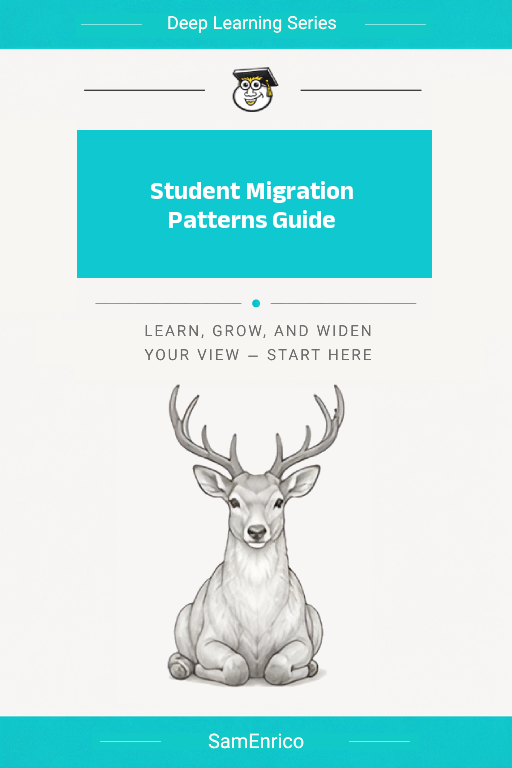
Student Migration Patterns Guide eBook
Discover international student flows to US, UK, Ca
Discover international student flows to US, UK, Canada, Australia, and Germany and post-study work rights.
Formats
Free sample
Chapter 1: The $100 Million Gamble–- Imagine you are sitting in a crowded student lounge in Mumbai, Lagos, or Manila. You have just been accepted to a university abroad. Your parents are crying tears of pride. Your friends are posting congratulations on social media. You have taken out loans that would have bought a house a generation ago.
You believe you are about to get a degree that will change your life.Now imagine that within two years of landing in your dream country, you are forced to leave. No permanent residency. No citizenship. No path to stay. You return home with a prestigious degree, a mountain of debt, and nothing to show for it except memories of a country that never really wanted you to stay.This scenario is not a nightmare.
It is the reality for the majority of international students today. According to data from the Organisation for Economic Co-operation and Development (OECD), fewer than 30 percent of international students who begin a degree in the United States, United Kingdom, or Australia secure permanent residency within a decade of graduation. In the United States, the number is closer to 15 percent for non-STEM graduates. That means eight out of every ten students who board a plane with dreams of a new life will board another plane back home within a few years.Yet every year, more than five million students make the journey. They pour over $40 billion annually into the US economy alone.
They fund university expansions, sustain small businesses near campus, and fuel a global industry of consultants, test prep centers, and visa services. And most of them do so without ever understanding the single most important truth about student migration.Here it is: your university ranking matters far less than your destination country’s immigration policy. The prestige of your degree is irrelevant if no legal pathway exists for you to stay. And the difference between permanent residency and forced departure is not your grades, your ambition, or your parents’ sacrifices. It is a set of bureaucratic rules that you can learn, anticipate, and exploit.This book exists because those rules are not secret—they are just hidden in plain sight.
They are buried in government websites written in dense legal language. They change every year, often without notice. And the people who benefit most from your tuition dollars—universities, agents, and even some governments—have every incentive to keep you in the dark.The New Golden Age of Mobility We are living through the largest wave of international student migration in human history. The number of students studying outside their home country has more than doubled since 2010, from approximately 2 million to over 5 million in 2025. This growth is not accidental.
It is driven by three powerful forces that show no sign of slowing.First, the rise of middle classes in emerging economies. China, India, Nigeria, Vietnam, and the Philippines have produced hundreds of millions of families with enough disposable income to consider foreign education. In India alone, the number of students taking the IELTS exam tripled between 2015 and 2025. These families are not sending their children abroad for luxury. They are making a calculated bet that a foreign degree will translate into higher lifetime earnings.Second, the stagnation of domestic higher education.
In many sending countries, university systems have failed to keep pace with demand. India has approximately 1,000 universities for a population of 1.4 billion. China has improved rapidly but still cannot accommodate all qualified applicants for its top-tier institutions. South Korea and Japan have aging populations and shrinking domestic student pools, pushing universities to recruit internationally. The result is a global supply-demand mismatch that fuels cross-border flows.Third, the transformation of education into an export industry.
Western nations have discovered that international students are exceptionally profitable. Unlike domestic students, who often receive subsidized tuition, international students pay full freight. A master’s degree in computer science at a US public university might cost a domestic student 15,000peryearandaninternationalstudent15,000 per year and an international student 15,000peryearandaninternationalstudent45,000. Multiply that by hundreds of thousands of students, and you have a multi-billion-dollar export industry that governments are reluctant to regulate too heavily.But here is the tension that defines this entire book: governments want the money, but they do not necessarily want the people. Every country in our five-nation study has a split personality when it comes to international students.
The visa office wants to approve students because they generate revenue. The immigration enforcement office wants to deport them because they represent competition for local workers. The education ministry wants to recruit them because they fill seats. The labor ministry wants to restrict them because unions demand protection for domestic workers.This schizophrenia creates opportunities for students who understand the system. It also creates traps for those who do not.From Brain Drain to Brain Circulation Twenty years ago, the dominant framework for understanding student migration was “brain drain.” The idea was simple: talented young people leave poor countries, move to rich countries, and never return.
The sending country loses its future leaders, doctors, and engineers. The receiving country gains skilled labor without paying for their education. Everyone understood this as a zero-sum game.That framework is now obsolete. The reality is more complex and, for some students, more promising.Today’s international students are more likely to engage in “brain circulation” than permanent brain drain. They move back and forth between countries.
They build careers that span continents. They maintain homes, bank accounts, and professional networks in multiple jurisdictions. A software engineer born in Bangalore, educated in Berlin, and working remotely for a San Francisco company is not draining any single country. She is circulating among all three.This shift has profound implications for how you should plan your migration strategy. If you assume that you will stay permanently in your destination country, you will make different choices than if you assume a five-year stay followed by a return home.
The same is true for assumptions about working remotely, starting a business, or retiring across borders.The data supports this flexibility. A 2024 study by the World Education Services found that among Indian students who graduated from US universities between 2015 and 2020, 42 percent had returned to India within five years, 38 percent remained in the US, and 20 percent had moved to a third country (most commonly Canada or Germany). The old binary of stay-or-go has been replaced by a spectrum of transnational lives.The Education-Migration Nexus This book introduces and relies upon a single organizing concept: the Education-Migration Nexus. The term sounds academic, but the idea is simple. For most of history, studying abroad and immigrating abroad were separate activities.
You studied at Oxford or the Sorbonne because you wanted an education. If you later immigrated, that was a separate decision based on jobs, family, or politics.Today, those two activities are fused. For millions of students, the primary purpose of studying abroad is not education. It is immigration. The degree is a means to an end—the end being a work permit, then permanent residency, then citizenship.
This is not a secret, though universities rarely advertise it. Walk into any student visa office in Mumbai or Nairobi, and you will hear applicants discussing pathways to…
This is the end of the free sample. Get the eBook to keep going. Buy now
About this book
Details
- Author
- Holcomb Kristofer
- Publisher
- SamEnrico
- Language
- English
- Genre
- Non-Fiction, Forecast & Outlook, Student Talent
- Released
- 2026-06-01
- Pages (approx.)
- 137
- Available as
- eBook, Audiobook

Read better in the ZLOADR app
Your eBooks on your phone or tablet. Sign in with your SamEnrico account and start reading.
More by Holcomb Kristofer
 Mindfulness for Daily StressHolcomb Kristofer$11.99
 Workplace Stress and Sleep GuideHolcomb Kristofer$11.99
 Vocal Tone Persuasion MethodHolcomb Kristofer$11.99
 Cousteau's Antarctic Ice DiveHolcomb Kristofer$11.99
 Restless Leg Syndrome Exercise PrescriptionHolcomb Kristofer$11.99
 Raven’s Gambit: Loki’s Double Agent in AsgardHolcomb Kristofer$11.99
 Understanding Kearns–sayre SyndromeHolcomb Kristofer$17.99
 How to Become a Lace-roller OperatorHolcomb Kristofer$11.99
 SAP AdministratorHolcomb Kristofer$11.99
 Expat Friendship Rebuilding ManualHolcomb Kristofer$12.99
You may also like
 Hong Kong Handover 1997Dunn Johnnie$11.99
 Zumba For Postnatal Recovery CourseNeal Christian$11.99
 Zumba for BeginnersLadner Nikia$11.99
 YouTube Comment Mining GuideHumes Pandora$12.99
 Worry Box MeditationCarlin Rudy$11.99
 Workplace Stress MeditationNguyen Lynn$11.99
 Workplace Stress and Sleep RepairHawley Ivory$11.99
 Workplace Perfectionism CureDelaney Jeffry$11.99
 Workplace Injustice Anger GuideWallen Isabelle$11.99
 Work Addiction and Burnout LinkGreenwood Ester$11.99
 Women in Yoga and WellnessBeattie Galina$11.99
 Women in Stand Up ComedyChun Evangeline$11.99