
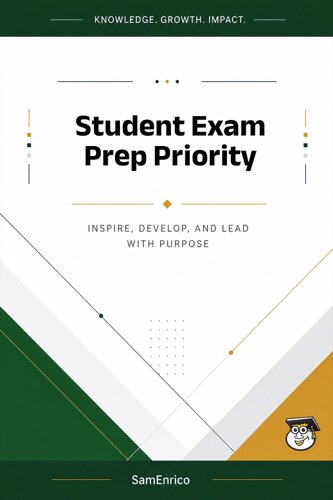
Non-FictionSelf-HelpExamsStudy
Student Exam Prep Priority eBook
Use ABCDE to rank study topics and practice questi
by Ward Kelly
Use ABCDE to rank study topics and practice questions before tests.
Formats
Free sample
Chapter 1: The 80/20 Lie--–- It was 2:47 AM, and Sarah had been staring at the same paragraph for forty-three minutes.Not reading it. Staring. Her eyes moved across the words—"The mitochondria are membrane-bound organelles found in the cytoplasm of eukaryotic cells"—but her brain had checked out somewhere around hour eleven of her study session. Around her, the library’s fluorescent lights hummed that special frequency designed to make exhausted students feel slightly nauseous. She had six highlighters spread across the table, three textbooks stacked like a fort, and a practice exam that she was too afraid to take because she already knew she’d fail it.She had been studying for this biology final for three weeks.
Three weeks of 6 PM to midnight sessions. Three weeks of flashcard apps, re-reading chapters, and watching You Tube videos at 1.75x speed. Three weeks of telling her friends “I can’t hang out, I have to study.”And she still felt completely, utterly unprepared.Sarah’s story is not unique. In fact, it’s so common that it’s practically a college cliché. The student who studies endlessly but can’t seem to break past a B-minus.
The student who sacrifices sleep, social life, and sanity—only to walk out of the exam room thinking, “That didn’t look anything like what I studied.”If you’ve ever felt that way, this book is for you.But here’s the thing about Sarah that might surprise you. When she finally got her grade back a week later, she had scored a 74%. C+. Not failing. But not good.
And certainly not worth the sixty-plus hours she had poured into preparing.She had worked hard. She had “put in the time.” And she had almost nothing to show for it.This is the great lie that schools, parents, and society have sold us: that studying harder is the same as studying smarter. That more hours equal better results. That if you just keep reading, keep highlighting, keep re-reading your notes, eventually it will all click into place.It won’t.In fact, research from cognitive psychology—specifically the work of Henry Roediger and Mark Mc Daniel, authors of Make It Stick—shows that many of the habits students believe are effective (re-reading, highlighting, cramming) are among the least effective ways to learn. They create what psychologists call “illusions of competence”: you feel like you know the material because it looks familiar, but when the exam asks you to retrieve that information from scratch, you come up empty.So what actually happened to Sarah?
She fell victim to what this book calls the Equal Effort Fallacy—the mistaken belief that all topics deserve the same amount of study time. She spent Monday night on Chapter 1 (cell structure), Tuesday night on Chapter 2 (metabolism), Wednesday night on Chapter 3 (genetics), and so on, right down the syllabus. Every chapter got three hours. Every topic got the same treatment.But on the actual exam, 80% of the questions came from just three chapters. Chapters she had studied, yes—but no more deeply than the five chapters that never appeared at all.She had wasted sixty hours on low‑yield material while giving the same sixty hours to high‑yield material.
It was like watering an entire lawn when only one patch was dying.The Cognitive Overload Trap Let’s talk about what happens inside your brain when you try to study everything equally.The human brain is not a hard drive. You cannot simply write information to it and expect it to stay there. Memory is not storage; memory is construction. Every time you learn something new, your brain physically rewires itself—strengthening some connections, weakening others, and constantly deciding what to keep and what to discard.But here’s the problem: your brain has limits.Cognitive psychologists call this cognitive load—the total amount of mental effort being used in your working memory at any given time. Think of working memory as a small desk.
You can only put a few pieces of paper on that desk at once. When you try to pile on too much—multiple topics, unrelated facts, different problem types—the desk becomes cluttered. Things fall off. You forget what you just read three minutes ago.The average person’s working memory can hold approximately four to seven discrete pieces of information at once. That’s it.
When you sit down to study for an exam that covers forty chapters, you are literally incapable of keeping all that information active in your mind simultaneously.So what do students do? They try anyway. They re-read the same chapter three times, hoping that repetition will force the information through a bottleneck that simply cannot accommodate it. They highlight almost every sentence on the page because everything seems important. They make flashcards for every single term, creating a pile of five hundred cards that they will never review comprehensively.This is not a moral failing.
It is a biological constraint. You cannot exceed the limits of human cognition any more than you can hold your breath for forty minutes.But the Equal Effort Fallacy makes this constraint much worse. When you treat every topic the same, you force your brain to carry equal weight for low‑value information—cluttering your working memory with facts that might not even appear on the exam. This is like packing for a weekend trip by bringing everything in your closet: sure, you won’t forget anything, but you’ll also be so weighed down that you can’t move efficiently.The students who perform best on exams are not the ones with the biggest brains or the highest IQs. They are the ones who are most strategic about what they put into that limited working memory.
They don’t try to remember everything. They try to remember the right things.The Research: Why “Studying Everything” Backfires Let’s get specific about the science. Because this isn’t just opinion—this is decades of peer‑reviewed research.In a landmark study published in Psychological Science in the Public Interest, researchers John Dunlosky and his colleagues evaluated ten common learning techniques. They ranked them by effectiveness based on rigorous criteria: whether the technique improved performance on real exams (not just self‑reported “feeling of knowing”), whether it worked across different subjects and age groups, and whether it had been replicated in multiple studies.The results were startling.The most popular study methods—re‑reading, highlighting, and summarizing—were rated low utility. They produce shallow learning and rapid forgetting.
Students who re‑read a chapter four times remember barely more than students who read it once. Highlighting is so ineffective that some studies have found it actually impairs later recall because the brain focuses on the act of highlighting rather than the meaning of the text.The most effective techniques—practice testing and distributed practice—were rated high utility. But here’s the key: those techniques only work when applied strategically. If you practice test yourself on low‑yield material, you’ve just wasted that practice. If you space out your study sessions for a topic that never appears on the exam, you’ve just spaced out irrelevance.The implication is clear: prioritization must…
This is the end of the free sample. Get the eBook to keep going. Buy now
About this book
Details
- Author
- Ward Kelly
- Publisher
- SamEnrico
- Language
- English
- Genre
- Non-Fiction, Self-Help, Exams, Study
- Released
- 2026-06-08
- Pages (approx.)
- 142
- Available as
- eBook, Audiobook

Read better in the ZLOADR app
Your eBooks on your phone or tablet. Sign in with your SamEnrico account and start reading.
More by Ward Kelly
 Norwood Scale Hair Loss ChartWard Kelly$11.99
 Authentic Networking ApproachWard Kelly$11.99
 Call of Duty Dopamine LoopWard Kelly$11.99
 DoorDash Dasher Rating RecoveryWard Kelly$11.99
 Quetzalcoatl's Fall: The Feathered Serpent's ExileWard Kelly$11.99
 Augmented Reality Design GuideWard Kelly$12.99
 Asana Advanced Features GuideWard Kelly$12.99
 Ultimate Handbook Guide to Yaren (de facto) : (Nauru) Travel GuideWard Kelly$11.99
 Renovation LabourerWard Kelly$11.99
 Understanding Mendelian Susceptibility to Atypical MycobacteriaWard Kelly$17.99
You may also like
 Hong Kong Handover 1997Dunn Johnnie$11.99
 Zumba For Postnatal Recovery CourseNeal Christian$11.99
 Zumba for BeginnersLadner Nikia$11.99
 YouTube Comment Mining GuideHumes Pandora$12.99
 Worry Box MeditationCarlin Rudy$11.99
 Workplace Stress MeditationNguyen Lynn$11.99
 Workplace Stress and Sleep RepairHawley Ivory$11.99
 Workplace Perfectionism CureDelaney Jeffry$11.99
 Workplace Injustice Anger GuideWallen Isabelle$11.99
 Work Addiction and Burnout LinkGreenwood Ester$11.99
 Women in Yoga and WellnessBeattie Galina$11.99
 Women in Stand Up ComedyChun Evangeline$11.99