
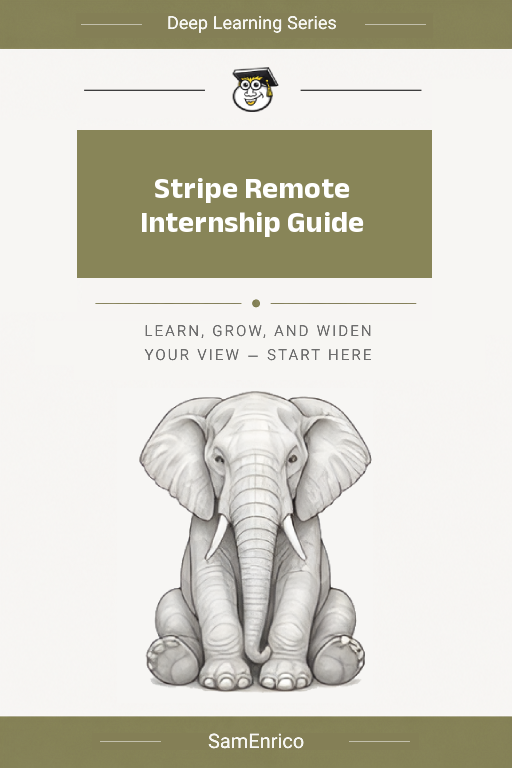
Non-FictionStudent's ShortcutPayments
Stripe Remote Internship Guide eBook
Land virtual internships at Stripe in payment proc
by Burger Zana
Land virtual internships at Stripe in payment processing, engineering, or business development.
Formats
Free sample
Chapter 1: The GDP Obsession–- In the summer of 2014, a twenty-two-year-old computer science student named Michael had just finished his third round of interviews with Google. He’d solved every algorithmic puzzle. He’d explained Big O notation until his throat was sore. He’d smiled through four back-to-back video calls. A week later, the rejection email arrived: “Strong candidate, but we’ve decided to move forward with other applicants.”Michael was devastated.
He’d done everything right—or so he thought. His GPA was 3.9. He’d completed two internships at respectable companies. He had a portfolio full of clever side projects. Yet somehow, he wasn’t good enough for the Googleplex.Six months later, a friend mentioned a different company.
“Have you looked at Stripe?” she asked. “They do payments. Their interns actually ship code to production. And they don’t care nearly as much about whether you can invert a binary tree as whether you can figure out why a webhook failed at 2 AM.”Michael had never heard of Stripe. He visited their careers page and found something unusual: job descriptions that mentioned “comfortable with ambiguity,” “increasing the GDP of the internet,” and a peculiar phrase: “We hire builders, not bricklayers.”He applied on a whim, expecting nothing.
Two months later, he was sitting in Stripe’s San Francisco office (before the remote-first era), staring at a laptop with production API keys on his first day. By the end of his internship, he’d written a service that prevented duplicate charges on failed payment retries—a problem that had cost Stripe’s merchants millions. He received a return offer with a signing bonus that dwarfed his entire previous year’s tuition.Michael’s story isn’t an anomaly. It’s the pattern. Stripe doesn’t hire interns the way Google or Meta does.
They’re not looking for leetcode grinders or students who’ve memorized every design pattern from the Gang of Four book. They’re looking for something far more specific: people who can take ownership of a real customer problem and solve it in a messy, ambiguous, production environment—often without a manager holding their hand.This chapter is about unlearning everything you think you know about tech internships. It’s about understanding Stripe’s unique philosophy, its founding mission, and the specific mindset that separates candidates who get offers from those who don’t. And most importantly, it’s about deciding whether you’re the kind of person Stripe actually wants—before you spend forty hours preparing for interviews you were never going to pass.The Collison Brothers’ Bet Stripe was founded in 2010 by Irish brothers Patrick and John Collison. They were nineteen and twenty-one respectively, and they’d already sold their first company (a programming language management tool called Auctomatic) for $5 million.
They could have done anything. They chose to build a company that would solve what they saw as the single biggest barrier to internet entrepreneurship: payments.Before Stripe, accepting money online was a nightmare. You needed a merchant account, a payment gateway, a PCI compliance certification, and weeks of integration work with clunky, poorly documented APIs. Pay Pal existed, but it was designed for e Bay sellers, not software developers. The Collisons believed that if you could make payments as simple as a few lines of code, you wouldn’t just help existing businesses—you’d create entirely new ones.That belief became Stripe’s mission statement, and it’s still printed on their internal strategy documents today: “Increase the GDP of the internet.”Let that sink in for a moment.
Stripe does not see itself as a payments company. They don’t see themselves as a fintech company. They see themselves as an infrastructure company whose success is measured not by their own revenue, but by how much economic activity they unlock for others. When a Stripe-powered startup in Nigeria sells a Saa S subscription to a customer in Japan, that’s GDP growth. When a freelancer in Indonesia gets paid through Stripe Connect, that’s GDP growth.
When a nonprofit in Kenya receives a donation via Stripe, that’s GDP growth—even if Stripe charges zero fees.This mission isn’t marketing fluff. It’s the filter through which every decision at Stripe is made. Product launches are evaluated not by “will this make us money?” but by “will this increase the GDP of the internet?” Intern projects are selected not by “what’s easy to scope for a summer?” but by “what urgent customer problem is currently blocking economic activity?”Understanding this mission is not optional. It is the single most important factor in whether you get hired. Stripe’s recruiters and hiring managers are trained to ask one question throughout the interview process: “Does this candidate genuinely care about solving other people’s problems, or do they just want a job at a prestigious tech company?”The candidates who get offers are the ones who can answer that question with evidence, not claims.The Intern as Owner, Not Trainee Here’s where Stripe diverges most dramatically from other large tech companies.
At Google, Facebook, Amazon, and Microsoft, internships are often structured as extended interviews. You’re given a pre-scoped project—usually a feature that’s nice to have but not critical. You have a manager who checks your progress weekly. Your code is reviewed carefully, and changes are often rolled out slowly, behind feature flags that won’t see production traffic for months.At Stripe, the opposite is true.Every intern at Stripe is assigned a dedicated manager, yes. But that manager’s role is not to tell you what to do.
It’s to help you figure out what to do, then get out of your way. The expectation is that by Week 2, you will have identified a customer problem, proposed a solution, and opened a pull request that touches production code.Let me repeat that: production code. Not a staging environment. Not a sandbox. Real code that could, in theory, affect real merchants and real money.This sounds terrifying.
And it is. But it’s also the reason Stripe interns learn more in twelve weeks than most new graduates learn in their first two years at other companies. You’re not being thrown to the wolves—there are safeguards. Every code change requires approval from at least one senior engineer. Every payment operation is idempotent (we’ll cover that in Chapter 3).
Every database migration is rehearsed in a shadow environment before it touches production.But the psychological shift is profound. You are not a trainee. You are not a “junior” anything. You are an owner. And owners are expected to act like it.One former Stripe intern, now a product manager at a fintech startup, described it this way: “At my previous internship, I spent three weeks writing unit tests for a feature I didn’t understand.
At Stripe, I spent three weeks designing, implementing, and shipping a retry queue that reduced failed payments by 8%. The difference was night and day. One treated me like a liability. The other treated me like an investment.”This philosophy extends to remote interns as well. In fact, Stripe’s remote…
This is the end of the free sample. Get the eBook to keep going. Buy now
About this book
Details
- Author
- Burger Zana
- Publisher
- SamEnrico
- Language
- English
- Genre
- Non-Fiction, Student's Shortcut, Payments
- Released
- 2026-05-30
- Pages (approx.)
- 148
- Available as
- eBook, Audiobook

Read better in the ZLOADR app
Your eBooks on your phone or tablet. Sign in with your SamEnrico account and start reading.
More by Burger Zana
 Oil and Gas Precedent AnalysisBurger Zana$11.99
 Alcohol Craving ManagementBurger Zana$11.99
 Mirroring Pace and LeadBurger Zana$11.99
 Ayurvedic Head MassageBurger Zana$11.99
 Mindful Restaurant Eating for Binge EatersBurger Zana$11.99
 The Homeless Shelter TargetBurger Zana$11.99
 Memory Reconstruction After TraumaBurger Zana$11.99
 St John's Wort SADBurger Zana$11.99
 The Silk and the Scoundrel: The Untold Love Story of Lady Hester Stanhope and Her Syrian AdventureBurger Zana$11.99
 Sabor a Ti: The Salsa Revolution on TelevisionBurger Zana$11.99
 How to Produce Horse HaltersBurger Zana$11.99
 Vegan Export Certification GuideBurger Zana$12.99
You may also like
 Hong Kong Handover 1997Dunn Johnnie$11.99
 Zumba For Postnatal Recovery CourseNeal Christian$11.99
 Zumba for BeginnersLadner Nikia$11.99
 YouTube Comment Mining GuideHumes Pandora$12.99
 Worry Box MeditationCarlin Rudy$11.99
 Workplace Stress MeditationNguyen Lynn$11.99
 Workplace Stress and Sleep RepairHawley Ivory$11.99
 Workplace Perfectionism CureDelaney Jeffry$11.99
 Workplace Injustice Anger GuideWallen Isabelle$11.99
 Work Addiction and Burnout LinkGreenwood Ester$11.99
 Women in Yoga and WellnessBeattie Galina$11.99
 Women in Stand Up ComedyChun Evangeline$11.99