
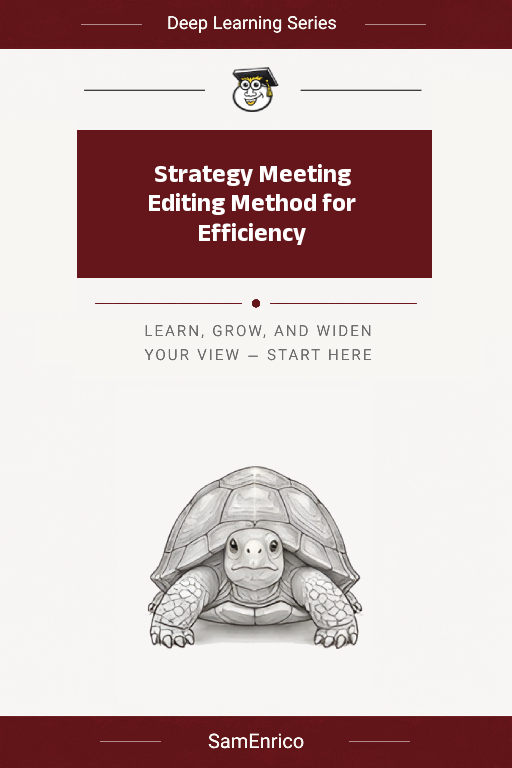
Non-FictionMeeting EfficiencyTime Optimization
Strategy Meeting Editing Method for Efficiency
Cut meeting time by forty percent without losing d
by Knight Lee
Cut meeting time by forty percent without losing decision quality. Apply the outcome-first agenda design, the pre-work consolidation technique, and the asynchronous deliberation protocol for non-urgent topics.
Formats
About this book
Free sample
Chapter 1: The $0.5 Trillion Hour--–- Sarah Chen had just been promoted to Vice President of Product at a mid-sized software company. She was thrilled. Then she looked at her calendar for the following week. Forty-seven hours of meetings. Forty-seven.
On a Monday morning, she called her mentor in tears. "I don't understand," she said. "I thought getting promoted meant I'd have more control over my time. Instead, I have back-to-back meetings from 8 AM to 6 PM every single day. When am I supposed to actually think?
When am I supposed to lead?" Her mentor, a seasoned executive who had survived three IPOs, laughed—not cruelly, but with recognition. "Welcome to the trap," she said. "The higher you climb, the more your job becomes sitting in rooms listening to other people talk. The secret is that most of those rooms don't need you in them. And most of those meetings don't need to happen at all."This chapter will change how you see every meeting invite you receive.
It will quantify the hidden cost of "meeting culture" in your organization. It will introduce the fundamental distinction between coordination and collaboration. It will define what decision quality actually means—because cutting meeting time is only valuable if you don't cut decision quality. And it will give you a single question to ask before every meeting you schedule or attend. By the end of this chapter, you will never look at a 60-minute calendar block the same way again.The Strange History of the 60-Minute Meeting Why are most meetings exactly one hour long?
The answer is not rooted in cognitive science, organizational psychology, or any research on how long humans can effectively deliberate. The answer is much dumber than that.In the early 1980s, when personal computers were still novelties, calendar software was a luxury. The first digital calendars—like the ones on early Macintosh computers and later Microsoft Outlook—had to make a choice about default meeting lengths. Engineers chose 30 minutes and 60 minutes because those were round numbers that fit neatly into the 8-hour workday. There was no research behind this decision.
No one studied whether 60 minutes was optimal for decision-making. No one asked whether 45 minutes might be better. The…
This is the end of the free sample. Get the eBook to keep going. Buy now
Contents
- Chapter 1
- Chapter 2
- Chapter 3
- Chapter 4
- Chapter 5
- Chapter 6
- Chapter 7
- Chapter 8
- Chapter 9
- Chapter 10
- Chapter 11
- Chapter 12
Details
- Author
- Knight Lee
- Publisher
- SamEnrico
- Language
- English
- Genre
- Non-Fiction, Meeting Efficiency, Time Optimization
- Released
- 2026-06-01
- Pages (approx.)
- 151
- Available as
- eBook, Audiobook

Read better in the ZLOADR app
Your eBooks on your phone or tablet. Sign in with your SamEnrico account and start reading.
More by Knight Lee
 Cali Cartel Phone NetworkKnight Lee$11.99
 Innovation Portfolio Management GuideKnight Lee$11.99
 Stress and Hair Loss HandbookKnight Lee$11.99
 Laundry Room Detox HandbookKnight Lee$11.99
 Antwerp Police InvestigationKnight Lee$11.99
 The Phantom of the Opera House: The Untold Story of the First Rock StarKnight Lee$11.99
 Icebreaker Pioneers: The Soviet Engineers Who Tamed the ArcticKnight Lee$11.99
 Ultimate Handbook Guide to Sakai : (Japan) Travel GuideKnight Lee$11.99
 Understanding Farber's DiseaseKnight Lee$17.99
 Sales Support SupervisorKnight Lee$11.99
 UAE Tax Digital Systems GuideKnight Lee$12.99
You may also like
 Hong Kong Handover 1997Dunn Johnnie$11.99
 Zumba For Postnatal Recovery CourseNeal Christian$11.99
 Zumba for BeginnersLadner Nikia$11.99
 YouTube Comment Mining GuideHumes Pandora$12.99
 Worry Box MeditationCarlin Rudy$11.99
 Workplace Stress MeditationNguyen Lynn$11.99
 Workplace Stress and Sleep RepairHawley Ivory$11.99
 Workplace Perfectionism CureDelaney Jeffry$11.99
 Workplace Injustice Anger GuideWallen Isabelle$11.99
 Work Addiction and Burnout LinkGreenwood Ester$11.99
 Women in Yoga and WellnessBeattie Galina$11.99
 Women in Stand Up ComedyChun Evangeline$11.99