
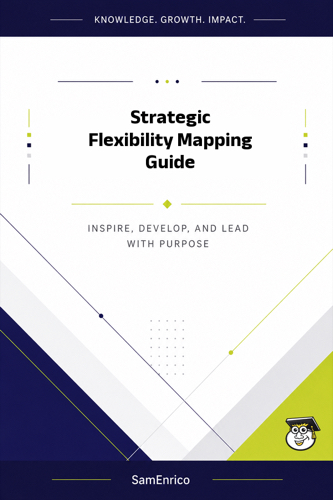
Non-FictionStrategic AtlasStrategic Agility
Strategic Flexibility Mapping Guide eBook
Map competitors by strategic flexibility and asset
Map competitors by strategic flexibility and asset specificity to see reaction speed.
Formats
Free sample
Chapter 1: The Speed Trap--–- The CEO of a mid-sized logistics company once told me, "We saw the disruption coming eighteen months before it killed us. We had better data, smarter people, and more money than the startup that ate our lunch. But by the time we finished our third strategic review, they had already signed our largest customers." He paused, stared at the empty wall behind my head, and added something I have never forgotten: "We weren't wrong. We were just slow. And slow, it turns out, is exactly the same as wrong."This chapter opens with a provocative premise that will unsettle every executive who has ever taken pride in getting the strategy "right." In markets defined by rapid change—what scholars call high-velocity environments—having the optimal long-term strategy matters less than having the fastest reaction time.
The most carefully crafted five-year plan is not an asset when the competitive landscape reshuffles every eighteen months. It is a liability. It creates the illusion of control while the actual game is being played at a speed your planning cycle cannot match.Slow competitors inadvertently create profit pools that agile firms can capture. Every minute your organization spends analyzing, debating, and approving is a minute your faster rival spends executing, learning, and iterating. By the time you have perfected your response, the market has already moved to a new problem.
The question is not whether you will face a competitor who is faster than you. The question is whether you will recognize the speed trap before it closes around your business.This book provides a systematic method for answering that question. It introduces a framework for mapping any competitor—or your own organization—along two critical dimensions: asset specificity and strategic flexibility. These two variables determine, with remarkable accuracy, how quickly a firm can react to threats and opportunities. Once you understand where a competitor sits on this map, you can predict their reaction speed to price wars, technological shifts, regulatory changes, and supply shocks.
More importantly, you can identify the gaps where your own speed advantage gives you the power to move before they can respond.But before we build that map, we must understand the terrain. And the terrain begins with a simple but brutal truth: speed is not a virtue. It is a weapon. And like any weapon, it can be turned against you if you do not understand its mechanics.The Illusion of Being Right There is a particular kind of pain that comes from being correct too late. It is different from being wrong.
Being wrong carries the sting of error, but it also carries the seed of learning. You adjust, you pivot, you try something else. Being correct too late offers no such redemption. Your analysis was flawless. Your data was accurate.
Your conclusion was undeniable. And none of it mattered, because by the time you acted, the window had already closed.Consider the fate of the traditional taxi industry when Uber appeared. Taxi companies were not ignorant of the threat. They understood, often within months of Uber's launch, that smartphone-based ride-hailing would disrupt their business model. Their analysis was correct.
Their projections were accurate. And yet, city by city, they lost market share to a competitor they had correctly identified. Why? Because their available reaction time—the speed with which they could deploy a countermeasure—was catastrophically slower than the required reaction time—the speed the market demanded.The taxi companies were trapped in what I call the Speed Trap. They had high asset specificity: medallions worth hundreds of thousands of dollars, dispatch systems built for phone calls, garages designed for centralized fleets, and labor agreements that assumed a certain way of working.
Every one of these assets was valuable—in the old world. In the new world, each asset became an anchor. The taxi companies could see the future. They just could not reach it before the future arrived.This pattern repeats across industries. Blockbuster saw Netflix coming.
Kodak invented the digital camera. Nokia built the first mass-market smartphone. In each case, the incumbent was not blindsided by ignorance. They were paralyzed by specificity. Their assets—stores, film manufacturing lines, proprietary operating systems—were perfectly designed for a world that was disappearing.
And because those assets could not be redeployed without massive loss, the firms could not react quickly enough to survive.The Speed Trap is not about intelligence. It is not about data. It is about the structural relationship between what you own and how fast you can change. Understanding this relationship is the first step toward escaping the trap—or, if you are the challenger, toward exploiting it.Defining Strategic Flexibility Before we can measure reaction speed, we must define what we mean by strategic flexibility. This term is often used loosely to mean "agility" or "adaptability" or even just "being lean." But for the purposes of this book, strategic flexibility has a precise meaning: the organizational ability to adapt to substantial, uncertain, and fast-occurring environmental changes without catastrophic loss of value.Let me break that definition into its components.First, "substantial" changes.
We are not talking about minor fluctuations in demand or routine competitive moves. Strategic flexibility matters when the change is large enough to threaten the firm's core business model. A 2 percent shift in market share is not a strategic flexibility problem. A technological discontinuity that renders your primary product obsolete—that is a strategic flexibility problem.Second, "uncertain" changes. If you know exactly what is coming and when, you do not need flexibility.
You need execution. Flexibility is valuable precisely when the future is ambiguous—when multiple scenarios are possible and you cannot predict which one will materialize. In such environments, the ability to delay commitment, to place small bets, and to reverse course without penalty becomes a strategic asset.Third, "fast-occurring" changes. This is the time dimension. If the environment changes slowly, even highly specific assets can be redeployed gradually.
The problem arises when the speed of environmental change exceeds the speed at which the firm can reconfigure its assets. When that happens, the firm enters the Speed Trap.Finally, "without catastrophic loss of value." This is the crucial constraint. Anyone can adapt if they are willing to destroy value. Selling assets at fire-sale prices, breaking contracts, laying off specialized workers—these are forms of adaptation, but they are not strategic flexibility. True strategic flexibility preserves value while changing direction.
It is the ability to say "we were wrong" without paying the full price of being wrong.This definition immediately suggests a paradox. The assets that create value in stable environments—dedicated factories, specialized skills, exclusive contracts—are precisely the assets that make adaptation costly. Conversely, the assets that enable rapid adaptation—general-purpose equipment, outsourced functions, temporary labor—are precisely the assets that generate lower returns in stable conditions. This trade-off is not a flaw in the framework. It is the central tension that every strategist must navigate.Required Reaction Time versus Available Reaction Time To operationalize this tension, we need two metrics.
The first is required reaction time: how quickly the market demands a response. This is not a fixed number. It varies by…
This is the end of the free sample. Get the eBook to keep going. Buy now
About this book
Details
- Author
- Devine Henriette
- Publisher
- SamEnrico
- Language
- English
- Genre
- Non-Fiction, Strategic Atlas, Strategic Agility
- Released
- 2026-06-08
- Pages (approx.)
- 151
- Available as
- eBook, Audiobook

Read better in the ZLOADR app
Your eBooks on your phone or tablet. Sign in with your SamEnrico account and start reading.
More by Devine Henriette
 Financial Projection Pitching GuideDevine Henriette$11.99
 Remote Retreats Time Zone PlanningDevine Henriette$11.99
 Deep Work Quarterly PlanningDevine Henriette$11.99
 Polish Resistance Kedyw GuideDevine Henriette$11.99
 The Last Boomtown: The Rise and Fall of Butte, Montana’s Copper KingsDevine Henriette$11.99
 Understanding Chromosome 1, Trisomy 1q32 QterDevine Henriette$17.99
 Security OfficerDevine Henriette$11.99
 Local Language Negotiation GuideDevine Henriette$12.99
 Ecommerce Retention PlaybookDevine Henriette$12.99
 How to Start a Autocycle Business (Beginners Guide)Devine Henriette$11.99
You may also like
 Hong Kong Handover 1997Dunn Johnnie$11.99
 Zumba For Postnatal Recovery CourseNeal Christian$11.99
 Zumba for BeginnersLadner Nikia$11.99
 YouTube Comment Mining GuideHumes Pandora$12.99
 Worry Box MeditationCarlin Rudy$11.99
 Workplace Stress MeditationNguyen Lynn$11.99
 Workplace Stress and Sleep RepairHawley Ivory$11.99
 Workplace Perfectionism CureDelaney Jeffry$11.99
 Workplace Injustice Anger GuideWallen Isabelle$11.99
 Work Addiction and Burnout LinkGreenwood Ester$11.99
 Women in Yoga and WellnessBeattie Galina$11.99
 Women in Stand Up ComedyChun Evangeline$11.99