
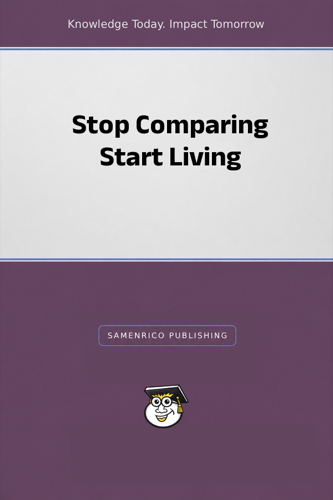
Stop Comparing Start Living eBook
Break the social comparison cycle that fuels impos
Break the social comparison cycle that fuels imposter syndrome and embrace your unique path.
Formats
Free sample
Chapter 1: The Unspoken Agreement--The first time I realized I had signed a contract I never read, I was lying on my bathroom floor at 11:47 PM on a Tuesday.My phone was face-up on the tile, inches from my nose, displaying a photograph of a woman I barely knew from college. She was standing on a balcony in Santorini, wearing a white linen dress, holding a glass of something pink, smiling in a way that suggested she had never once questioned her own worth. The caption read: "Grateful. So grateful. #Blessed #Hard Work Pays Off #Living My Best Life."I had just spent fourteen hours at a job I pretended to love, come home to a microwave dinner I ate standing up, and cried for no reason I could name.
And now I was on the floor, comparing my insides to her outsides, and losing.I didn't know it yet, but I had just performed the most common, most destructive, and most invisible ritual of modern life. I had engaged in what psychologists call social comparison. I had measured my messy, exhausted, behind-the-scenes reality against someone else's carefully curated highlight reel. And I had concluded, as we almost always do, that I was falling short.This book is about that moment. Not the Santorini balcony moment specifically, but the thousands of smaller moments that surround it: the scroll, the pang, the spiral, the shame, the exhausting work of trying to feel like enough in a culture that profits from your insecurity.But before we go anywhere else, we need to be honest about something.
This book will not tell you to "never compare yourself to anyone." That advice is not only impossible—it is bad advice. Comparison is not the enemy. Unconscious, weaponized, algorithmically exploited comparison is the enemy. The difference between those two things is the difference between drowning and swimming.Let me explain.The Invention of the Inner Scale In 1954, a social psychologist named Leon Festinger published a paper that fundamentally changed how we understand human motivation. His theory was simple, elegant, and devastating: human beings have an innate drive to evaluate their own opinions and abilities.
And when objective measures are unavailable—when there is no ruler to tell you how tall you are, no stopwatch to tell you how fast you run—we evaluate ourselves by comparing ourselves to other people.Festinger called this social comparison theory. He identified two directions of comparison. Upward comparison means looking at someone you perceive as better off than you. Downward comparison means looking at someone you perceive as worse off. Both, he argued, are natural.
Both serve an evolutionary purpose. If your ancestor didn't compare his spear-throwing ability to his neighbor's, he never learned to throw better. If he didn't compare his shelter to the next cave over, he never learned to insulate against the cold.Comparison, in other words, is how we learned to improve.But Festinger could not have predicted what would happen to his theory in the early twenty-first century. He could not have imagined that human beings would carry a portable comparison machine in their pockets, one that delivered an endless feed of upward comparisons, algorithmically optimized for maximum insecurity, refreshed every three seconds, available at 11:47 PM on a bathroom floor.The problem is not that we compare. The problem is that we now compare constantly, unconsciously, and against people whose full reality we cannot see.
We are comparing our entire, complicated, often painful existence to someone else's greatest hits. And we are doing it thousands of times per day.This is the Unspoken Agreement. The silent promise we make to measure our insides by other people's outsides. The contract we signed without reading the fine print, which states, in effect: "I will feel small so that the algorithm can feel rich."The Two Faces of Comparison Before we go any further, we need to draw a line that most books refuse to draw. Most self-help books tell you to "stop comparing yourself to others" as if comparison were a bad habit you could simply drop, like biting your nails or leaving the toilet seat up.
But that advice misunderstands what comparison actually is.Comparison is a tool. Tools are neither good nor bad. A knife can slice bread or stab a person. A car can take you to work or run over your neighbor's mailbox. The morality is in the use, not in the thing itself.The same is true of comparison.Healthy comparison is conscious, limited, and actionable.
It looks at someone one step ahead—not ten steps, not a hundred—and asks: "What can I learn from their path?" It gathers data, then puts down the comparison and picks up the work. Healthy comparison feels like curiosity. It feels like "Oh, that's interesting—they did that. Maybe I could try something similar." It does not feel like shame. It does not feel like lack.
It does not keep you up on a bathroom floor.Toxic comparison is unconscious, unlimited, and paralyzing. It looks at someone ten steps ahead—or in a completely different life circumstance, with completely different resources—and asks: "Why am I not there yet?" It does not gather data. It generates feelings. Toxic comparison feels like a verdict. It feels like "I am behind.
I am less than. I will never catch up." It does not lead to action. It leads to spiraling, scrolling, and shrinking.The difference between these two is not the direction of the comparison. Upward comparison can be healthy or toxic. Downward comparison can be healthy (gratitude) or toxic (smugness).
The difference is in three specific conditions.The Comparison Pre-Flight Checklist I want you to remember three questions. They are the most important questions in this entire book. Before you compare yourself to anyone—whether in person, on social media, or in the privacy of your own anxious mind—run this checklist.Question One: Is the gap small?Ask yourself: Is this person roughly one step ahead of me, or ten? Are they in a similar life circumstance, with similar resources, or are they operating from a completely different starting line?Comparison only works as a learning tool when the gap is small enough that their path could plausibly be your path. Comparing your first month at the gym to someone who has been training for a decade is not useful.
It is not information. It is just pain. Comparing your first draft to a published author's final book is not useful. It is just pain. Comparing your Tuesday night alone to someone's Santorini vacation is not useful.
It is just pain.The healthy comparison asks: "What is the actual distance between us?" If the distance is more than one year of focused effort, you are not comparing. You are just torturing yourself.Question Two: Do I have full data?Ask yourself: Do I know this person's struggles, failures, costs, and trade-offs? Or do I only see their wins?This is the killer. This is the one that gets us every time. Social media is not a window into someone's life.
It is a curated museum of their best moments. You see the vacation photos, not the credit card debt. You…
This is the end of the free sample. Get the eBook to keep going. Buy now
About this book
Details
- Author
- Downey Julianna
- Publisher
- SamEnrico
- Language
- English
- Genre
- Non-Fiction, Self-Help
- Released
- 2026-06-10
- Pages (approx.)
- 132
- Available as
- eBook, Audiobook

Read better in the ZLOADR app
Your eBooks on your phone or tablet. Sign in with your SamEnrico account and start reading.
More by Downey Julianna
 Postpartum Infant Swim GuideDowney Julianna$11.99
 Intermediate Strength ProgramDowney Julianna$11.99
 Polyvagal Trigger TheoryDowney Julianna$11.99
 Sarcopenia Omega 3 PrescriptionDowney Julianna$11.99
 Defensiveness Reduction GuideDowney Julianna$11.99
 AdTech Investment GuideDowney Julianna$11.99
 Alcohol Recovery and Sports EventsDowney Julianna$11.99
 Carter Georgia GovernorDowney Julianna$11.99
 The Trade That Changed the Game: How One Bold Move Reshaped the NBADowney Julianna$11.99
 The Forgotten Queen: Hecuba’s CurseDowney Julianna$11.99
 The Forgotten Navigators: How a Lost Tuareg Guide Rediscovered the SaharaDowney Julianna$11.99
 The Dancer's Guide to ZumbaDowney Julianna$11.99
You may also like
 Hong Kong Handover 1997Dunn Johnnie$11.99
 Zumba For Postnatal Recovery CourseNeal Christian$11.99
 Zumba for BeginnersLadner Nikia$11.99
 YouTube Comment Mining GuideHumes Pandora$12.99
 Worry Box MeditationCarlin Rudy$11.99
 Workplace Stress MeditationNguyen Lynn$11.99
 Workplace Stress and Sleep RepairHawley Ivory$11.99
 Workplace Perfectionism CureDelaney Jeffry$11.99
 Workplace Injustice Anger GuideWallen Isabelle$11.99
 Work Addiction and Burnout LinkGreenwood Ester$11.99
 Women in Yoga and WellnessBeattie Galina$11.99
 Women in Stand Up ComedyChun Evangeline$11.99