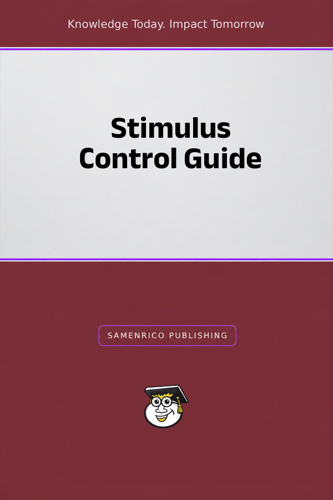
Stimulus Control Guide eBook
Teaches associating bed only with sleep, not wakef
Teaches associating bed only with sleep, not wakefulness.
Formats
Free sample
Chapter 1: The Bedroom Betrayal--The moment your head touches the pillow, your mind comes alive.Not with creativity or pleasant daydreams. With a familiar, sinking dread. The kind that whispers: Here we go again. Your heart rate ticks up. Your thoughts begin to race through tomorrow's meetings, yesterday's arguments, last week's embarrassments.
You shift positions. Fluff the pillow. Turn onto your stomach, then your back, then your side. The blankets are too hot, then too cold. The room is too quiet, then every creak of the house is a thunderclap.You check the clock.
11:47 PM.You close your eyes and command yourself to sleep. Come on. Just sleep. You have to be up in six hours. You try breathing exercises.
Counting sheep. Meditating. Praying. Bargaining with the universe. If I fall asleep right now, I can still get five and a half hours.You check the clock again.
12:23 AM.Thirty-six minutes have passed. It felt like three hours.This is the moment most people double down. They try harder. They summon every ounce of willpower, every relaxation trick they have ever read on the internet, every suggestion from well-meaning friends who do not understand. Have you tried chamomile tea?
Yes. What about melatonin? Yes. Maybe you just need to turn off your phone an hour before bed? Done all of it.And still, you lie there.
Awake. Frustrated. Increasingly certain that something is wrong with you.Here is the truth that will shock you: There is nothing wrong with you.Your brain is working exactly as it has been trained to work. And the person who did the training is you.The Insomnia Epidemic No One Is Talking About Before we fix this problem, you need to understand its true scale. You are not alone.
In fact, you are part of a massive, exhausted crowd.The American Academy of Sleep Medicine estimates that between 30 and 50 million adults in the United States suffer from chronic insomnia. That is roughly one in every six people you pass on the street. The World Health Organization calls insomnia a "global health epidemic," with prevalence rates exceeding 40 percent in some countries. In the United Kingdom, the National Health Service reports that insomnia costs the economy over £40 billion annually in lost productivity and healthcare expenses. In Australia, one in three adults reports regular difficulty sleeping.But these numbers, as staggering as they are, tell only half the story.The other half is about severity.
Among those 50 million Americans, approximately 10 to 15 million have what clinicians call severe chronic insomnia. These are people who spend more than an hour trying to fall asleep most nights, wake repeatedly, or wake too early and cannot return to sleep. They have struggled for months, often years. They have tried over-the-counter remedies, prescription medications, herbal supplements, acupuncture, expensive mattresses, cooling pillows, weighted blankets, white noise machines, and apps that promise to track and optimize their sleep cycles.And nothing has worked.If you are reading this book, there is a very high probability that you belong to this group. You are not casually curious about sleep optimization.
You are desperate. You have felt the terror of watching the clock tick from midnight to 1 AM to 2 AM to 3 AM, knowing that each passing minute steals a piece of tomorrow's functionality. You have dragged yourself through workdays on three hours of sleep, functioning at forty percent capacity, hiding your exhaustion behind coffee and sheer will. You have canceled social plans, avoided driving long distances, and snapped at people you love because your nervous system is perpetually fried.You have wondered, in your darkest moments, if you will ever sleep normally again.The answer is yes. Absolutely yes.
But not through the methods you have already tried.The Fundamental Mistake Almost Everyone Makes Here is the single most important sentence in this entire book. Read it twice:You cannot force sleep. You can only create the conditions under which sleep becomes inevitable.This sounds simple. It is not obvious. And almost every insomniac makes the opposite assumption.Think about how most people try to solve insomnia.
They go to bed earlier. They spend more time in bed. They lie there, willing themselves to sleep, trying harder with each passing minute. This seems logical. If you are not getting enough sleep, the solution must be to give yourself more opportunity to sleep, right?Wrong.
Dead wrong. Clinically, catastrophically wrong.The more time you spend awake in bed, the more you train your brain to associate your bed with wakefulness, frustration, anxiety, and struggle. Your bed becomes a trigger for alertness, not relaxation. And once that association is learned, it operates automatically, beneath conscious awareness, like a reflex.This is not a metaphor. This is actual neuroscience.Pavlov, His Dogs, and Your Bedroom In the early 1900s, a Russian physiologist named Ivan Pavlov made a discovery that would revolutionize psychology.
He was studying digestion in dogs, measuring their salivation responses to food. But he noticed something strange. The dogs began salivating before the food arrived. They salivated at the sound of the laboratory assistant's footsteps. They salivated at the sight of the food bowl.
They salivated at the bell that preceded feeding.Pavlov realized that the dogs had learned an association. A neutral stimulus—the bell—had been paired with food so many times that the bell alone triggered the same physiological response as the food itself. He called this conditioned reflex. The dogs had been conditioned to salivate at a sound that originally meant nothing to them.This is exactly what has happened to you, but in reverse.Your bed started as a neutral stimulus. It was just furniture.
But over months and years of lying awake in frustration, tossing and turning, checking the clock, worrying about tomorrow, you have paired your bed with wakefulness and anxiety. The bed is the bell. And instead of salivation, the conditioned response is cortical arousal—a state of alertness that makes sleep impossible.Let me say that again because it is the entire foundation of this book: You have conditioned yourself to become alert the moment you get into bed.This is not a character flaw. This is not weakness. This is not a sign that you are broken.
This is basic behavioral psychology, and every mammal with a nervous system can be conditioned in exactly this way. You have simply learned something that is ruining your life. And if you learned it, you can unlearn it.The Vicious Cycle of Psychophysiological Insomnia There is a clinical name for what you are experiencing: psychophysiological insomnia. It sounds complicated, but it describes a simple, devastating cycle.Let me walk you through it step by step.Step one: You have a normal, understandable reason for a few bad nights. Maybe it is stress at work.
Maybe a relationship problem. Maybe jet lag or illness or a noisy neighbor. Everyone experiences these nights. A healthy sleeper recovers quickly and moves on.Step two: After a few bad nights, you begin to worry about sleep itself. You lie down and think, What if I can't fall asleep again?
That worry triggers mild anxiety. That anxiety triggers alertness. That alertness delays sleep onset.Step three: You fall asleep later than…
This is the end of the free sample. Get the eBook to keep going. Buy now
About this book
Details
- Author
- Calabrese Augustine
- Publisher
- SamEnrico
- Language
- English
- Genre
- Non-Fiction, Health & Wellness, Behavioral
- Released
- 2026-06-06
- Pages (approx.)
- 149
- Available as
- eBook, Audiobook

Read better in the ZLOADR app
Your eBooks on your phone or tablet. Sign in with your SamEnrico account and start reading.
More by Calabrese Augustine
 Hoffa Disappearance Podcast Investigative GuideCalabrese Augustine$11.99
 Reading People Body Language GuideCalabrese Augustine$11.99
 Housing Market StressCalabrese Augustine$11.99
 Remote Work Week PlanningCalabrese Augustine$11.99
 Goal Framework ResearchCalabrese Augustine$11.99
 Fitbit Step Count EnvyCalabrese Augustine$11.99
 Recovering From Being Fired GuideCalabrese Augustine$11.99
 The Battle of the Java Sea: The Pacific's Forgotten Cataclysm (1942)Calabrese Augustine$11.99
 The Iron Poet: Brunel and the Birth of Modern EngineeringCalabrese Augustine$11.99
 How to Produce Textile Machinery PartsCalabrese Augustine$11.99
 AI for Bad Debt Provision CalculationCalabrese Augustine$12.99
 UAE VAT on Financial ServicesCalabrese Augustine$12.99