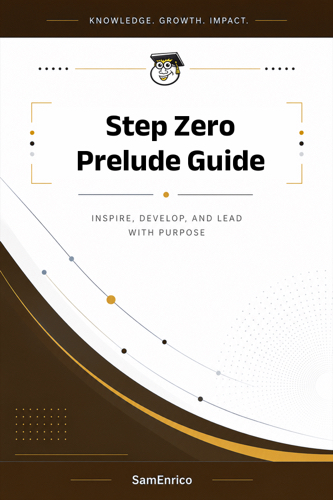
Step Zero Prelude Guide eBook
Covers pre-step work: hitting bottom, willingness,
Covers pre-step work: hitting bottom, willingness, and open-mindedness before step one.
Formats
Free sample
Chapter 1: The Last Gasp--–- Every story of recovery begins the same way: not with a dramatic crash, not with handcuffs or hospital beds, not with an intervention staged by tearful loved ones—but with a small, private, almost embarrassingly quiet moment when the lying stops. Just for a second. Just long enough to feel the full weight of what you have been carrying. That second is the last gasp. It is not the worst thing that happened to you.
It is not the event that finally convinced everyone else that you had a problem. It is the smallest humiliation, the most private shame, the one truth you could no longer push aside because pushing it aside had become more exhausting than admitting it. This chapter is about finding that moment, trusting it, and understanding why waiting for a “real” rock bottom is the most dangerous decision you never knew you were making.The Cinematic Bottom Is a Trap Close your eyes for a moment and imagine what “rock bottom” looks like. If you are like most people, you see something dramatic: a car wrapped around a telephone pole, a job loss announced in a supervisor’s office, an overdose in a public bathroom, an eviction notice taped to an apartment door, a spouse walking out with suitcases. These images come from movies, from memoirs, from the kinds of stories that make for compelling testimonials at recovery meetings.
They are real for some people. But they are not real for most people—and waiting for them to happen to you is a form of slow, socially sanctioned suicide.The cinematic bottom keeps you trapped because it gives you permission to keep going. As long as you still have a job, as long as your license is still valid, as long as your partner hasn’t left, as long as your children are still speaking to you, you can tell yourself that you haven’t hit bottom yet. Therefore, you don’t need to stop. Therefore, you can keep using or drinking.
Therefore, you are fine. This is not logic. This is addiction’s favorite lullaby, and you have been humming it for years.The truth that best-selling recovery literature has documented for decades—from the personal stories in Alcoholics Anonymous to Gabor Maté’s case studies in In the Realm of Hungry Ghosts—is that most people hit bottom internally long before anything external collapses. The lawyer who drinks alone every night but never misses a court date has hit bottom emotionally. The surgeon who performs operations flawlessly but goes home to drink himself unconscious has hit bottom existentially.
The mother who cares for her children during the day and lies awake in shame at night has hit bottom relationally. Their external lives look intact. Their internal lives are ruins. And because the external world keeps validating them—good job, nice family, no arrests—they keep waiting for a bottom that will never look like the movies.The Myth of “Not Bad Enough Yet”The single most effective lie addiction tells is this: you are not bad enough yet to need help. This lie has a thousand variations.
“I haven’t lost my job.” “I’ve never gotten a DUI.” “I only drink beer, not liquor.” “I only use on weekends.” “I’ve never been to the hospital.” “I’m not like those people.” Each variation serves the same purpose: to keep you comparing yourself to a worse-off version of an addict, thereby proving that you are not actually an addict at all.Here is what makes this lie so insidious. The goalposts never stop moving. When you first started worrying about your drinking or using, you probably told yourself that you would stop if you ever missed a day of work because of it. Then you missed a day of work—and you told yourself you would stop if you ever missed a second day. Then you missed a second day, and you told yourself you would stop if you got written up.
Then you got written up, and you told yourself you would stop if you got fired. Each consequence becomes the new normal. What once would have horrified you becomes Tuesday. This is not a character flaw. This is the predictable neurobiology of addiction: your brain adapts to each new level of consequence by lowering the alarm threshold.
What should feel like an emergency feels like routine.The “not bad enough yet” myth is also a trap because it confuses comparison with diagnosis. You are not trying to prove that you are the worst case in human history. You are trying to determine whether your relationship with a substance or behavior is causing you pain. That is a binary question: yes or no. Comparison is irrelevant.
The fact that someone else has lost more than you have does not mean you have lost nothing. The fact that someone else drinks more than you do does not mean your drinking is harmless. But addiction needs you to believe otherwise, so it keeps feeding you examples of people who are worse off, and you keep nodding along, grateful that you are not them, and you keep using.The High-Bottom and Low-Bottom Spectrum Clinical and 12-step literature have long recognized that bottoms come in different depths. The distinction between high-bottom and low-bottom is not about morality or severity of addiction. It is about the pattern of collapse.High-bottom individuals are those whose external lives remain largely intact even as their internal worlds disintegrate.
They hold jobs. They maintain relationships—sometimes poorly, but they maintain them. They pay their bills. They show up. From the outside, they look like anyone else.
But inside, they are drowning. Their bottom is emotional, existential, or relational. They often describe their surrender as quiet, almost anticlimactic: “I didn’t lose anything dramatic. I just couldn’t stand myself anymore.” High-bottom bottoms are the most common type, and they are the most commonly missed—both by the person experiencing them and by the professionals who might otherwise help. Because nothing external has exploded, everyone assumes everything is fine.
Including you.Low-bottom individuals are those whose external lives have visibly collapsed. They have lost jobs, homes, families, freedom. Their bottom is often physical and legal. They may have experienced overdoses, arrests, hospitalizations, or evictions. Their surrender is often forced by circumstances rather than chosen from internal despair.
This does not make their recovery more valid or more likely. In fact, low-bottom individuals sometimes struggle more with readiness because their surrender was coerced. They stop because they have to, not because they want to—and that difference matters enormously in early recovery.Neither bottom is superior. Neither bottom guarantees recovery. The only bottom that matters is the one that produces genuine surrender: the internal cessation of fighting, the quiet admission that you cannot continue as you have been, the last gasp.
Some people reach that point while driving a luxury car. Some reach it in a homeless shelter. The car does not make the surrender more real. The shelter does not make it more noble. Surrender is surrender, and it happens in the same private space for everyone…
This is the end of the free sample. Get the eBook to keep going. Buy now
About this book
Details
- Author
- Orellana Isidro
- Publisher
- SamEnrico
- Language
- English
- Genre
- Non-Fiction, Self-Help / Readiness
- Released
- 2026-06-11
- Pages (approx.)
- 148
- Available as
- eBook, Audiobook

Read better in the ZLOADR app
Your eBooks on your phone or tablet. Sign in with your SamEnrico account and start reading.
More by Orellana Isidro
 The Autistic Child Parent AngerOrellana Isidro$11.99
 HIIT For Dads GuideOrellana Isidro$11.99
 Empathy Role Play ScenariosOrellana Isidro$11.99
 The Competitive Pricing Analysis GuideOrellana Isidro$11.99
 The Last Oath of the GorgonOrellana Isidro$11.99
 MBE Certification MasteryOrellana Isidro$12.99
 Twitter PR for StartupsOrellana Isidro$12.99
 The Breeder's Guide to Midget White TurkeysOrellana Isidro$11.99
 How to Start a Blow-out Prevention Apparatus Business (Beginners Guide)Orellana Isidro$11.99
 Lead ConsultantOrellana Isidro$11.99