
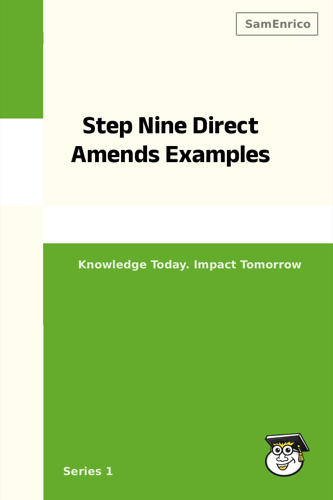
Step Nine Direct Amends Examples eBook
Specific scripts for direct amends to common harms
by Speed Burl
Specific scripts for direct amends to common harms.
Formats
Free sample
Chapter 1: The Decision Matrix--–- The first time I tried to make an amend, I called my ex-wife after three years of silence. I had a script in my head: “I’m sorry for everything. I was a mess. I hope you can forgive me.” She listened. Then she said, “Which everything?
The time you emptied our joint account? The Christmas you didn’t come home? The lie you told my mother about where I was? Which one are you sorry for?” I had nothing to say. Because she was right.
“Everything” is not an amend. “Everything” is a fog you hide inside so you never have to look at the specific shape of what you actually did.This chapter dismantles the most common Ninth Step mistake: the blanket apology. It then builds, from the ground up, the only structure that actually works: the three-part direct amend. And finally, it introduces the Unified Decision Matrix—a two-question tool that will guide every single amend you make from this point forward. By the end of this chapter, you will never again say “I’m sorry for everything.” You will know exactly what to say, to whom, and whether you should say anything at all.Why “I’m Sorry for Everything” Is a Trap The blanket apology is seductive because it feels brave.
You pick up the phone, you say the words, you feel the release of guilt. But here is the problem: guilt is not the same as responsibility. Guilt is a feeling inside your own body. Responsibility is a set of actions taken in the real world. The blanket apology confuses the two.
You feel better, but the person you harmed is left holding a bag of vague remorse with no repair attached.Let me give you an example from the research on apologies. In a 2016 study published in the Journal of Experimental Social Psychology, researchers found that victims of transgressions rated “specific, behavior-focused apologies” as significantly more satisfying than “general, emotion-focused apologies.” That is the science behind what recovering people have known for decades: an amend must name the harm. If you cannot name it, you are not ready to make it.The blanket apology also creates a second, hidden injury. When you say “I’m sorry for everything,” you are asking the victim to do the emotional labor of remembering your specific harms. You are saying, in effect, “I feel bad, so you figure out what I did.” That is the opposite of an amend.
An amend is supposed to lift the burden from the victim, not add to it.Consider two apologies side by side. First: “I’m sorry for how I treated you back then.” Second: “I’m sorry that I stole your rent money in December of 2019. You told me you were afraid of being evicted, and I took that money anyway. You must have been terrified.” The first apology requires the victim to fill in the blanks. The second apology shows that you have done your homework.
You remember. You understand. You are not asking them to educate you about your own harms.The blanket apology also fails the “Except When” test, which we will introduce later in this chapter. If you cannot be specific, you cannot know whether your amend will injure the victim further. A vague “I’m sorry for everything” might open wounds that the victim had closed.
You might bring up a harm they had forgotten—or one they had specifically asked you never to mention again. Specificity is not just about effectiveness. It is about safety.So the first rule of this book is simple: Never make a blanket apology. If you find yourself reaching for the word “everything,” stop. Put down the phone.
Close the email draft. And read the next section, where you will learn the three-part structure that replaces “everything” with something real.The Three-Part Structure of a Direct Amend Every direct amend in this book follows the same architecture. I call it the Three-Part Structure. It is not original to me—it has been implicit in recovery literature for nearly a century. But no one has ever laid it out as explicitly as I will lay it out here.
Memorize these three parts. Practice them. Write them on an index card and keep them in your wallet. Because every script in every subsequent chapter is simply a variation of these three parts.Part One: The Acknowledgment This is where you name the specific harm. Not the category of harm.
Not the feeling behind the harm. The exact, concrete, observable action you took. “I stole your rent money.” “I lied to your mother about where you were.” “I did not show up to your father’s funeral.” “I told Sarah that you were cheating on your husband.” Each of these statements names a specific behavior. Notice what they do not say: “I was a bad person.” “I was struggling with addiction.” “I was going through a hard time.” Those are explanations, not acknowledgments. The acknowledgment is about the victim, not about you.
It is a mirror held up to your own action.Why does specificity matter? Because the victim already knows what you did. They do not need you to tell them that you were struggling. They need you to tell them that you see what you did. Acknowledgment is the opposite of denial.
And denial is what kept you sick. Every time you minimized, rationalized, or justified your behavior, you were denying the reality of the harm. Part One of the amend is the death of denial. You say the words out loud. You do not soften them.
You do not add “but.” You just say what you did.Part Two: The Impact Statement This is where you demonstrate that you understand what your action did to the victim. You do not guess. You do not assume. You state what you have learned, usually from listening to the victim in the past or from your own inventory work. “You were afraid you would be evicted because of me.” “She believed you were lying to her, and your relationship with your mother has never recovered.” “You stood alone at the grave because I was too drunk to drive.” “She confronted your husband, and they almost divorced.”The impact statement is the most emotionally difficult part of the amend because it requires empathy.
And empathy is hard for people who have spent years hiding from their own feelings. But here is the good news: you do not have to be perfect. You do not have to read the victim’s mind. You just have to try. If you get it wrong, they will correct you.
And that correction is a gift. It is more information. It is a chance to listen.Notice what the impact statement does not do. It does not say, “I feel terrible about what I did.” That is about your feelings. The impact statement is about their experience.
It is not “I feel guilty.” It is “You were terrified.” The difference is everything. One keeps the focus on you. The other shifts it to the person you harmed. A direct amend is not…
This is the end of the free sample. Get the eBook to keep going. Buy now
About this book
Details
- Author
- Speed Burl
- Publisher
- SamEnrico
- Language
- English
- Genre
- Non-Fiction, Self-Help, Amends
- Released
- 2026-06-06
- Pages (approx.)
- 147
- Available as
- eBook, Audiobook

Read better in the ZLOADR app
Your eBooks on your phone or tablet. Sign in with your SamEnrico account and start reading.
More by Speed Burl
 Law Enforcement EQ TrainingSpeed Burl$11.99
 Initiating Sex With ConfidenceSpeed Burl$11.99
 ABCDE for Email Inbox ZeroSpeed Burl$11.99
 Vanished in the Veil: The Lost Expedition of the *Mimic*Speed Burl$11.99
 How to Become a Liquor InspectorSpeed Burl$11.99
 AI for IT Service Desk AutomationSpeed Burl$12.99
 Learn to Play the Đàn Tỳ BàSpeed Burl$11.99
 Infrastructure SpecialistSpeed Burl$11.99
You may also like
 Hong Kong Handover 1997Dunn Johnnie$11.99
 Zumba For Postnatal Recovery CourseNeal Christian$11.99
 Zumba for BeginnersLadner Nikia$11.99
 YouTube Comment Mining GuideHumes Pandora$12.99
 Worry Box MeditationCarlin Rudy$11.99
 Workplace Stress MeditationNguyen Lynn$11.99
 Workplace Stress and Sleep RepairHawley Ivory$11.99
 Workplace Perfectionism CureDelaney Jeffry$11.99
 Workplace Injustice Anger GuideWallen Isabelle$11.99
 Work Addiction and Burnout LinkGreenwood Ester$11.99
 Women in Yoga and WellnessBeattie Galina$11.99
 Women in Stand Up ComedyChun Evangeline$11.99