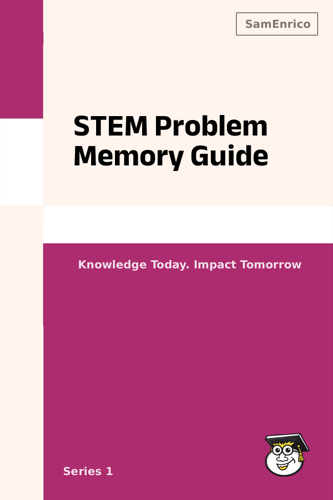
STEM Problem Memory Guide eBook
Remember formulas, equations, and problem solving
Remember formulas, equations, and problem solving steps systematically.
Formats
Free sample
Chapter 1: The Forgetting Assassin--–- The screen glows at 2:14 a.m. Maya stares at her organic chemistry textbook, at the same reaction mechanism she has read seven times in the past three hours. The page is open to the Krebs cycle—a dizzying spiral of citrate, isocitrate, alpha-ketoglutarate, succinyl-Co A, and a dozen other molecules she cannot keep straight. Her highlighter is running dry. Her index cards are stacked three inches high.
And tomorrow morning at 8:00 a.m., she will sit for a midterm that covers exactly this material.She knows this cycle. She knows that she knows it. Just two hours ago, she recited all eight steps aloud to her bathroom mirror. But now, staring at the blank notebook page where she is trying to reproduce the cycle from memory, her brain offers nothing. Not a single enzyme name.
Not one carbon count. The knowledge that felt so solid during her review has evaporated like acetone on a warm glass slide.Maya is not unintelligent. She earned a 4.2 GPA in high school and placed in the ninety-third percentile on the SAT math section. She is not lazy. She has logged forty-seven study hours in the past nine days.
And she is not distracted. Her phone has been in airplane mode for the past six hours. By every conventional measure, Maya is doing everything right.So why can she not remember the Krebs cycle?The answer lies in a discovery made in 1885 by a German psychologist named Hermann Ebbinghaus—a discovery that most STEM students have never encountered, yet one that predicts with mathematical precision exactly why Maya is failing. Ebbinghaus was not interested in philosophy or vague theories of mind. He was a hard empiricist.
He memorized lists of nonsense syllables—meaningless three-letter combinations like RUR, ZOF, and LEQ—and then tested himself at systematically varied intervals to measure how quickly memory decays when no active recall occurs.What he found was both devastating and liberating.The Mathematics of Forgetting Ebbinghaus documented that memory loss follows a negative exponential curve. In plain language: within one hour of learning new information, the human brain forgets approximately 50 percent of it. Within twenty-four hours, that number climbs to 70 percent. Within one week, unless the information has been actively retrieved, up to 90 percent is gone.This is the Forgetting Curve. And it is not a flaw in your brain.
It is a feature.Your brain is not designed to remember arbitrary symbols, equations, or reaction mechanisms. It is designed to keep you alive on the African savanna. From an evolutionary perspective, remembering the precise formula for the quadratic equation—x=−b±b2−4ac2ax = \frac{-b \pm \sqrt{b^2 - 4ac}}{2a}x=2a−b±b2−4ac—confers zero survival advantage. Remembering which berry bush caused vomiting last week, or which animal trail led to water, or which facial expression preceded an attack—those memories matter. Your brain prioritizes spatial, emotional, and procedural memories.
It actively discards abstract symbolic information as metabolic noise.Ebbinghaus quantified this systematic erasure. His original data, replicated dozens of times across cultures and age groups, show that without intervention, your brain begins deleting new symbolic information within minutes. The curve is steepest immediately after learning. At time zero—the moment you first understand a formula—retention is 100 percent. After twenty minutes, it drops to approximately 60 percent.
After one hour, 40 to 50 percent. After nine hours, 35 percent. After one day, 30 percent. After two days, 25 percent. After one week, 20 percent.This means that Maya, who last reviewed the Krebs cycle at 10:00 p.m., has already lost more than half of what she studied by 2:00 a.m.—not because she is bad at memorization, but because she is human.
The Forgetting Curve is universal. It applies equally to Nobel laureates and first-year undergraduates. It applies to you. And it will continue to apply until you stop fighting your brain's architecture and start working with it.The Illusion of Competence Here is the cruel irony that traps students like Maya: she feels like she knows the material while she is studying. When she reads the Krebs cycle for the fourth time, the text feels familiar.
The molecules seem to fall into place. She nods along as if watching a movie she has seen before. This feeling of fluency—the ease with which her brain processes the text during rereading—creates a powerful illusion of competence.But fluency is not memory. Fluency is recognition. And recognition is not recall.Consider this distinction.
If someone shows you a multiple-choice question with four possible answers, you are using recognition: the correct answer is right there in front of you, and your brain merely needs to detect which one matches the faint trace left by your previous study. That is easy. That is why multiple-choice tests feel easier than short-answer or fill-in-the-blank tests.Recall, by contrast, requires you to generate the answer from scratch with no cues. That is what Maya attempted when she closed her textbook and tried to write out the Krebs cycle from memory. That is what you will face when an exam asks you to "state and derive the quadratic formula" rather than "which of the following is the quadratic formula?"The gap between recognition and recall is enormous.
And nearly all conventional study methods—rereading, highlighting, summarizing, watching video explanations, listening to recorded lectures—train recognition only. They feel productive because fluency feels good. But they leave you with a house of cards that collapses the moment you close the book.A landmark study conducted at Washington University in St. Louis in 2008 demonstrated this precisely. Students were divided into two groups.
Both studied the same scientific passages. One group used their normal study methods—primarily rereading. The other group used retrieval practice: after reading the passage once, they closed the book and wrote down everything they could remember, then checked their accuracy. One week later, the rereading group retained approximately 30 percent of the material. The retrieval practice group retained more than 70 percent.The difference was not intelligence.
It was method.The Two Brains: System 1 and System 2To understand why retrieval practice works and why rereading fails, we must briefly visit the work of Nobel laureate Daniel Kahneman. In his bestselling book Thinking, Fast and Slow, Kahneman describes two cognitive systems that operate simultaneously within every human brain.System 1 is fast, automatic, intuitive, and pattern-based. It is the system that recognizes a friend's face in a crowd without conscious effort. It catches a falling coffee cup before you even realize it is tipping. It drives a familiar route home while you think about what to make for dinner.
System 1 operates effortlessly, consumes minimal metabolic energy, and handles most of your daily cognition without your awareness.System 2 is slow, deliberate, analytical, and effortful. It is the system that calculates 17 times 24 from scratch. It translates a sentence from English to Japanese. It compares two mortgage interest rates and decides which loan is cheaper. System 2 requires focus, consumes significant energy, and fatigues quickly.
It is also the system that most students engage when they study—reading slowly, highlighting key terms, re-deriving equations step by step.Here is the crucial insight that changes everything: System 2 is terrible at…
This is the end of the free sample. Get the eBook to keep going. Buy now
About this book
Details
- Author
- Richter Katheryn
- Publisher
- SamEnrico
- Language
- English
- Genre
- Non-Fiction, Self-Help, STEM Education
- Released
- 2026-06-09
- Pages (approx.)
- 142
- Available as
- eBook, Audiobook

Read better in the ZLOADR app
Your eBooks on your phone or tablet. Sign in with your SamEnrico account and start reading.
More by Richter Katheryn
 Continuing Care Retirement Contract BriefRichter Katheryn$11.99
 Digital Planner Etsy Shop BrandingRichter Katheryn$11.99
 Lucid Dreaming MemoryRichter Katheryn$11.99
 Diphtheria Vaccine Membrane DeathRichter Katheryn$11.99
 The Quantum Whisperer: Satyendra Bose and the Birth of Bose-Einstein StatisticsRichter Katheryn$11.99
 The Great Australian Land Grab: How a Nation Was Sold OutRichter Katheryn$11.99
 Ultimate Handbook Guide to Pingdingshan : (China) Travel GuideRichter Katheryn$11.99
 Internal Comms Budget PlanningRichter Katheryn$12.99
 Art Therapist Board MemberRichter Katheryn$12.99
 Understanding Cholestasis, Progressive Familial IntrahepaticRichter Katheryn$17.99
 Library Clerk (Circulation System)Richter Katheryn$11.99