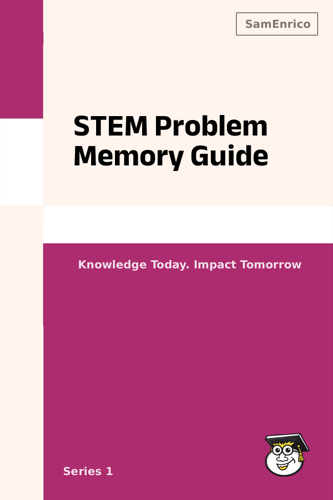
STEM Problem Memory Guide Audiobook
Remember formulas, equations, and problem solving
Remember formulas, equations, and problem solving steps systematically.
Formats
Free sample
Chapter 1: The Forgetting Assassin--–- The screen glows at 2:14 a.m. Maya stares at her organic chemistry textbook, at the same reaction mechanism she has read seven times in the past three hours. The page is open to the Krebs cycle—a dizzying spiral of citrate, isocitrate, alpha-ketoglutarate, succinyl-Co A, and a dozen other molecules she cannot keep straight. Her highlighter is running dry. Her index cards are stacked three inches high.
And tomorrow morning at 8:00 a.m., she will sit for a midterm that covers exactly this material.She knows this cycle. She knows that she knows it. Just two hours ago, she recited all eight steps aloud to her bathroom mirror. But now, staring at the blank notebook page where she is trying to reproduce the cycle from memory, her brain offers nothing. Not a single enzyme name.
Not one carbon count. The knowledge that felt so solid during her review has evaporated like acetone on a warm glass slide.Maya is not unintelligent. She earned a 4.2 GPA in high school and placed in the ninety-third percentile on the SAT math section. She is not lazy. She has logged forty-seven study hours in the past nine days.
And she is not distracted. Her phone has been in airplane mode for the past six hours. By every conventional measure, Maya is doing everything right.So why can she not remember the Krebs cycle?The answer lies in a discovery made in 1885 by a German psychologist named Hermann Ebbinghaus—a discovery that most STEM students have never encountered, yet one that predicts with mathematical precision exactly why Maya is failing. Ebbinghaus was not interested in philosophy or vague theories of mind. He was a hard empiricist.
He memorized lists of nonsense syllables—meaningless three-letter combinations like RUR, ZOF, and LEQ—and then tested himself at systematically varied intervals to measure how quickly memory decays when no active recall occurs.What he found was both devastating and liberating.The Mathematics of Forgetting Ebbinghaus documented that memory loss follows a negative exponential curve. In plain language: within one hour of learning new information, the human brain forgets approximately 50 percent of it. Within twenty-four hours, that number climbs to 70 percent. Within one week, unless the information has been actively retrieved, up to 90 percent is gone.This is the Forgetting Curve. And it is not a flaw in your brain.
It is a feature.Your brain is not designed to remember arbitrary symbols, equations, or reaction mechanisms. It is designed to…
This is the end of the free sample. Get the Audiobook to keep going. Buy now
About this book
Details
- Author
- Richter Katheryn
- Publisher
- SamEnrico
- Language
- English
- Genre
- Non-Fiction, Self-Help, STEM Education
- Released
- 2026-06-09
- Pages (approx.)
- 142
- Available as
- eBook, Audiobook

Listen in the VoxFlicks app
Audiobooks and audio dramas wherever you go. Sign in with your SamEnrico account and press play.
More by Richter Katheryn
 Continuing Care Retirement Contract BriefRichter Katheryn$11.99
 Digital Planner Etsy Shop BrandingRichter Katheryn$11.99
 Lucid Dreaming MemoryRichter Katheryn$11.99
 Diphtheria Vaccine Membrane DeathRichter Katheryn$11.99
 The Quantum Whisperer: Satyendra Bose and the Birth of Bose-Einstein StatisticsRichter Katheryn$11.99
 The Great Australian Land Grab: How a Nation Was Sold OutRichter Katheryn$11.99
 Ultimate Handbook Guide to Pingdingshan : (China) Travel GuideRichter Katheryn$11.99
 Internal Comms Budget PlanningRichter Katheryn$12.99
 Art Therapist Board MemberRichter Katheryn$12.99
 Understanding Cholestasis, Progressive Familial IntrahepaticRichter Katheryn$17.99
 Library Clerk (Circulation System)Richter Katheryn$11.99