
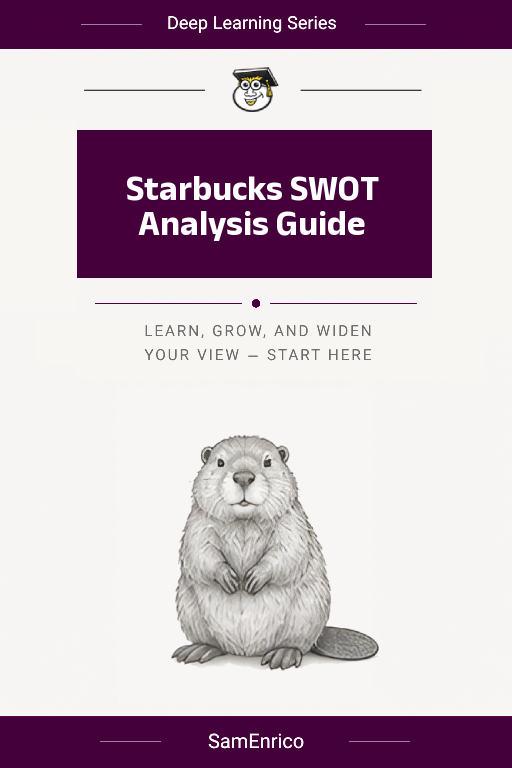
Non-FictionStrategic AtlasCoffee Retail
Starbucks SWOT Analysis Guide
Evaluate store footprint, loyalty program, China g
Evaluate store footprint, loyalty program, China growth, and unionization pressures for coffee giant.
Formats
About this book
Free sample
Chapter 1: The Density Trap...--The numbers looked perfect on paper. Thirty-eight thousand stores. Eighty million weekly customers. A market capitalization that once flirted with $150 billion. For two decades, the formula was simple: open more stores, capture more commuters, print more cash.
The architects of modern Starbucks believed in the inevitability of density—that a store on every corner wasn't just profitable but destiny. By 2019, Manhattan had a Starbucks within a five-minute walk of 92% of its residents. Chicago's Loop had fourteen stores within a half-mile radius. San Francisco's Financial District averaged one Starbucks per every 1,200 office workers.Then the world stopped commuting.The pandemic did not kill Starbucks. But it exposed a fatal assumption buried in the expansion model: that the crowds would always come.
When office occupancy fell to 40% of pre-2020 levels and stayed there for years, the math unraveled. Stores that had been cash machines became cost centers. The "Third Place"—that carefully cultivated idea of a coffeehouse as a living room extension—became, in too many urban locations, a place customers actively avoided due to safety concerns, staffing shortages, and the chaotic overflow of mobile order pickups.This chapter dissects the first of four pressures threatening Starbucks' reinvention: store footprint optimization. Specifically, it examines how the strategy of aggressive global expansion—the once-sacred goal of 55,000 stores—became a liability, why over 400 urban stores closed between 2023 and 2025, and how the twin threats of cannibalization and remote work forced a fundamental rethink of where a coffee company belongs in the post-pandemic city.The Gospel of Growth: How 55,000 Became a Sacred Number To understand the over-saturation crisis, one must first understand the expansion logic that created it. Starbucks, under Howard Schultz's original vision, was never supposed to be ubiquitous.
The first stores were carefully placed in high-traffic urban cores with dense foot traffic and educated, coffee-curious customers. Expansion was disciplined. But the public markets demand growth, and by the mid-2010s, the pressure to show new store openings every quarter overwhelmed the discipline of selective placement.The 55,000 figure first appeared in analyst presentations around 2017. It was not a forecast based on…
This is the end of the free sample. Get the eBook to keep going. Buy now
Contents
- Chapter 1
- Chapter 2
- Chapter 3
- Chapter 4
- Chapter 5
- Chapter 6
- Chapter 7
- Chapter 8
- Chapter 9
- Chapter 10
- Chapter 11
- Chapter 12
Details
- Author
- Armijo Lamonica
- Publisher
- SamEnrico
- Language
- English
- Genre
- Non-Fiction, Strategic Atlas, Coffee Retail
- Released
- 2026-06-01
- Pages (approx.)
- 126
- Available as
- eBook, Audiobook

Read better in the ZLOADR app
Your eBooks on your phone or tablet. Sign in with your SamEnrico account and start reading.
More by Armijo Lamonica
 Teen Affirmation Self Talk GuideArmijo Lamonica$11.99
 The Self Esteem Sexual Confidence GuideArmijo Lamonica$11.99
 Mossy Log RestArmijo Lamonica$11.99
 TM Group Practice Benefits CourseArmijo Lamonica$11.99
 Polio Eradication Campaign HistoryArmijo Lamonica$11.99
 The Silent War: The Betrayal of the Navajo Code TalkersArmijo Lamonica$11.99
 AI Financial Compliance GuideArmijo Lamonica$12.99
 Understanding Muscular Dystrophy Limb-girdle Type 2b, Myoshi TypeArmijo Lamonica$17.99
 Wire Jewelry MakingArmijo Lamonica$11.99
 How to Start a Centralised Supply and Purchasing Service (public Sector) Business (Beginners Guide)Armijo Lamonica$11.99
You may also like
 Hong Kong Handover 1997Dunn Johnnie$11.99
 Zumba For Postnatal Recovery CourseNeal Christian$11.99
 Zumba for BeginnersLadner Nikia$11.99
 YouTube Comment Mining GuideHumes Pandora$12.99
 Worry Box MeditationCarlin Rudy$11.99
 Workplace Stress MeditationNguyen Lynn$11.99
 Workplace Stress and Sleep RepairHawley Ivory$11.99
 Workplace Perfectionism CureDelaney Jeffry$11.99
 Workplace Injustice Anger GuideWallen Isabelle$11.99
 Work Addiction and Burnout LinkGreenwood Ester$11.99
 Women in Yoga and WellnessBeattie Galina$11.99
 Women in Stand Up ComedyChun Evangeline$11.99