
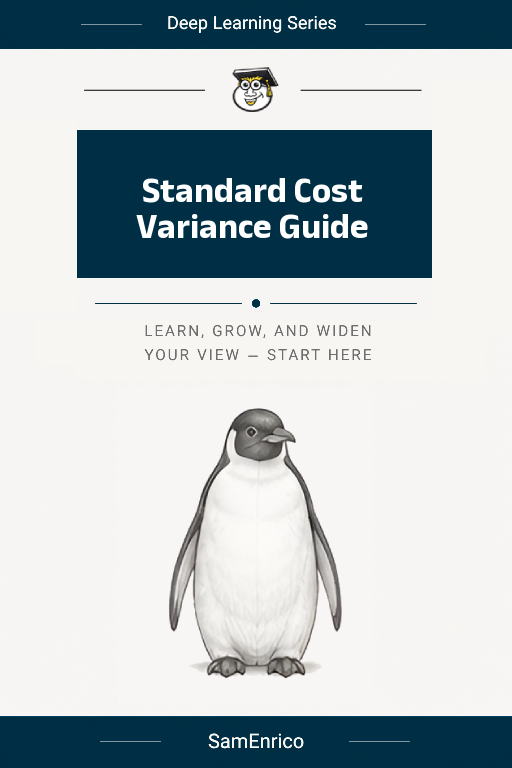
Standard Cost Variance Guide
Calculate material, labor, and overhead variances.
Calculate material, labor, and overhead variances. Apply price and quantity variance formulas to analyze operational performance.
Formats
About this book
Free sample
Chapter 1: The Filter Paradox--–- In a windowless conference room on the third floor of a manufacturing plant that had been operating continuously since 1987, a cost accountant named David watched his screen refresh for the four hundred and seventeenth time that month. His company had just installed a $2.7 million enterprise resource planning system capable of tracking every nut, bolt, and labor minute in real time. The system generated 14,000 cost data points per shift. David's job was to make sense of them. He could not.
The data waterfall was so overwhelming that by the time he finished validating one batch of numbers, three more had arrived. His monthly variance report, once a crisp ten pages, had bloated to eighty-seven pages of tables nobody read. His plant manager, a pragmatic woman named Elena who had worked on the factory floor for twenty years before being promoted, finally told him: "Stop giving me more data. Give me fewer things to worry about."That moment captures the central paradox of modern cost management. We have never had more data about what things actually cost.
And we have never been more confused about what those numbers mean. The promise of real-time analytics, cloud ERP systems, and artificial intelligence was supposed to make cost control effortless. Instead, it has delivered information overload. Without a filter, a flood of actual cost data is not insight—it is noise. The filter that solves this problem was invented nearly a century ago, long before anyone used the words "digital transformation." That filter is standard costing.
And despite what you may have heard, it has never been more relevant than it is today.This chapter confronts the common myth that standard costing is obsolete. It builds the philosophical foundation for everything that follows in this book. You will learn why successful companies don't just track actual costs—they actively measure differences between actual and standard. You will understand the crucial distinction between a standard cost and a budget, two terms that are constantly confused even by experienced managers. You will discover the principle of management by exception, the single most powerful tool…
This is the end of the free sample. Get the eBook to keep going. Buy now
Contents
- Chapter 1
- Chapter 2
- Chapter 3
- Chapter 4
- Chapter 5
- Chapter 6
- Chapter 7
- Chapter 8
- Chapter 9
- Chapter 10
- Chapter 11
- Chapter 12
Details
- Author
- Coulter Trang
- Publisher
- SamEnrico
- Language
- English
- Genre
- Non-Fiction, Student's Shortcut, Variance Analysis
- Released
- 2026-05-29
- Pages (approx.)
- 155
- Available as
- eBook, Audiobook

Read better in the ZLOADR app
Your eBooks on your phone or tablet. Sign in with your SamEnrico account and start reading.
More by Coulter Trang
 Retail Master GuideCoulter Trang$11.99
 Persuasion Data VisualizationCoulter Trang$11.99
 Laci Peterson News ArchiveCoulter Trang$11.99
 Indian GST Annual Return First Year ManualCoulter Trang$11.99
 Gig Economy Stopgap Income GuideCoulter Trang$11.99
 Substance Abuse Young StarsCoulter Trang$11.99
 Fiverr Package Pricing ManualCoulter Trang$11.99
 Citation Rules for Visual LearnersCoulter Trang$11.99
 Binding Language PatternsCoulter Trang$11.99
 The Last Transmission: The USS Scorpion’s Silent DescentCoulter Trang$11.99
 The Great Migration: Voices of the Underground RailroadCoulter Trang$11.99
 The Golden Arches of Empire: Ray Kroc and the Rise of McDonald'sCoulter Trang$11.99