
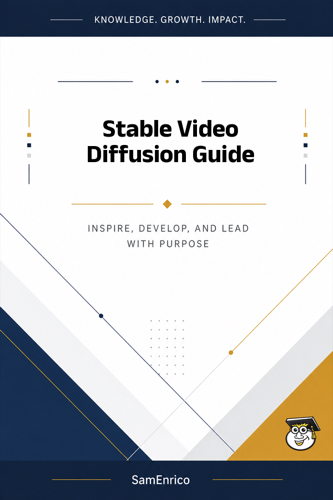
Non-FictionAI OperatorImage-to-Video
Stable Video Diffusion Guide Audiobook
Animate still images into short video clips, contr
Animate still images into short video clips, controlling motion direction and intensity with parameters.
Formats
Free sample
Chapter 1: The Pixel Prison...--Every still image you have ever created or admired is trapped. That breathtaking landscape photograph you captured at golden hour? Frozen. That AI-generated portrait with the perfect lighting? Paralyzed.
That product shot you spent hours composing? Static. For the entire history of visual media, we have been perfecting the art of freezing time, only to realize that what we actually crave is its opposite: motion.Welcome to the post-static era.The human eye is not designed for stillness. Evolution wired your visual cortex to detect movement above almost any other stimulus. A stationary tiger in the bushes might go unnoticed; a twitching tail triggers instant fight-or-flight.
This ancient circuitry explains why animated content consistently outperforms static imagery across every modern metric—social media engagement, advertising recall, emotional resonance, and viewer retention. When you animate a still image, you are not merely adding a gimmick. You are speaking the native language of the human visual system.Stable Video Diffusion, or SVD, represents the first open-source bridge between the world of perfect static generation and the messy, beautiful reality of motion. Unlike commercial tools that treat their algorithms as black boxes, SVD invites you to turn dials, pull levers, and understand exactly why a waterfall flows gently at one setting and crashes violently at another. This chapter traces the lineage of generative video, contrasts SVD with its competitors, and establishes the core conceptual framework you will need to master every subsequent chapter.The Generative Family Tree: From Pixels to Motion To understand where SVD sits in the ecosystem, you must first understand the three generations of generative media.First Generation: Text-to-Image Models In 2022, Stable Diffusion democratized image generation.
For the first time, a user with a consumer graphics card could type "a photograph of a astronaut riding a horse" and receive a plausible image seconds later. These models learned the statistical relationships between words and pixels by compressing billions of images into latent space—a kind of conceptual map where "dog" sits near "wolf" but far from "toaster." The breakthrough was not just quality but accessibility. Open-source weights meant anyone could run, modify, and improve the model.However, image generation has a fatal limitation for storytellers: it produces corpses. Beautiful, high-resolution, perfectly lit corpses. A generated image of a laughing child contains no laughter.
A waterfall contains no flow. You are looking at a photograph of a moment that never existed, frozen forever.Second Generation…
This is the end of the free sample. Get the Audiobook to keep going. Buy now
About this book
Details
- Author
- Frantz Willene
- Publisher
- SamEnrico
- Language
- English
- Genre
- Non-Fiction, AI Operator, Image-to-Video
- Released
- 2026-06-09
- Pages (approx.)
- 137
- Available as
- eBook, Audiobook

Listen in the VoxFlicks app
Audiobooks and audio dramas wherever you go. Sign in with your SamEnrico account and press play.
More by Frantz Willene
 Operation Car Wash Soccer CorruptionFrantz Willene$11.99
 OKRs for Dry JanuaryFrantz Willene$11.99
 Understanding Post Acute Withdrawal SyndromeFrantz Willene$11.99
 Mental Health Partner EsteemFrantz Willene$11.99
 Quetzalcoatl’s Flute: The Song of Feathered SerpentFrantz Willene$11.99
 Understanding Immunodeficiency With Short Limb DwarfismFrantz Willene$17.99
 Cold Storage IoT GuideFrantz Willene$12.99
 First 48 Hours Crisis HandbookFrantz Willene$12.99
 How to Start a Bristle Dressing for Brushes Business (Beginners Guide)Frantz Willene$11.99
 UI ArchitectFrantz Willene$11.99
You may also like
 Hong Kong Handover 1997Dunn Johnnie$11.99
 Zumba For Postnatal Recovery CourseNeal Christian$11.99
 Zumba for BeginnersLadner Nikia$11.99
 YouTube Comment Mining GuideHumes Pandora$12.99
 Worry Box MeditationCarlin Rudy$11.99
 Workplace Stress MeditationNguyen Lynn$11.99
 Workplace Stress and Sleep RepairHawley Ivory$11.99
 Workplace Perfectionism CureDelaney Jeffry$11.99
 Workplace Injustice Anger GuideWallen Isabelle$11.99
 Work Addiction and Burnout LinkGreenwood Ester$11.99
 Women in Yoga and WellnessBeattie Galina$11.99
 Women in Stand Up ComedyChun Evangeline$11.99