
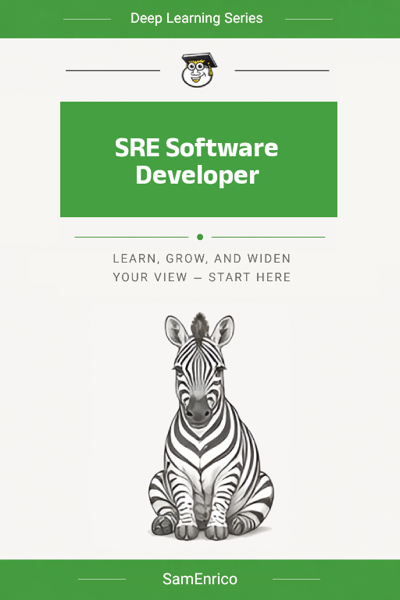
SRE Software Developer eBook
A Coursebook on SRE Software Developer
by Russo Alane
A Coursebook on SRE Software Developer
Formats
Free sample
Chapter 1: The 3 AM Page--– The phone buzzed against Maya’s nightstand like a trapped hornet. She was awake before her eyes opened, that ancient developer instinct firing—the one that knows, deep in your bones, that someone else’s midnight is about to become your problem. 2:17 AM. Pager Duty. “SEV-1: Payment Gateway Timeout Spike.”Her heart didn’t race anymore.
Not after three years of this. Instead, a cold clarity settled over her as she stumbled to her home office, laptop already booting. Her cat, Sauron, glared from the foot of the bed. Even the cat knew.Slack was on fire. Fourteen messages in thirty seconds:“is payments down?”“customers can’t checkout”“@maya what did you deploy?”“we’re losing $$ every minute”Maya’s hands moved automatically: ssh → journalctl → grep ERROR.
The logs screamed something about connection pools and timeouts. She’d added a caching layer yesterday. A simple Redis cache. “Just a performance improvement,” she’d told her manager. “Low risk.
What could go wrong?”Everything. Everything could go wrong.By 3:10 AM, she’d found it. Her connection pool settings were too aggressive. Every pod was holding onto Redis connections, starving the pool, causing timeouts. The fix was simple: roll back the deploy.
By 3:22 AM, payments were flowing again. By 3:45 AM, she’d typed the postmortem draft: “Root cause: developer error. Mitigation: revert change. Lesson learned: be more careful.”She hit send, crawled back to bed, and lay awake until dawn, staring at the ceiling, wondering if she was a good engineer or just a very tired firefighter.Six months later, Maya would look back at that night and realize something that changed her entire career: she hadn’t learned the right lesson at all.The Lie of “Be More Careful”Every developer has a 3 AM story. Maybe not a SEV-1.
Maybe just a broken build, a failed deploy, a test suite that passed locally but exploded in CI. But every developer knows the feeling: your code worked on your machine. Then you shipped it. Then the world caught fire.And every time, the postmortem says the same thing: “Be more careful.”This is a lie.Not a malicious lie. It’s the lie well-meaning teams tell themselves because they don’t know what else to say.
“Be more careful” is the default explanation when you lack the vocabulary to describe what actually happened. It’s the junk drawer of incident analysis—a place to throw everything you don’t understand.Here’s the truth that took Maya six months to learn: Carefulness is a finite resource. Systems are not.You cannot be careful enough, often enough, across enough people, for long enough, to prevent every failure. Humans make mistakes. That’s not a bug; it’s a feature of being human.
If your system fails whenever a human makes a mistake, your system is the problem—not the human.This book is built on a single, radical idea: Software developers must own production outcomes, not just feature delivery.Not “should help with operations sometimes.” Not “can learn a few monitoring basics.” Own. As in, accountable. As in, you don’t stop caring the moment your code passes tests and ships to production.If that sounds terrifying, good. It should. But here’s the paradox: owning production outcomes is the most liberating thing you can do as a developer.
Because once you accept that your code will run in a hostile, unpredictable, failing world, you stop pretending that “works on my machine” is enough. You stop hoping for perfect conditions. You start designing for reality.And reality is messy.The Myth of the Handoff Most software organizations operate on a hidden assumption: developers write code, then throw it over a wall to someone else who runs it.Maybe that “someone else” is an operations team. Maybe it’s a platform team. Maybe it’s a mythical creature called “Dev Ops” that somehow does everything.
Whatever the label, the underlying model is the same: separation of concerns means separation of responsibility.Developers care about features. Ops cares about stability. And never the twain shall meet—except in the weekly status meeting where each side blames the other.This model has a name. It’s called “throwing it over the wall.” And it’s responsible for more 3 AM pages than any single technical failure.Here’s what happens in this model:Developer writes code. Tests pass locally.
Code ships.Something breaks in production.Ops pages the developer at 3 AM.Developer fixes the immediate problem, grumbling about “fragile infrastructure.”Ops adds a new monitoring rule, grumbling about “careless developers.”Repeat.Nobody wins. The developer resents being woken up for “infrastructure problems.” The ops engineer resents cleaning up after “feature factories.” And the customer? The customer just sees another outage.The SRE Software Developer model breaks this cycle by removing the wall entirely.Defining the SRE Software Developer Let’s be precise about what we’re building in this book.An SRE Software Developer is a software engineer who applies systems thinking, operational discipline, and product judgment to build resilient systems. They write code, yes—but they also design for failure, instrument for observability, participate in incident response, and continuously improve reliability through data, not guesswork.This is not a new job title (though it could be). It’s a mindset shift that any developer can adopt.Here’s what an SRE Software Developer does differently:Traditional Developer SRE Software Developer Writes code until tests pass Writes code until it’s production-ready Asks “Does it work?”Asks “How does it break?”Treats outages as someone else’s problem Treats outages as learning opportunities Adds monitoring after the fact Instruments during development Says “it worked on my machine”Says “let me see the logs”Fixes the bug Fixes the process that allowed the bug The SRE Software Developer does not “do operations.” They are operations—not as a full-time job, but as a core competency.
They understand that code doesn’t exist in a vacuum. It runs on hardware (or containers, or serverless functions) that can fail. It talks to networks that can partition. It stores data in databases that can corrupt. It depends on services that can go down.And they design for all of it.What This Book Is (And Isn’t)Before we go further, let me be clear about what you’re holding.This is not an SRE textbook.
There are excellent books about Site Reliability Engineering—Google’s Site Reliability Engineering, The Site Reliability Workbook, Seeking SRE. If you want to join a dedicated SRE team at Google or Netflix, those books are essential reading.This is also not an operations manual. You won’t find 200 pages on configuring Kubernetes or tuning Postgre SQL. Those are important skills, but they’re not the core of what makes an SRE Software Developer.This is a coursebook for developers who want to build reliable systems without becoming full-time operators.You’ll learn how to:Define and track reliability with Service Level Objectives (SLOs)Use error budgets to balance feature work and reliability work Design failure-tolerant code with patterns like circuit breakers and retries Instrument your code for observability (not just monitoring)Run Production Readiness Reviews before launching services Deploy safely…
This is the end of the free sample. Get the eBook to keep going. Buy now
About this book
Details
- Author
- Russo Alane
- Publisher
- SamEnrico
- Language
- English
- Genre
- Non-Fiction, Informative, Educational
- Released
- 2026-05-04
- Pages (approx.)
- 128
- Available as
- eBook, Audiobook

Read better in the ZLOADR app
Your eBooks on your phone or tablet. Sign in with your SamEnrico account and start reading.
More by Russo Alane
 Upwork Freelance Business PlanRusso Alane$11.99
 Ketamine for Depression GuideRusso Alane$11.99
 Career Transition for Tech WorkersRusso Alane$11.99
 Child Star Complete AnthologyRusso Alane$11.99
 Iraq War F18 PilotRusso Alane$11.99
 Seasonal Energy PlanningRusso Alane$11.99
 Luftwaffe Radar CountermeasuresRusso Alane$11.99
 Citation Rules for Editions and VolumesRusso Alane$11.99
 Resentment Toward SiblingsRusso Alane$11.99
 The Silk and the Spy: A Forbidden Love in the Age of ImperialismRusso Alane$11.99
 The Last Voyage of the Mary Celeste: A Ghost Ship's Memory MapRusso Alane$11.99
 The Last Oracle of the Andes: The Hidden Prophecies of the ChasquiRusso Alane$11.99