
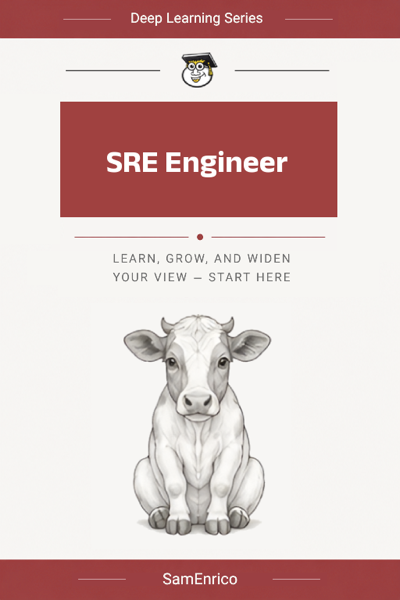
Non-FictionInformativeEducational
SRE Engineer eBook
A Coursebook on SRE Engineer
by Viera Rikki
A Coursebook on SRE Engineer
Formats
Free sample
Chapter 1: The Pager at 3 AM--–- The first time you get paged at 3 AM, you will feel two things simultaneously: the primal jolt of adrenaline that comes from being ripped out of deep sleep, and the sinking realization that you have no idea what the alert means. The dashboard shows green. The error rate looks normal. But the pager does not lie—or rather, the pager does not page itself. Somewhere in the dark silence of the night, a system you are responsible for has decided that you, and only you, are the person who needs to wake up and fix it.
You stumble to your laptop, eyes half-open, and begin the slow, humiliating process of trying to understand what broke while the world slept. By the time you identify the issue—a misconfigured timeout in a service you didn't even know existed—you have been awake for two hours, you have cursed the name of every developer who ever touched the codebase, and you have made a silent promise to yourself: never again. And yet, tomorrow night, or the night after, or the night after that, the pager will scream again. This is the reality of operations work for the vast majority of technology companies. It is not sustainable.
It is not necessary. And it is the reason this book exists.The Great Misunderstanding: What SRE Is Not Before we can understand what Site Reliability Engineering actually is, we must first demolish a persistent and damaging myth: that SRE is just "advanced system administration" or "Dev Ops with a different job title." This misunderstanding has led countless organizations to rebrand their existing operations teams as "SRE," change nothing about how they work, and then wonder why they are still woken up at 3 AM. If you take nothing else from this chapter, take this: SRE is not a role you hire for. It is a practice you build. It is a mathematical framework that treats operations as a software engineering problem, not a human endurance problem.The confusion is understandable.
The term "Site Reliability Engineer" contains the word "engineer," and most engineers think of themselves as builders of new things, not maintainers of old things. The sysadmin of the 1990s and early 2000s was a heroic figure—the person who kept the servers running through sheer force of will, late-night troubleshooting, and an encyclopedic knowledge of arcane configuration files. That model produced memorable war stories but also produced burnout, turnover, and systems that broke in the same ways over and over because no one had time to fix the root causes. The sysadmin was a firefighter. The SRE is the person who designs the building so that fires cannot start in the first place—and when they do, the sprinklers activate automatically.Consider the difference between a traditional operations team and an SRE team in terms of their weekly activities.
A traditional team spends Monday fighting a database connection pool exhaustion issue, Tuesday manually restarting failed batch jobs, Wednesday investigating why a deployment caused errors (and then rolling back manually), Thursday patching a server because the security team found a vulnerability, and Friday writing documentation that no one will read. By Friday afternoon, they are exhausted, they have accomplished nothing that moves the business forward, and they have made zero progress toward preventing next week's fires. An SRE team, by contrast, would spend Monday instrumenting the database to expose connection pool metrics, Tuesday writing a script that automatically restarts failed batch jobs (and alerts only if the script fails), Wednesday implementing canary deployments that roll back automatically when errors exceed a threshold, Thursday automating patching through infrastructure as code, and Friday running a game day where they intentionally break a service to test their automated responses. The difference is not talent or effort. The difference is philosophy.The Three Pillars of the SRE Mindset The SRE approach rests on three foundational pillars that distinguish it from every previous operations methodology.
Understanding these pillars is not optional—they are the grammar of the language you will speak for the rest of this book.Pillar One: Operations Is a Software Problem The first pillar is the recognition that any manual operational task performed more than once should be automated. This sounds obvious, but its implications are radical. If restarting a service is a manual process, you will eventually restart it wrong, or forget to restart it, or restart it too many times, or restart it in the wrong order. Human beings are terrible at repetitive tasks. We get bored, we get distracted, we make mistakes.
Computers, on the other hand, are excellent at repetitive tasks. They will restart the service exactly the same way every single time, and they will do it in milliseconds, not minutes. The job of the SRE is to write the software that automates the toil away, not to perform the toil manually and call it "operational excellence."This shift from manual operations to automated operations is the single most important career move an SRE can make. Every time you find yourself doing the same task twice, you should stop and ask: "Can I write a script for this?" The answer is almost always yes. And if the answer is no because the task is too complex or too unpredictable, then the real problem is that the system is too complex and unpredictable—and that is what you should be fixing instead of performing the manual task.Pillar Two: Reliability Is a Trade-Off, Not an Absolute The second pillar is the concept of acceptable risk.
No system can be 100 percent reliable. The laws of physics, the limits of software engineering, and the finite attention span of your on-call engineers guarantee that something will eventually break. The question is not "how do we achieve perfect reliability?" but rather "how much unreliability are we willing to tolerate in exchange for shipping features faster?" This trade-off is managed through a concept called the error budget, which we will explore in depth in Chapter 3. For now, understand that every decision to prioritize stability over speed, or speed over stability, has a cost. The error budget makes that cost explicit and measurable.The traditional operations mindset treats any downtime as a failure that must never happen again.
This leads to a culture of fear, where no one wants to change anything because change might cause an outage. The result is a system that becomes increasingly brittle over time, held together by undocumented workarounds and tribal knowledge, until eventually it fails catastrophically. The SRE mindset treats downtime as an expected and manageable part of operating at scale. When an outage occurs, the question is not "who caused this?" but "what can we learn from this, and how do we adjust our error budget to account for this type of failure in the future?"Pillar Three: Blamelessness Is a Prerequisite for Learning The third pillar is the most culturally challenging and the most important for long-term success. A blameless culture is not about being "nice" or avoiding difficult conversations.
It is about the cold, hard reality that punishing people for mistakes causes those mistakes to be hidden, not eliminated. When an engineer is afraid that…
This is the end of the free sample. Get the eBook to keep going. Buy now
About this book
Details
- Author
- Viera Rikki
- Publisher
- SamEnrico
- Language
- English
- Genre
- Non-Fiction, Informative, Educational
- Released
- 2026-06-02
- Pages (approx.)
- 147
- Available as
- eBook, Audiobook

Read better in the ZLOADR app
Your eBooks on your phone or tablet. Sign in with your SamEnrico account and start reading.
More by Viera Rikki
 Post Burn Scar Body Image PlanViera Rikki$11.99
 Ray Satyajit Apu TrilogyViera Rikki$11.99
 Executive Burnout Recovery WorkbookViera Rikki$11.99
 Restless Leg Syndrome KidsViera Rikki$11.99
 Self Esteem for Seniors with COPDViera Rikki$11.99
 The Jade Emperor's Celestial Bureaucracy: How China's Gods Govern the CosmosViera Rikki$11.99
 Ultimate Handbook Guide to Xiamen : (China) Travel GuideViera Rikki$11.99
 Understanding Mental Retardation X Linked Borderline Maoa Metabolism AnomalyViera Rikki$17.99
 India Digital Personal Data ActViera Rikki$12.99
 Cost Benefit Prompt Engineering GuideViera Rikki$12.99
You may also like
 Hong Kong Handover 1997Dunn Johnnie$11.99
 Zumba For Postnatal Recovery CourseNeal Christian$11.99
 Zumba for BeginnersLadner Nikia$11.99
 YouTube Comment Mining GuideHumes Pandora$12.99
 Worry Box MeditationCarlin Rudy$11.99
 Workplace Stress MeditationNguyen Lynn$11.99
 Workplace Stress and Sleep RepairHawley Ivory$11.99
 Workplace Perfectionism CureDelaney Jeffry$11.99
 Workplace Injustice Anger GuideWallen Isabelle$11.99
 Work Addiction and Burnout LinkGreenwood Ester$11.99
 Women in Yoga and WellnessBeattie Galina$11.99
 Women in Stand Up ComedyChun Evangeline$11.99