
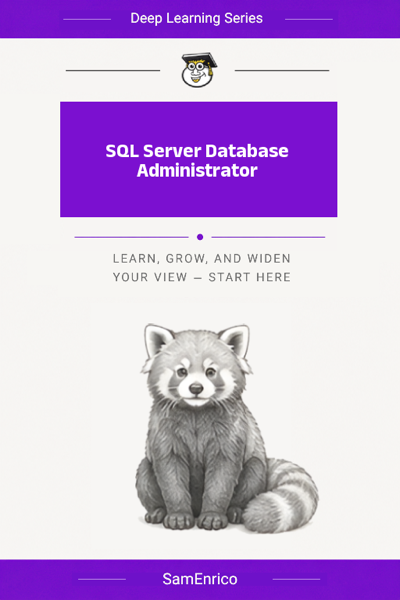
SQL Server Database Administrator eBook
A Coursebook on SQL Server Database Administrator
by Thames Artie
A Coursebook on SQL Server Database Administrator
Formats
Free sample
Chapter 1: The Accidental Guardian...–- Maria Chen never planned to become a database administrator. She had studied computer science with dreams of building artificial intelligence models, but three months into her first job at a midsized insurance firm, the senior DBA quit abruptly. The development team needed someone to figure out why the claims processing system froze every Friday at 3 PM. Maria, the only person who knew what a clustered index was from a database course, inherited 47 production servers, 2,000 databases, and a pager that would not stop buzzing. Her first week involved two all-nighters, a corrupted transaction log, and a frantic call from the CEO asking if customers would get paid on time.
That was seven years ago. Today, Maria leads a team of six DBAs and has learned that the title "Database Administrator" describes less than half of what she actually does. She is a detective, a firefighter, an architect, a diplomat between developers and infrastructure teams, and occasionally a therapist for panicked application owners. This chapter is for everyone like Maria—thrust into the role, overwhelmed by the responsibility, and looking for a map of the territory ahead.The Hidden Reality of the DBA Role Most people outside the database profession imagine a DBA as someone who sits in a dark room, typing arcane commands into a black terminal, emerging only to declare that the backup failed. The reality is more nuanced and far more interesting.
A modern SQL Server DBA operates at the intersection of hardware, operating systems, networks, security compliance, application logic, and human psychology. The database is where the business lives. Every transaction, every customer interaction, every financial record passes through the databases you manage. When the database slows down, the whole company feels it. When the database goes offline, the company stops.The first hard truth about being a DBA is that you become visible only when something breaks.
No one sends a thank-you email for a database that performed perfectly all week. But let a query run for thirty seconds longer than expected during month-end reporting, and suddenly everyone wants to talk to you. This asymmetry between effort and recognition frustrates many new DBAs, but reframing it helps. Your success is measured in absence of failure. A quiet pager means you are doing your job well.
The goal is not glory—it is reliability, integrity, and speed.The Production DBA Versus the Development DBA Versus the BI DBANot all DBAs do the same work. The field has fractured into specializations, and understanding these distinctions helps you chart your career path and communicate your value to employers.The Production DBA focuses on operational stability. These are the people on call overnight, the ones who configure backups, monitor disk space, manage high availability, and respond to emergencies. A production DBA spends more time reading error logs and Dynamic Management Views (DMVs) than writing T-SQL. They worry about recovery time objectives (RTOs) and recovery point objectives (RPOs).
They know exactly how long a full restore takes on every critical database because they have tested it. The production DBA's greatest fear is a corrupted transaction log discovered at 2 AM on a Saturday.The Development DBA sits between the developers and the database engine. They review schema changes, tune queries before they reach production, implement indexing strategies, and design database structures that balance normalization with performance. Development DBAs need deep understanding of execution plans, statistics, and query optimizer behavior. They attend application design meetings and push back when developers want to put GUID clustered indexes on hundred-million-row tables.
The development DBA speaks both developer language and database language, translating between the two worlds.The BI DBA specializes in the business intelligence stack: Integration Services (SSIS), Reporting Services (SSRS), and Analysis Services (SSAS). They optimize ETL workflows, manage report subscriptions, tune MDX or DAX queries, and ensure that the data warehouse refreshes before executives arrive at 8 AM. The BI DBA worries about columnstore indexes, partition switching, and processing strategies for large cubes. They understand slowly changing dimensions and the difference between a snowflake and star schema.Most DBAs, especially early in their careers, wear multiple hats. A small company might expect its sole DBA to handle production emergencies, review developer pull requests, and build the weekly sales report.
Recognizing which specialization aligns with your strengths helps you target learning and, eventually, negotiate roles that fit your interests.The SQL Server Ecosystem: More Than Just a Database Engine When people say "SQL Server," they often mean the database engine—the core service that stores data and processes queries. But the SQL Server product family includes several major components that fall under the DBA's purview.The Database Engine is your primary responsibility. It handles ACID compliance, locking, indexing, query processing, and transaction logging. You will spend eighty percent of your time here.Integration Services (SSIS) is the ETL platform. It moves data between sources and destinations, cleans transformations, and orchestrates complex data flows.
A BI DBA manages SSIS catalogs, monitors package execution, and troubleshoots performance bottlenecks in data flows. SSIS packages run via SQL Server Agent jobs, so even if you never open the SSIS designer, you will need to know why a package failed and how to restart it from a checkpoint.Reporting Services (SSRS) delivers paginated reports to business users. DBAs manage report subscriptions, configure execution accounts, monitor report server databases, and occasionally debug why a report renders slowly or times out. Understanding SSRS means knowing how report execution caches work, what snapshot isolation does for report consistency, and how to deploy reports programmatically.Analysis Services (SSAS) provides semantic modeling for BI. It comes in two flavors: multidimensional (the legacy OLAP engine) and tabular (the modern in-memory model).
Managing SSAS involves processing partitions, monitoring memory pressure, tuning DAX queries, and configuring security roles. A growing number of organizations use Azure Analysis Services instead of on-premises SSAS, but the management principles remain similar.You do not need to become an expert in all four pillars to be a great DBA. Understanding what each component does, how to check if it is running, and where to find its logs covers ninety percent of what you will need. The remaining ten percent you learn when something breaks.The Soft Skills That Separate Good DBAs from Great Ones Technical skill gets you hired. Soft skills keep you employed and promotable.
The stereotype of the antisocial DBA who refuses to talk to developers persists, but the best DBAs I have worked with are exceptional communicators.Managing expectations tops the list. When a developer asks, "How long will this restore take?" do not guess. Say, "I need to test the restore on a non-production server to give you an accurate estimate. I will have an answer in two hours." Developers respect honesty even when the news is bad. They do not respect guesses that turn out wrong.Saying no without saying no is an art.
When an application team requests sysadmin access "just to run a trace," do not simply decline. Explain the risk: a single misconfigured trace flag can bring down the instance. Then offer an alternative: "I will create a limited user with VIEW SERVER STATE and ALTER TRACE permissions. That gives you…
This is the end of the free sample. Get the eBook to keep going. Buy now
About this book
Details
- Author
- Thames Artie
- Publisher
- SamEnrico
- Language
- English
- Genre
- Non-Fiction, Informative, Educational
- Released
- 2026-05-11
- Pages (approx.)
- 152
- Available as
- eBook, Audiobook

Read better in the ZLOADR app
Your eBooks on your phone or tablet. Sign in with your SamEnrico account and start reading.
More by Thames Artie
 Meeting Minute Efficiency GuideThames Artie$11.99
 Challenge Skill BalanceThames Artie$11.99
 Hydration to Reduce CravingsThames Artie$11.99
 The Liquidation Preference DatabaseThames Artie$11.99
 First Responder Relationship StressThames Artie$11.99
 Saladin’s Symphony: The Lion of Islam’s March to VictoryThames Artie$11.99
 How to Start a Blasting and Associated Rock Removal Work Business (Beginners Guide)Thames Artie$11.99
 Business Registration in GhanaThames Artie$12.99
 Madrid Priority ClaimThames Artie$12.99
 Understanding Wegener's GranulomatosisThames Artie$17.99