
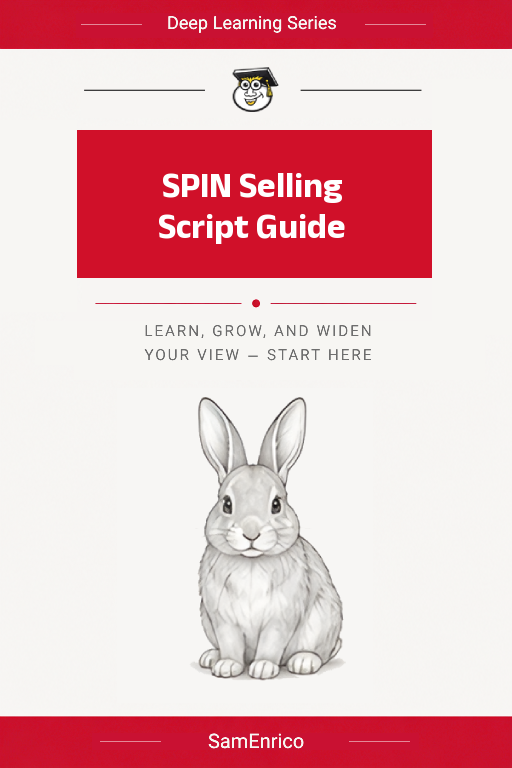
SPIN Selling Script Guide eBook
Apply SPIN methodology with Situation, Problem, Im
Apply SPIN methodology with Situation, Problem, Implication, Need-Payoff questions in scripts.
Formats
Free sample
Chapter 1: The Script Trap--–- Every sales script you have ever been handed is designed to fail. That is not an opinion. It is a conclusion drawn from 35,000 sales calls analyzed over twelve years by the Huthwaite research team. The data was clear: traditional scripts—those neat lists of opening lines, benefit statements, and closing phrases—worked perfectly well for small, simple transactions. But when the sale became complex, when the buyer faced real risk, when the decision involved multiple stakeholders, those same scripts collapsed.
Not because the words were wrong. Because the entire premise was backwards.The premise of most sales training is that you need to say the right thing at the right time. Say this objection handler. Say that benefit statement. Say this closing question.
The SPIN methodology flips that premise entirely. The goal is not to say the right thing. The goal is to ask the right thing. And not just any questions—questions in a specific sequence that mirrors how the human brain actually makes buying decisions.This chapter will dismantle the assumptions behind traditional scripts, introduce the four-quadrant SPIN framework that replaces them, and establish the single most important rule that governs every successful complex sale. By the end, you will understand why most scripts feel like wrestling an alligator and why the SPIN approach feels like a conversation.The Three Failures of Traditional Scripts Before we build something better, we need to understand what we are replacing.
Traditional sales scripts suffer from three fatal flaws, each documented in the Huthwaite research.Failure One: The Premature Solution The most common pattern in failed sales calls is what researchers called the “premature solution.” The seller identifies a problem—often a small, surface-level problem—and immediately jumps to presenting their product as the answer. The conversation sounds like this:Seller: “So your current reporting takes ten days?”Buyer: “Yes, it’s a bit slow.”Seller: “Our platform automates reporting. Let me show you.”The buyer’s implicit need (“a bit slow”) never became an explicit need (“this delay is costing us $50,000 per quarter and jeopardizing our audit compliance”). Without that amplification, the buyer has no urgency. The product sounds like a nice-to-have.
And nice-to-have purchases get delayed, budgeted against, and eventually forgotten.The research showed that successful sellers spent significantly more time on the problem before introducing any solution. They asked an average of four times more problem-related questions than unsuccessful sellers. The premature solution is not just inefficient—it is the primary cause of price objections, ghosting, and deal stalls.Failure Two: The Feature Monologue The second failure is the feature monologue. Traditional scripts often include long lists of product features, each paired with a generic benefit statement. The seller recites these as if checking boxes.
“Our platform offers real-time analytics. That means you get faster insights. It also offers automated alerts. That means you never miss a deadline. It also offers…”The buyer’s brain, meanwhile, has checked out.
The problem is not that features are irrelevant. The problem is that features have no inherent value until the buyer connects them to a specific, felt pain. A feature is just a claim. A benefit is just a prediction. But when the buyer themselves articulates what a solution would mean for their specific situation, that is not a claim or a prediction.
That is a commitment.Successful sellers in the Huthwaite study spent almost no time describing features. Instead, they asked questions that led the buyer to describe the benefits. The seller’s job is not to be interesting. The seller’s job is to make the buyer feel intelligent for seeing the value themselves.Failure Three: The Aggressive Close The third failure is the aggressive close. Traditional scripts often include high-pressure closing techniques: the assumptive close (“Shall I put this on your card?”), the urgency close (“This price expires Friday”), the sharp angle close (“If I could show you a way to save 20 percent, would you be interested?”).
These techniques work—sometimes—for low-cost, low-risk, transactional sales. Think retail, door-to-door, or short-term subscriptions.But in complex B2B sales, aggressive closes backfire. The buyer becomes defensive. They sense manipulation. They ask for more time, more information, more approvals.
The Huthwaite data showed that the most successful sellers did not use any recognizable closing technique. Instead, they obtained commitment naturally by summarizing the value the buyer had already articulated. The close was not a performance. It was a formality.The SPIN Solution: Four Questions, One Sequence The solution to these three failures is the SPIN framework. SPIN is an acronym for four types of questions: Situation, Problem, Implication, and Need-Payoff.
Each type serves a distinct purpose. Each builds on the previous. And together, they form a sequence that mirrors the buyer’s psychological journey from indifference to action.Let us define each quadrant clearly, because confusion here leads to failure later.Situation Questions: The Context Gatherers Situation questions ask for facts about the buyer’s current environment. Examples include: “How do you currently handle lead routing?” “What software do you use for inventory management?” “How many people are on your quality assurance team?”These questions are necessary but dangerous. Necessary because you cannot solve a problem you do not understand.
Dangerous because buyers hate answering questions they believe you should already know. The research showed that unsuccessful sellers asked far more Situation questions than successful sellers. Why? Because unsuccessful sellers did not do their homework. They used the sales call as their research method.The rule for Situation questions is brutal but simple: only ask what you cannot discover through pre-call research.
If the answer is on Linked In, the company’s website, their annual report, or a quick Google search, you should already know it. Asking a buyer “How many salespeople do you have?” when their Linked In company page lists 150 employees in sales roles signals laziness. It erodes credibility before you have earned any.Low-risk Situation questions are open-ended and process-oriented. “Walk me through your current workflow from lead capture to close.” That question cannot be answered by research. It invites the buyer to tell a story.
High-risk Situation questions are fact-based and closed-ended. “Do you use Salesforce?” That question has a yes/no answer. It signals you did not check their website or their job postings.The goal with Situation questions is to ask just enough to establish context, then move on. Think of them as the scaffolding of a building—necessary during construction but invisible in the final structure.Problem Questions: The Pain Uncoverers Problem questions ask about difficulties, frustrations, and unmet needs. Examples include: “What aspects of your current reporting process cause the most frustration?” “Where do errors typically creep into your quality checks?” “How much time does your team lose each week to manual data entry?”These questions are the heart of discovery.
They surface implicit needs—the vague complaints that every buyer has but few feel compelled to solve. The key insight from the Huthwaite research is that implicit needs do not predict sales success. Almost every buyer has implicit needs. The buyers who actually buy are those who turn implicit needs into explicit needs—specific, quantified consequences they are…
This is the end of the free sample. Get the eBook to keep going. Buy now
About this book
Details
- Author
- Byrnes Casandra
- Publisher
- SamEnrico
- Language
- English
- Genre
- Non-Fiction, First 30 Days, SPIN Selling
- Released
- 2026-05-30
- Pages (approx.)
- 139
- Available as
- eBook, Audiobook

Read better in the ZLOADR app
Your eBooks on your phone or tablet. Sign in with your SamEnrico account and start reading.
More by Byrnes Casandra
 The Remote Work Morning HuddleByrnes Casandra$11.99
 Resentment and Shame HandbookByrnes Casandra$11.99
 Plant Based Menopause Nutrition ManualByrnes Casandra$11.99
 The Construction Worker StretchByrnes Casandra$11.99
 John Tyler Accidental President GuideByrnes Casandra$11.99
 The Desert Codebreakers: Unlocking Ancient Secrets in Jordan's Secret LabByrnes Casandra$11.99
 Pets.com: The $300 Million Dog That Didn’t BarkByrnes Casandra$11.99
 Understanding CryoglobulinemiaByrnes Casandra$17.99
 Supplemental Examination GuideByrnes Casandra$12.99Supplemental Examination GuideByrnes Casandra$12.99
 Smart Home InstallerByrnes Casandra$11.99
 A Beginners Guide to Bank pool (Volume 1)Byrnes Casandra$11.99