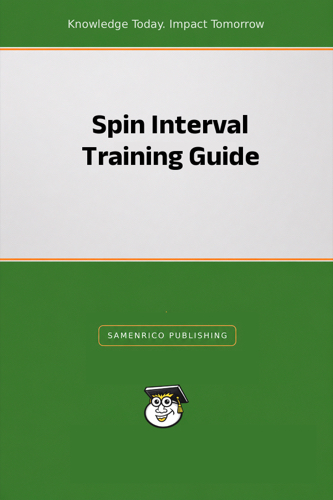
Spin Interval Training Guide eBook
Perform timed sprints, climbs, and recovery segmen
Perform timed sprints, climbs, and recovery segments for maximum burn.
Formats
Free sample
Chapter 1: The Afterburn Lie--Every fitness magazine, every influencer, and every well-meaning friend who has ever told you that “long, slow cardio is the best way to burn fat” has sold you a well-packaged half-truth. They showed you images of marathoners with lean, sinewy bodies and spin instructors with chiseled legs, and they implied a simple equation: more time on the bike equals more fat off your body. It makes intuitive sense, doesn’t it? Move for an hour, burn 500 calories. Move for two hours, burn 1,000.
But here is the uncomfortable reality that the fitness industry rarely shouts from the rooftops: the human body is not a simple calorie furnace. It is a complex, adaptive, retaliatory biological system that actively fights against steady-state endurance. And for the vast majority of people seeking maximum fat loss in minimum time, the traditional long ride is one of the least efficient tools in the shed.This book is built on a different premise—one that has been validated by decades of exercise physiology research but only recently made its way into boutique spin studios and the training logs of elite cyclists. That premise is this: what you do during your workout matters far less than what your body is forced to do after you step off the bike. The secret to melting stubborn adipose tissue does not lie in the ninety minutes of moderate pedaling.
It lies in the metabolic chaos you create during short, violent bursts of effort followed by carefully timed recoveries. This chapter will dismantle the steady-state myth, introduce you to the single most important physiological concept for interval training—the afterburn effect—and redefine what the phrase “maximum burn” actually means in the context of this book. By the time you finish these pages, you will never look at a spin bike the same way again. You will understand why a twenty-minute session of timed sprints and climbs can outperform a sixty-minute slog, and you will be armed with the science to explain it to every skeptic who tells you that “real” workouts take an hour.The Myth of the Fat-Burning Zone Let us begin by killing a sacred cow. For decades, cardio equipment manufacturers and fitness certifications have promoted the concept of the “fat-burning zone.” You have seen it: the colorful chart on the treadmill display showing that at low to moderate intensity (roughly 50–65% of your maximum heart rate), your body derives a higher percentage of its energy from fat stores rather than carbohydrates.
This is scientifically true—in a petri dish, at a single moment in time. At rest or during a gentle walk, your body prefers to burn fat because fat provides nine calories per gram and is a dense, slow-burning fuel. During high-intensity effort, your body switches to carbohydrates (glycogen) because carbs can be mobilized and broken down more quickly, even though they provide only four calories per gram.Here is where the lie creeps in. The “fat-burning zone” ignores the single most important variable in weight loss: total caloric expenditure, not percentage of fuel source. Imagine two people.
Person A rides at a gentle pace in the fat-burning zone for one hour, burning 300 calories, 70% of which come from fat (210 fat calories). Person B performs twenty minutes of high-intensity intervals, burning 250 total calories, but only 40% from fat (100 fat calories). Based on the zone chart, Person A wins, right? Wrong. The chart does not account for what happens when Person B steps off the bike.
Person A’s metabolism returns to baseline within thirty to sixty minutes. Person B’s metabolism, however, has been thrown into a state of biochemical chaos, and it will take the body anywhere from fourteen to twenty-four hours to fully restore order. During that restoration period, the body burns additional calories—many of them from fat—without Person B lifting a finger.This phenomenon is called Excess Post-Exercise Oxygen Consumption, or EPOC. It is the scientific name for the afterburn effect. And it is the single most underutilized tool in the average exerciser’s arsenal.
A 2011 meta-analysis published in the Journal of Exercise Science and Fitness reviewed over forty studies on EPOC and concluded that high-intensity interval training (HIIT) produces a significantly greater and more prolonged post-exercise oxygen consumption compared to steady-state training, even when total work performed is equal. In plain English: intervals keep your body burning calories for hours after you have showered and gone back to your desk. Steady-state cardio stops burning extra calories almost as soon as you stop moving.The Biochemistry of Chaos: How Sprints Break Your Metabolism (In a Good Way)To truly understand why timed sprints and climbs produce maximum burn, you need a basic map of what happens inside your muscle cells during an all-out effort. Do not worry—this is not a medical textbook, and we will return to this map throughout the book as needed. But the foundation is essential.Your body has three primary energy systems.
The first is the phosphocreatine (PCr) system, which provides immediate energy for about ten to fifteen seconds of maximum output—think of a standing start sprint. The second is the glycolytic (anaerobic) system, which kicks in after that and can sustain high-intensity effort for roughly sixty to ninety seconds by breaking down stored glycogen without oxygen. The third is the oxidative (aerobic) system, which uses oxygen to produce energy for low-to-moderate intensity efforts lasting minutes or hours.When you perform a timed sprint of fifteen to sixty seconds, you primarily engage the PCr and glycolytic systems. These systems produce a massive amount of force quickly, but they also generate metabolic byproducts—most notably hydrogen ions and lactate. For decades, athletes were taught that lactate was a “waste product” that caused muscle burn and fatigue.
That understanding is now outdated. Modern sports science recognizes lactate as a crucial fuel source and signaling molecule. But the hydrogen ions that accompany lactate production are problematic; they lower the p H of your muscle cells, creating an acidic environment that interferes with muscle contraction and nerve signaling. That burning sensation you feel in your legs during the last five seconds of a sprint is not lactate. It is the acidic environment caused by the rapid accumulation of hydrogen ions.Here is where the afterburn effect begins.
After you stop the sprint and enter your recovery segment, your body must work hard to restore homeostasis. It must:Replenish depleted ATP (the energy currency of the cell) and PCr stores.Convert lactate back into usable fuel (gluconeogenesis).Buffer and clear hydrogen ions to restore normal muscle p H.Re-oxygenate the blood and tissues.Repair microscopic damage to muscle fibers.Elevate body temperature, which itself increases metabolic rate.Increase heart rate and respiratory rate, both of which require energy.Every single one of those processes requires oxygen. Every single one of them burns calories. And crucially, the more intense the work interval, the greater the disturbance, and the longer and more expensive the cleanup process. A gentle twenty-minute spin creates a small disturbance that your body cleans up in half an hour.
A twenty-minute session of 30/30 climbs (thirty seconds hard, thirty seconds easy) creates a massive disturbance that your body may…
This is the end of the free sample. Get the eBook to keep going. Buy now
About this book
Details
- Author
- Summitt Crista
- Publisher
- SamEnrico
- Language
- English
- Genre
- Non-Fiction, Health & Wellness, Cardio
- Released
- 2026-06-10
- Pages (approx.)
- 149
- Available as
- eBook, Audiobook

Read better in the ZLOADR app
Your eBooks on your phone or tablet. Sign in with your SamEnrico account and start reading.
More by Summitt Crista
 Family History Preservation WorkbookSummitt Crista$11.99
 Affirmation for KidsSummitt Crista$11.99
 Nights and Weekends Spending FixSummitt Crista$11.99
 The Influencer Contract Disclosure GuideSummitt Crista$11.99
 Giselle's Legacy: How One Ballerina Defied Gravity and Changed Ballet ForeverSummitt Crista$11.99
 Low Income Literacy SolutionsSummitt Crista$12.99
 Certification for Palm Oil ExportSummitt Crista$12.99
 Ultimate Handbook Guide to Ahwaz : (Iran) Travel GuideSummitt Crista$11.99
 HistotechnicianSummitt Crista$11.99
 Understanding Usher Syndrome, Type 1eSummitt Crista$17.99