
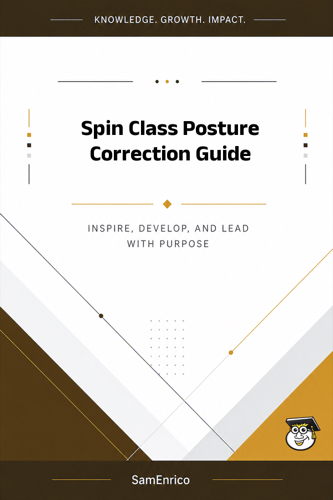
Spin Class Posture Correction Guide eBook
Fix rounded shoulders, locked elbows, and bouncing
by Cordova Kit
Fix rounded shoulders, locked elbows, and bouncing hips to ride more efficiently and prevent pain.
Formats
Free sample
Chapter 1: The Kinetic Heist--–- Every time you push down on a pedal, you generate force. That force travels through your body like water through a garden hose. But here’s what no spin instructor has ever told you: most riders lose 40% of that force before it ever reaches the flywheel. Not because they are weak. Not because they are unfit.
Because they have a leak. And that leak is called posture.The average spin class burns between 400 and 700 calories per session. But the average spinner also wastes nearly half their effort through three simple mechanical errors: rounded shoulders that collapse the upper body, locked elbows that turn arms into rigid rods instead of shock absorbers, and bouncing hips that convert horizontal power into vertical chaos. If you have ever left a spin class with neck pain, numb hands, a sore lower back, or the nagging feeling that you worked twice as hard as the person next to you but got half the result, you have experienced the kinetic heist. Someone—or something—stole your power.
That someone is you. And this chapter will show you exactly how the theft happens, why spin bikes are different from every other bike on earth, and why the posture that feels comfortable in daily life is the same posture that is robbing you blind on the saddle.The Spin Bike Is Not a Road Bike Before we can fix anything, we must understand what makes a spin bike unique. Most people assume that cycling is cycling—that the posture advice for road riding, mountain biking, or even casual cruising applies equally to a spin class. This assumption is dangerously wrong. A spin bike is a fixed-gear machine with a heavy flywheel that creates momentum.
Unlike a road bike, you cannot coast. The pedals move as long as the flywheel spins, which means your body is under constant, unrelenting load. There is no micro-rest during a descent or a glide through an intersection. Every second of every class, your muscles are engaged, and every second, your posture is either saving you or sabotaging you.Second, a spin bike is static. On a road bike, you shift your weight to climb, descend, corner, and avoid potholes.
Your body moves dynamically with the terrain. On a spin bike, the bike does not move. The handlebars do not turn. The frame does not flex. Your body is fixed in space relative to the machine.
This means that any postural fault is not a momentary slip—it is a repetitive strain that repeats 80 to 100 times per minute, for 45 minutes, three to five times per week. Multiply that by a year, and a small error becomes a chronic injury.Third, spin bike geometry varies wildly. Some spin bikes mimic a time trial position with handlebars significantly lower than the saddle. Others are more upright, like a city bike. Unlike a professional bike fit that costs hundreds of dollars, most spin bikes are adjusted by riders who guess at saddle height and handlebar position.
The result is a machine that actively encourages poor posture. The handlebars invite you to lean forward, which rounds the shoulders. The fixed position encourages you to lock your elbows for stability. And the heavy flywheel begs you to mash down with your quads, which bounces your hips like a basketball.Understanding these differences is not academic. It is practical.
A road cyclist can get away with mediocre posture for a 20-mile ride because they can change positions, stand up, and coast. A spinner has no such luxury. You are locked into a repetitive motion prison. And your only escape is perfect posture.The Kinetic Chain: Your Body as a Machine Imagine a line of people passing buckets of water from a river to a burning building. The person at the river fills a bucket.
They hand it to the next person. That person hands it to the next. If every person is strong, stable, and aligned, the water reaches the fire quickly. But if one person drops the bucket, fumbles the pass, or spills half the water, the chain breaks. Your body works exactly the same way.
Force is generated at the foot—specifically at the ball of the foot where it meets the pedal. From there, it travels up through the ankle, the knee, the hip, the pelvis, the spine, the shoulder, the elbow, the wrist, and finally into the handlebars. That pathway is called the kinetic chain. Every joint in that chain is a potential leak.The most efficient position is what biomechanists call "stacked joints." When your body is correctly aligned, the bones bear the load instead of the muscles. Imagine a column of children’s blocks stacked perfectly straight.
You can place a heavy book on top, and the stack holds. Now imagine the same blocks slightly tilted. The book slides off, or the blocks collapse. Your skeleton is the same. When your ear, shoulder, hip, and ankle align vertically, your bones transfer force directly down through the pedals.
When they are misaligned, your muscles have to work overtime just to keep you upright, let alone produce power. That is why two riders with identical fitness levels can produce wildly different outputs. The one with stacked joints is using their skeleton. The one with poor posture is using their muscles as scaffolding.Here is the hard truth: your comfortable standing posture is probably your worst enemy on the bike. Most people sit at desks, look at phones, and drive cars in a position of chronic thoracic flexion—rounded shoulders, forward head, collapsed chest.
That position feels normal because it is your baseline. But when you get on a spin bike, that same rounded posture is magnified by the forward lean of the handlebars. You are not fixing your posture on the bike. You are bringing your office chair onto the saddle.The Three Silent Thieves This book revolves around three specific posture faults because they account for over 90% of spin-related pain and inefficiency. Each fault has a name, a mechanism, and a fix that you will learn in subsequent chapters.
But first, you must recognize them.The first thief is rounded shoulders. Anatomically, this is upper cross syndrome: tight pectoral muscles and upper trapezius paired with weak rhomboids, lower trapezius, and deep neck flexors. On a spin bike, rounded shoulders collapse the chest, restrict breathing, and shift the head forward, which strains the neck. But the real crime is mechanical. Rounded shoulders pull your center of mass forward over the handlebars, which forces your arms to bear weight they were never designed to carry.
That weight then travels down the kinetic chain and locks your elbows, which creates the second thief.The second thief is locked elbows. When your elbows are straight—0 degrees of bend—your arms become rigid rods. Rigid rods do not absorb vibration. They transmit it. Every pedal stroke sends a shockwave from the handlebars, through your locked elbows, into your shoulders, and up your neck.
That is why so many spinners finish class with trapezius muscles that feel like concrete. Locked elbows also compress the ulnar nerve, which runs along the inside of the elbow and into…
This is the end of the free sample. Get the eBook to keep going. Buy now
About this book
Details
- Author
- Cordova Kit
- Publisher
- SamEnrico
- Language
- English
- Genre
- Non-Fiction, Health & Wellness, Posture
- Released
- 2026-06-09
- Pages (approx.)
- 137
- Available as
- eBook, Audiobook

Read better in the ZLOADR app
Your eBooks on your phone or tablet. Sign in with your SamEnrico account and start reading.
More by Cordova Kit
 Teen Rumination Stopping GuideCordova Kit$11.99
 Loneliness Emotional RegulationCordova Kit$11.99
 Stalking Religious Leader CasesCordova Kit$11.99
 Antwerp Diamond Heist Anniversary ReckoningCordova Kit$11.99
 The Last Dance of the TitanicCordova Kit$11.99
 Echoes of the Moon: The Apollo 12 Mission's Forgotten TwinCordova Kit$11.99
 Understanding Doxorubicin-induced CardiomyopathyCordova Kit$17.99
 How to Start a Screenplay Writers - Independent BusinessCordova Kit$11.99
 CarpentryCordova Kit$11.99
 AI Legal Document GeneratorCordova Kit$12.99
 Right To Work Laws GuideCordova Kit$12.99
You may also like
 Ergonomic WorkspaceCates Riva$11.99
 Spin Posture Perfect GuideRandle Mei$11.99
 Posture and Pelvic Floor GuideBurr Kathie$11.99
 Upper Back Flexibility GuideColwell Mary$11.99
 The Arthritis Posture GuideBecnel Hoa$11.99
 Spin Desk Job SolutionMccaffrey Thomasina$11.99
 Strength Training For PostureByrnes Gail$11.99
 The Posture Correction StretchHoneycutt Bobbie$11.99
 Chest Opening Stretching GuideCaballero Karolyn$11.99
 Upper Back Mobility WorkRitchey Loren$11.99
 Spin Posture and Alignment FixWorden Sandy$11.99
 Massage For PostureRead Tamie$11.99