
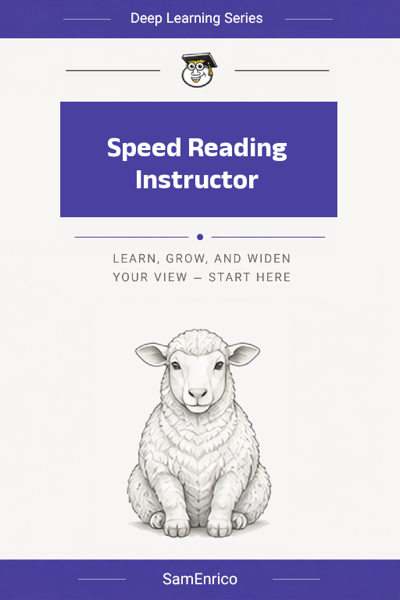
Non-FictionInformativeEducational
Speed Reading Instructor eBook
A Coursebook on Speed Reading Instructor
by Ritchey Jama
A Coursebook on Speed Reading Instructor
Formats
Free sample
Chapter 1: The Stack of Shame--–- The stack sat on the nightstand for eleven months.Three hundred and thirty days. Thirty-three books, most of them untouched beyond the first chapter. A biography of Steve Jobs with a bookmark still wedged between pages 47 and 48. A novel recommended by a friend, the spine still cracking with newness. A business book about negotiation strategies, its cover already dog-eared from being moved aside to reach the alarm clock.
And underneath it all, a single paperback about speed reading itself—bought on impulse at an airport bookstore, read through page 12, then abandoned like all the rest.This is the Stack of Shame. Every reader has one. It might live on a nightstand, a coffee table, a Kindle home screen, or a browser tab labeled "Read Later" that has not been opened in eighteen months. It represents a quiet, persistent failure that no one talks about at dinner parties. We discuss our workout routines, our diets, our career achievements.
We do not discuss the books we intended to read but could not.The average American adult purchases seventeen books per year. The average American adult finishes five. That means twelve books per person, per year, join the Stack of Shame. Multiply that by the number of adults in the United States, and you arrive at a staggering number: over two billion unfinished books sitting unread on nightstands, coffee tables, and digital devices at this very moment.Two billion.That is not a reading problem. That is a crisis of unfinished intention.The Lie We Tell Ourselves The most damaging lie about reading is also the most common: “I am just not a fast reader.”This is not modesty.
This is a self-diagnosis that people accept as permanent, like eye color or shoe size. “I am just not a fast reader” is delivered with the same finality as “I am not a morning person” or “I have no sense of direction.” It is treated as a fixed trait, a genetic limitation, a box checked on the character sheet at birth.It is also completely false.Reading speed is not a fixed trait. It is a skill. And like any skill—typing, cooking, playing a musical instrument, learning a language—it responds to training. The difference is that no one expects to sit down at a piano for the first time and play a Chopin nocturne.
But every day, millions of adults sit down with a book and expect to read at the same speed they did in fourth grade, using the same techniques they learned when they were nine years old, and they call themselves “slow” when those techniques fail them.You were never taught to read. You were taught to decode.Decoding is the process of converting letters into sounds and sounds into words. It is what children learn in kindergarten and first grade. They point to the letter C, they say “kuh,” they point to the letter A, they say “ah,” they blend them into “ca,” and eventually they recognize “cat.” This is an extraordinary achievement for a five-year-old brain. It is a disaster for an adult brain trying to process forty pages of dense technical material before a Tuesday deadline.Decoding is slow.
Decoding is sequential. Decoding requires the inner voice to sound out every syllable. And decoding is completely unnecessary once you have achieved basic literacy.You do not need to sound out the word “cat” anymore. You recognize it instantly, as a single visual shape, the way you recognize a face in a crowd. You do not sound out “M-O-T-H-E-R” every time you see the word.
You see the shape, the configuration of letters, and meaning appears. This is called visual word recognition, and your brain is already doing it for thousands of words.The problem is that your eyes have not been trained to do it efficiently. And your inner voice has not been trained to get out of the way.The Actual Speed Limit Is Not What You Think Let us conduct a small experiment. Read the following sentence at your normal speed:The quick brown fox jumps over the lazy dog.Now ask yourself: how long did your eyes pause on each word? If you are like most readers, you fixated on each of the nine words individually.
Your eyes jumped (that is the saccade), paused (that is the fixation), jumped again, paused again. Nine fixations for one sentence.Now read this sentence:Thequickbrownfoxjumpsoverthelazydog.That is uncomfortable, is it not? Your brain is working harder, because the spaces are gone. The spaces are not just polite formatting. They are instructions to your visual system.
They tell your eyes where to stop and where to start.But here is the secret: your eyes can see more than one word per fixation. In fact, your eyes can see up to four words to the left of a fixation point and up to fifteen words to the right. That is not a theoretical maximum. That is the physical capability of the human fovea—the high-acuity center of the retina—when it is properly trained.The reason you fixate on every single word is not because your eyes are incapable of seeing more. It is because your reading training stopped at age nine, and no one ever told you that you could see more.The biological throughput of the human visual system is approximately 1,000 to 1,500 words per minute.
That is not a marketing claim from a late-night infomercial. That is the upper limit of what the optic nerve and the visual cortex can process, given ideal conditions and expert training.The average adult reads between 200 and 250 words per minute.You are currently operating at twenty percent of your biological capacity.The Four Saboteurs Why is the gap so large? Four habits, learned in childhood and reinforced over decades, are sabotaging your reading speed. You can think of them as the Four Saboteurs. They work together, each making the others worse.The first saboteur is subvocalization.
This is the inner voice that reads every word aloud inside your head. When you read the word “subvocalization,” you just heard it in your mind. That is subvocalization in action. It is not a bad thing—it helps with comprehension, especially for complex material. But when it runs at full speed for every word, it caps your reading speed at approximately 300 words per minute, because that is about as fast as you can speak.
Your inner voice cannot talk faster than your outer voice. And your outer voice cannot talk at 600 words per minute without becoming unintelligible gibberish.The second saboteur is regression. This is the unconscious habit of skipping backward to re-read words or phrases you have already passed. Regressions happen for many reasons: distraction, uncertainty, habit, or simply because the eyes are tired. The average reader regresses ten to fifteen times per hundred words.
That means ten to fifteen percent of your reading time is spent going backward instead of forward. Imagine driving a car where ten to fifteen percent of your forward progress was erased by random reverse movements. You would not call that efficient driving. But you call it normal reading.The third saboteur…
This is the end of the free sample. Get the eBook to keep going. Buy now
About this book
Details
- Author
- Ritchey Jama
- Publisher
- SamEnrico
- Language
- English
- Genre
- Non-Fiction, Informative, Educational
- Released
- 2026-06-03
- Pages (approx.)
- 142
- Available as
- eBook, Audiobook

Read better in the ZLOADR app
Your eBooks on your phone or tablet. Sign in with your SamEnrico account and start reading.
More by Ritchey Jama
 Cross Border Freight ForecastRitchey Jama$11.99
 Stretching Morning GuideRitchey Jama$11.99
 Sakara Clean Eating StatusRitchey Jama$11.99
 The Arthritis Disability Benefits GuideRitchey Jama$11.99
 The MMORPG Gaming AddictionRitchey Jama$11.99
 The Timbuktu Calculus: Love and Numbers in the Golden Age of MaliRitchey Jama$11.99
 How to Start a Dressing Gown for Women and Girls Business (Beginners Guide)Ritchey Jama$11.99
 B2B Sales Jordan Market GuideRitchey Jama$12.99
 CDFI Loan Rates GuideRitchey Jama$12.99
 Understanding Sideroblastic Anemia, AutosomalRitchey Jama$17.99
You may also like
 Hong Kong Handover 1997Dunn Johnnie$11.99
 Zumba For Postnatal Recovery CourseNeal Christian$11.99
 Zumba for BeginnersLadner Nikia$11.99
 YouTube Comment Mining GuideHumes Pandora$12.99
 Worry Box MeditationCarlin Rudy$11.99
 Workplace Stress MeditationNguyen Lynn$11.99
 Workplace Stress and Sleep RepairHawley Ivory$11.99
 Workplace Perfectionism CureDelaney Jeffry$11.99
 Workplace Injustice Anger GuideWallen Isabelle$11.99
 Work Addiction and Burnout LinkGreenwood Ester$11.99
 Women in Yoga and WellnessBeattie Galina$11.99
 Women in Stand Up ComedyChun Evangeline$11.99