
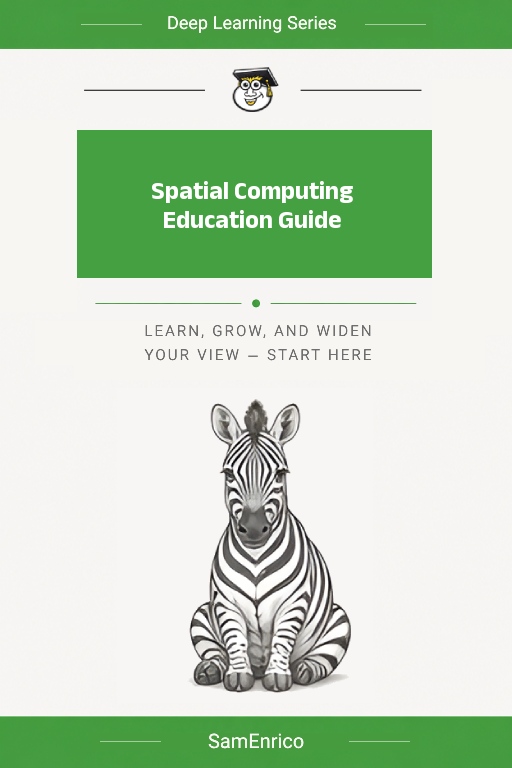
Non-FictionForecast & OutlookSpatial Computing
Spatial Computing Education Guide eBook
Explore mixed reality where digital objects intera
Explore mixed reality where digital objects interact with physical space for hands-on learning.
Formats
Free sample
Chapter 1: The Broken Pencil...--–- The classroom of 2024 looks almost identical to the classroom of 1924. That is not an exaggeration—it is an indictment. A teacher from a century ago, transported forward in time, would recognize nearly everything: rows of desks, a teacher at the front, students staring at flat surfaces (chalkboards then, screens now), and a bell that segments learning into arbitrary blocks. The only difference is the glow. Instead of chalk dust, we have blue light.
Instead of slate, we have glass. But the fundamental relationship between the learner and the material has not changed in one hundred years. Students sit. They look. They listen.
They forget.This is not a failure of effort. It is a failure of interface.For the entirety of modern education, we have forced three-dimensional human beings to learn about a three-dimensional world through two-dimensional surfaces. We teach the geometry of a sphere by drawing a circle on paper. We teach the anatomy of the heart by coloring a flat diagram. We teach the structure of DNA by projecting a double helix onto a screen that flattens its spiral into something resembling a twisted ladder.
And then we wonder why students struggle to transfer that knowledge to the real world—why they can ace the test but fail to recognize the same concept when it appears in a different context. The problem is not the student. The problem is not the teacher. The problem is the pencil.This book is about throwing away the pencil. Not metaphorically.
Literally.Spatial computing represents the most significant shift in human-computer interaction since the mouse. It replaces the two-dimensional interface—windows, icons, menus, pointers—with a three-dimensional interface where digital objects exist in physical space, anchored to real surfaces, responsive to real gestures, and visible from real perspectives. For education, this is not an incremental improvement. It is a category change, as fundamental as the move from oral tradition to written text or from handwritten manuscripts to the printing press.But there is a catch. A massive one.
And ignoring it has already cost schools billions of dollars.The catch is this: spatial computing is not better because it is more exciting. It is better because it is more congruent with how human brains actually learn. And most of what has been sold to schools as "VR education" or "AR learning" completely misses this point. They put headsets on students, run flashy simulations, measure engagement (which is just excitement, not learning), and declare victory. Then the headsets go into locked cabinets after six months, because the novelty wears off and the learning gains never materialize.
This book exists to prevent that from happening to you.The $50 Billion Graveyard of Good Intentions Between 2016 and 2023, global spending on educational technology exceeded $50 billion. A significant portion of that went into immersive technologies—VR headsets, AR applications, mixed reality platforms. And a significant portion of that money is now sitting in locked storage closets, gathering dust, because the implementation failed. This is not a technology problem. It is a pedagogical problem.The technology worked.
The headsets displayed correct images. The tracking was accurate. The content was aligned to standards. None of that mattered, because teachers were given devices without frameworks, students were given experiences without context, and administrators were given ROI projections without realistic implementation plans. The result is predictable and tragic: a graveyard of good intentions, funded by bond measures and grants, now serving as expensive paperweights.This book is not for the technology enthusiasts who bought those headsets.
It is for the teachers who inherited them, the administrators who need to justify the next purchase, and the educators who refuse to repeat the mistakes of the past. Spatial computing is not a gimmick. But it will become one if we continue to treat it as a drop-in replacement for screens, rather than a fundamental rethinking of what learning can be.Here is the truth that no vendor will tell you: a poorly designed mixed reality lesson is worse than a well-designed lecture. The lecture, at least, is predictable. The students know what to expect.
They have coping strategies for boredom. A bad MR lesson, by contrast, is disorienting, exhausting, and actively counterproductive. It requires students to manage attention, balance, social awareness, and technical troubleshooting simultaneously—while also trying to learn content. That is a recipe for cognitive overload, not deeper learning.So this book is not cheerleading. It is not a vendor catalog.
It is a rigorous, evidence-based, classroom-tested framework for designing and implementing spatial computing experiences that actually teach. It assumes nothing about your budget, your technical expertise, or your prior experience. It gives you permission to start small—with a single smartphone, a cardboard viewer, and a five-minute activity—and scale up as you learn.What This Chapter Actually Does (And Does Not Do)Before we go any further, let me be explicit about what this first chapter accomplishes and what it deliberately leaves for later chapters.This chapter does:Establish the foundational vocabulary you need to navigate the spatial computing landscape without getting lost in marketing jargon Clarify the critical differences between Virtual Reality, Augmented Reality, and Mixed Reality—differences that determine which tool is right for which learning goal Introduce the concept of anchoring, which is the single most important technical and pedagogical concept in the entire book Provide a practical decision matrix that helps you choose the right medium (VR, AR, or MR) for any learning scenario Situate spatial computing within the broader history of educational technology, so you understand why previous immersive technologies failed and how to avoid those failures This chapter does not:Tell you which headset to buy (that is Chapter 3)Explain the cognitive science of embodied learning (that is Chapter 2)Provide lesson plans (those begin in Chapter 7)Address data privacy and ethics (that is Chapter 6)Solve classroom management logistics (that is Chapter 11)Think of this chapter as the foundation. If you skip it, the rest of the book will still make logical sense, but you will lack the conceptual framework that makes the later chapters coherent and actionable. The educators who fail at spatial computing almost always fail because they skipped the foundation—they bought hardware, installed software, and turned students loose without understanding the underlying principles.
You are better than that. You are reading this book.The Vocabulary That Will Save You Thousands of Dollars Let us begin with clarity. The spatial computing industry suffers from a terminal case of marketing-driven terminology confusion. Vendors use "VR," "AR," and "MR" interchangeably depending on which sounds most impressive in their pitch decks. This is not harmless.
It leads schools to purchase the wrong devices for their learning goals, which leads to failed implementations, which leads to locked cabinets, which leads to budget committees refusing to fund the next generation of technology.So let us fix the vocabulary now. Permanently.Virtual Reality (VR) replaces your entire field of view with a computer-generated environment. When you put on a VR headset, you cannot see the physical world at all. Your desk, your students, your whiteboard—all gone. In their place is a digital world that you can look around, walk through (if you have enough…
This is the end of the free sample. Get the eBook to keep going. Buy now
About this book
Details
- Author
- Worthy Danika
- Publisher
- SamEnrico
- Language
- English
- Genre
- Non-Fiction, Forecast & Outlook, Spatial Computing
- Released
- 2026-05-29
- Pages (approx.)
- 155
- Available as
- eBook, Audiobook

Read better in the ZLOADR app
Your eBooks on your phone or tablet. Sign in with your SamEnrico account and start reading.
More by Worthy Danika
 Gaslighting Self Trust RepairWorthy Danika$11.99
 Reddit Subreddit Comparison TrapWorthy Danika$11.99
 Email Marketing For PublishingWorthy Danika$11.99
 Colombian Energy Transition ActWorthy Danika$11.99
 The Silent Codebreakers: How WWII’s Female Cryptanalysts Cracked the UnbreakableWorthy Danika$11.99
 Camillus the Divine: Rome's Forgotten War GodWorthy Danika$11.99
 Maintenace TechnicianWorthy Danika$11.99
 How to Start a British Jews Society Business (Beginners Guide)Worthy Danika$11.99
 FinCEN Beneficial Ownership PrimerWorthy Danika$12.99
 Understanding Ichthyosis Follicularis Atrichia Photophobia SyndromeWorthy Danika$17.99
You may also like
 Hong Kong Handover 1997Dunn Johnnie$11.99
 Zumba For Postnatal Recovery CourseNeal Christian$11.99
 Zumba for BeginnersLadner Nikia$11.99
 YouTube Comment Mining GuideHumes Pandora$12.99
 Worry Box MeditationCarlin Rudy$11.99
 Workplace Stress MeditationNguyen Lynn$11.99
 Workplace Stress and Sleep RepairHawley Ivory$11.99
 Workplace Perfectionism CureDelaney Jeffry$11.99
 Workplace Injustice Anger GuideWallen Isabelle$11.99
 Work Addiction and Burnout LinkGreenwood Ester$11.99
 Women in Yoga and WellnessBeattie Galina$11.99
 Women in Stand Up ComedyChun Evangeline$11.99