
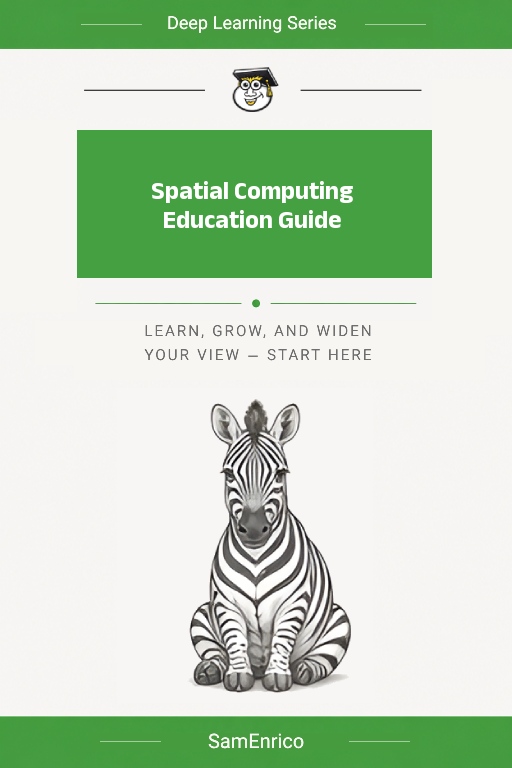
Non-FictionForecast & OutlookSpatial Computing
Spatial Computing Education Guide Audiobook
Explore mixed reality where digital objects intera
Explore mixed reality where digital objects interact with physical space for hands-on learning.
Formats
Free sample
Chapter 1: The Broken Pencil...--–- The classroom of 2024 looks almost identical to the classroom of 1924. That is not an exaggeration—it is an indictment. A teacher from a century ago, transported forward in time, would recognize nearly everything: rows of desks, a teacher at the front, students staring at flat surfaces (chalkboards then, screens now), and a bell that segments learning into arbitrary blocks. The only difference is the glow. Instead of chalk dust, we have blue light.
Instead of slate, we have glass. But the fundamental relationship between the learner and the material has not changed in one hundred years. Students sit. They look. They listen.
They forget.This is not a failure of effort. It is a failure of interface.For the entirety of modern education, we have forced three-dimensional human beings to learn about a three-dimensional world through two-dimensional surfaces. We teach the geometry of a sphere by drawing a circle on paper. We teach the anatomy of the heart by coloring a flat diagram. We teach the structure of DNA by projecting a double helix onto a screen that flattens its spiral into something resembling a twisted ladder.
And then we wonder why students struggle to transfer that knowledge to the real world—why they can ace the test but fail to recognize the same concept when it appears in a different context. The problem is not the student. The problem is not the teacher. The problem is the pencil.This book is about throwing away the pencil. Not metaphorically.
Literally.Spatial computing represents the most significant shift in human-computer interaction since the mouse. It replaces the two-dimensional interface—windows, icons, menus, pointers—with a three-dimensional interface where digital objects exist in physical space, anchored to real surfaces, responsive to real gestures, and visible from real perspectives. For education, this is not an incremental improvement. It is a category change, as fundamental as the move from oral tradition to written text or from handwritten manuscripts to the printing press.But there is a catch. A massive one.
And ignoring it has already cost schools billions of dollars.The catch is this: spatial computing is not better because it is more exciting. It is better because it is more congruent with how human brains actually learn. And most of what has been sold to schools as "VR education" or "AR learning" completely misses this point. They put…
This is the end of the free sample. Get the Audiobook to keep going. Buy now
About this book
Details
- Author
- Worthy Danika
- Publisher
- SamEnrico
- Language
- English
- Genre
- Non-Fiction, Forecast & Outlook, Spatial Computing
- Released
- 2026-05-29
- Pages (approx.)
- 155
- Available as
- eBook, Audiobook

Listen in the VoxFlicks app
Audiobooks and audio dramas wherever you go. Sign in with your SamEnrico account and press play.
More by Worthy Danika
 Gaslighting Self Trust RepairWorthy Danika$11.99
 Reddit Subreddit Comparison TrapWorthy Danika$11.99
 Email Marketing For PublishingWorthy Danika$11.99
 Colombian Energy Transition ActWorthy Danika$11.99
 The Silent Codebreakers: How WWII’s Female Cryptanalysts Cracked the UnbreakableWorthy Danika$11.99
 Camillus the Divine: Rome's Forgotten War GodWorthy Danika$11.99
 Maintenace TechnicianWorthy Danika$11.99
 How to Start a British Jews Society Business (Beginners Guide)Worthy Danika$11.99
 FinCEN Beneficial Ownership PrimerWorthy Danika$12.99
 Understanding Ichthyosis Follicularis Atrichia Photophobia SyndromeWorthy Danika$17.99
You may also like
 Hong Kong Handover 1997Dunn Johnnie$11.99
 Zumba For Postnatal Recovery CourseNeal Christian$11.99
 Zumba for BeginnersLadner Nikia$11.99
 YouTube Comment Mining GuideHumes Pandora$12.99
 Worry Box MeditationCarlin Rudy$11.99
 Workplace Stress MeditationNguyen Lynn$11.99
 Workplace Stress and Sleep RepairHawley Ivory$11.99
 Workplace Perfectionism CureDelaney Jeffry$11.99
 Workplace Injustice Anger GuideWallen Isabelle$11.99
 Work Addiction and Burnout LinkGreenwood Ester$11.99
 Women in Yoga and WellnessBeattie Galina$11.99
 Women in Stand Up ComedyChun Evangeline$11.99