
Non-FictionSelf-HelpLayout Design
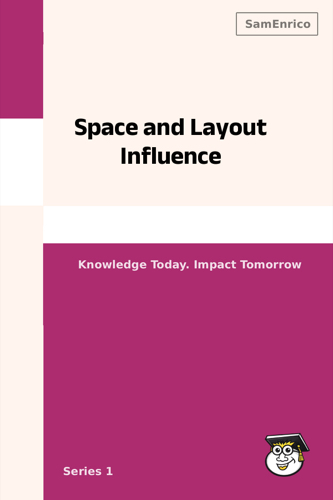
Space and Layout Influence eBook
Arrange elements for visual hierarchy.
by Munn Jacque
Arrange elements for visual hierarchy.
Formats
Free sample
Chapter 1: The Silent Director--–- Every layout has a director. This director decides where you look first, where you look second, and where you never look at all. This director determines what feels important and what feels like noise. This director works so quietly, so invisibly, that most people—including most designers—never notice it is there. But once you learn to see it, you cannot unsee it.
The director is space.Space is the most powerful, most underused, and most misunderstood tool in the designer's arsenal. Beginners obsess over color, font selection, imagery, and effects. Professionals obsess over gaps, margins, intervals, and breathing room. The beginner asks: "What should I add?" The professional asks: "What should I remove, and how much space should I put in its place?"This book is built on a single, transformative claim: visual hierarchy is not primarily about making things bigger or bolder. It is about managing the space between and around elements to dictate the order of perception.
Size, color, and weight are supporting actors. Space is the director.Before we can build hierarchy, we must understand the raw material we are working with. And that material—space—is almost universally misunderstood.The Cathedral and the Storage Closet Let us begin with a simple analogy. Imagine two rooms.The first room is a great cathedral: vaulted ceilings, wide aisles, enormous distances between pillars, shafts of light cutting through empty air. You enter, and your breath catches.
You look up. You look around. The space itself commands attention. The emptiness is not absence. It is presence.
It tells you: this place matters. What happens here is important. Slow down. Pay attention.The second room is a crowded storage closet: boxes stacked to the ceiling, barely room to turn around, every surface covered. You open the door, and you feel a different emotion entirely.
You feel urgency. You feel the need to find what you came for and leave. You feel a little claustrophobic. The space—or rather, the lack of space—tells you: nothing here is precious. Everything is disposable.
Move quickly.Both rooms communicate. Both rooms have a hierarchy. But the cathedral speaks through space, while the storage closet speaks through density.Your layouts are the same. Every page you design is either a cathedral or a storage closet. Most beginners, terrified of empty space, unknowingly design storage closets.
They fill every available pixel, believing that more content equals more communication. The result is not communication. It is noise.The professional designer designs cathedrals. They understand that space is not what is left over. Space is what makes the content matter.The Anatomy of a Page: What You Actually See Close your eyes for a moment.
Picture a page—any page. A magazine spread, a website, a poster, a book. What do you see?Most people, when asked this question, describe the content: the headline, the photograph, the logo, the button. They describe the figure, not the ground.But here is the truth that separates professionals from amateurs: your brain does not process the page element by element. It processes the page as a field of spatial relationships.
Before you have consciously identified a single word, your visual cortex has already mapped the distribution of density and emptiness. It has already identified the largest block of negative space. It has already noted where the clusters are. It has already assigned provisional importance based entirely on spatial isolation.In other words, hierarchy begins before reading. Hierarchy begins with space.Consider two identical headlines.
Place the first headline in a dense field of text and images. Place the second headline alone on a page with generous margins around it. Which one feels more important? The second, of course. And yet nothing about the headline itself has changed.
No size increase. No color change. No bold weight. Only space.This is the fundamental insight of spatial hierarchy: space is not neutral. Space carries meaning.
Space assigns value.Passive Space Versus Active Space: The Critical Distinction To master spatial hierarchy, you must internalize one distinction above all others: the difference between passive space and active space.Passive space is the unconscious void. It is the margin you never set because the software defaulted to one inch. It is the gap between paragraphs that exists because you pressed Enter twice without thinking. It is the area around a logo that is empty because you ran out of things to put there. Passive space has no job.
It does not guide, emphasize, separate, or connect. It simply accumulates. Passive space is the visual equivalent of filler words in speech—"um," "ah," "like"—noise that signals a lack of intention.Active space is deliberately shaped, measured, and positioned to perform a specific function. It is the generous margin around a luxury product that whispers this matters. It is the tight, consistent gap between a grid of thumbnails that shouts these belong together.
It is the exaggerated space before a new section heading that tells the reader a shift is coming. Active space has intent. It has been measured, adjusted, tested, and refined.Here is the rule that separates professionals from amateurs: In a masterful layout, the space has been worked as hard as the content.Look at any great piece of design—a classic magazine spread from Vanity Fair, a museum exhibition poster by Paula Scher, a well-crafted website like Apple's product pages. Cover the content with your hand. Look only at the shapes of the white space.
You will see that those shapes are not random. They are designed. They have form, rhythm, and purpose. The negative space is as carefully drawn as the positive elements.Now look at a poor layout—a cluttered flyer, an overstuffed Power Point slide, a confusing e-commerce product page. Cover the content.
The white space is shapeless—a leftover puddle, not a sculpted form. It has no structure because it was never considered.The difference between passive and active space is the difference between accident and intention.Figure-Ground Theory: The Brain's Spatial Flip Why does active space matter so much? The answer lies in the biology of perception. Your brain cannot process figure and ground simultaneously. It switches between them, rapidly and unconsciously.This is the insight of Figure-Ground Theory, first articulated by the Danish psychologist Edgar Rubin in 1915.
Rubin created the famous optical illusion that bears his name: the vase that is also two faces facing each other. Look at the dark area, and you see a vase. Look at the light areas, and you see two profiles. You cannot see both at once. Your perception flips.This flipping is not a bug.
It is a feature. Your brain is constantly deciding what is figure (the object of attention) and what is ground (the background context). And here is the designer's leverage point: you can control which elements become figure and which become ground through the manipulation of space.When you surround a small element with vast negative space, that element becomes figure immediately. The space becomes ground. The brain has no choice.
There is nothing else to look at. This is the mechanism behind the "Mona Lisa effect" that we will explore…
This is the end of the free sample. Get the eBook to keep going. Buy now
About this book
Details
- Author
- Munn Jacque
- Publisher
- SamEnrico
- Language
- English
- Genre
- Non-Fiction, Self-Help, Layout Design
- Released
- 2026-06-06
- Pages (approx.)
- 144
- Available as
- eBook, Audiobook

Read better in the ZLOADR app
Your eBooks on your phone or tablet. Sign in with your SamEnrico account and start reading.
More by Munn Jacque
 Creator Business Plan GuideMunn Jacque$11.99
 Online Casino Self Exclusion GuideMunn Jacque$11.99
 Money Anxiety Coping GuideMunn Jacque$11.99
 The Wool Barons of Australia: Spinning Gold from the OutbackMunn Jacque$11.99
 Learn to Play the Lyra (Byzantine)Munn Jacque$11.99
 India Job Notice Period GuideMunn Jacque$12.99
 How to Start a Bottles Made of Plastic Business (Beginners Guide)Munn Jacque$11.99
 Microcline MiningMunn Jacque$11.99
You may also like
 Hong Kong Handover 1997Dunn Johnnie$11.99
 Zumba For Postnatal Recovery CourseNeal Christian$11.99
 Zumba for BeginnersLadner Nikia$11.99
 YouTube Comment Mining GuideHumes Pandora$12.99
 Worry Box MeditationCarlin Rudy$11.99
 Workplace Stress MeditationNguyen Lynn$11.99
 Workplace Stress and Sleep RepairHawley Ivory$11.99
 Workplace Perfectionism CureDelaney Jeffry$11.99
 Workplace Injustice Anger GuideWallen Isabelle$11.99
 Work Addiction and Burnout LinkGreenwood Ester$11.99
 Women in Yoga and WellnessBeattie Galina$11.99
 Women in Stand Up ComedyChun Evangeline$11.99