
Non-FictionInformativeEducational
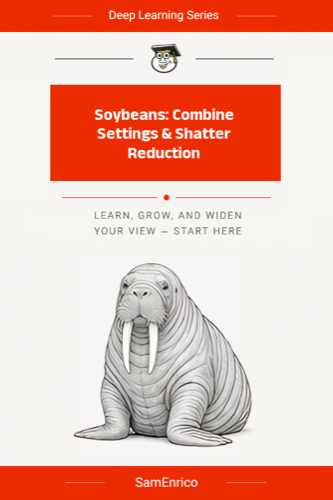
Soybeans: Combine Settings & Shatter Reduction eBook
This harvesting publication, published by SamEnric
by Mojica Zonia
This harvesting publication, published by SamEnrico, covers Soybeans: Combine Settings & Shatter Reduction
Formats
Free sample
Chapter 1: The Hidden Harvest...--–- The first time I watched a farmer lose 187 bushels in ten minutes, he never knew it happened. The beans fell behind his header, scattered across the stubble like golden coins dropped from a pocket with a hole, and fed every bird in three counties. When I walked back to show him the drop-pan, he looked at the ground, then at me, and said, “That’s normal.” It was not normal. It was theft—and he was the victim, the perpetrator, and the eyewitness all at once.This book exists because that moment has played out on millions of acres across every soybean-growing region of the world, year after year, decade after decade. Farmers who spend thousands of dollars on seed, fertilizer, chemicals, and fuel routinely leave 3, 4, even 5 bushels of every acre lying on the ground behind their combines.
They do not do this because they are lazy or incompetent. They do it because no one has ever shown them what they are losing—and because the machine in front of them hides its sins in stubble and dust.The Silent Crime in Your Rearview Mirror Let us begin with an uncomfortable truth: the modern combine is an engineering marvel designed to deceive you about its own performance. It hums along, lights flashing, grain tank filling, cab computer displaying happy numbers, while behind you a carpet of soybeans feeds wildlife, germinates volunteer plants for next season, and rots into organic matter that benefits no one’s bottom line. Your yield monitor tells you what made it into the tank. It cannot tell you what you left behind.I have stood beside farmers who argued with me about the beans on the ground behind their machines.
“That’s just pod shatter,” they would say. “You can’t do anything about that.” And then I would show them the difference between a shattered pod (brittle pieces, no whole beans) and a whole bean on the ground (intact, round, edible). Whole beans on the ground are not Mother Nature’s fault. Whole beans on the ground are your fault.The distinction matters because it points directly to the solution. Shattered pods from pre-harvest dryness are biological losses you cannot fully eliminate, though you can minimize them by harvesting at the correct moisture window.
Whole beans on the ground are mechanical losses—beans that were threshed, separated, and then ejected from the machine or dropped by the header. Mechanical losses are entirely within your control. And in most fields, mechanical losses account for 60 to 80 percent of total visible loss.The Four Tiers of Loss: Where Do You Stand?Before we can fix a problem, we must measure it. And before we can measure it, we must define what we are measuring. Throughout this book, we will use a four-tier classification system that every operator should memorize and apply daily.
These tiers are based on decades of extension research, manufacturer testing, and real-world harvest data from thousands of fields.Exceptional: Less than 2 percent loss. This is elite operator performance. Achieving this tier requires daily drop-pan checks, hourly adjustments, and a combine that is correctly set for every condition change. Operators in this tier keep more than 98 of every 100 bushels they grow. They are the top 5 percent of harvesters.
This book’s goal is to put you in this tier.Good: 2 to 3 percent loss. This is achievable by any operator who follows the protocols in this book with consistent discipline. Loss at this level represents acceptable biological shatter plus minimal mechanical loss. Many farmers mistakenly believe this is “normal” and stop improving. It is not normal.
It is good—but good leaves money on the table.Average Industry Baseline: 4 to 5 percent loss. This is where most farmers operate today. They may not see beans on the ground because they are not looking. Or they see them and assume nothing can be done. At $12 soybeans, a 4.5 percent loss on 1,000 acres costs $21,600 per year.
Over a decade, that is a quarter of a million dollars.Negligent: More than 5 percent loss. This tier is defined by visible beans on the ground from the cab. If you can look behind your combine while harvesting and see beans without getting out of your seat, you are losing more than 5 percent. At 8 percent loss, you are leaving nearly one of every twelve bushels you grew. At 10 percent loss, you might as well take every tenth pass across the field and dump the grain tank on the ground before you go home.The difference between negligent and exceptional is approximately 6 to 8 percent of your gross yield.
On 1,000 acres at 60 bushels per acre and $12 beans, that difference is $43,200 to $57,600 per year. Every year. For the rest of your farming career. If this book saves you 4 percent of your yield—moving you from average (4.5 percent loss) to good (2.5 percent loss)—it will pay for itself in the first 100 acres of the first field you harvest after reading it.The Red Flag Rule: Your First Diagnostic Tool Here is a rule so simple that it seems almost insulting to state it. And yet I have watched hundreds of operators violate it every single harvest day for years.
If you can see beans on the ground from the cab, you are losing money.Stop. Read that again. If you are harvesting soybeans and you look behind the combine—not even getting out, just turning your head—and you see beans, you have a problem that requires immediate attention. There is no scenario in which visible beans from the cab are acceptable. None.
Zero. Every bean you see is a bushel you did not sell.I have heard every objection. “That’s just the dry pods popping.” No, dry pods shatter into fragments, not whole beans. “That’s from the headlands where I turned around.” No, headland loss is still loss, and it often indicates reel speed or header height problems. “The field is uneven.” No, uneven fields require different settings, not acceptance of loss.The red flag rule exists because your eyes are the most underutilized sensor on your combine.
Yield monitors, moisture sensors, and automated adjustments are wonderful tools. None of them can see a bean on the ground. Only you can do that. And when you see beans, you must stop, diagnose, and correct.The Drop Pan: Your Most Powerful Tool If the red flag rule is your diagnostic trigger, the drop pan is your diagnostic instrument. This simple device—a one-meter square pan, or even a cookie sheet or cardboard box of the same dimensions—is the single most important tool in this entire book.
More important than any setting, any adjustment, any piece of technology. The drop pan tells the truth when every other part of your combine is lying to you.Here is how to use it. Before you enter a field, stop the combine. Place the drop pan on the ground ahead of the header. Drive over it without changing any settings.
Then stop immediately after the pan passes under the machine. Retrieve the pan. Count the beans in it. This is your pre-harvest loss—beans that fell from pods due to dryness, disease, or weather before…
This is the end of the free sample. Get the eBook to keep going. Buy now
About this book
Details
- Author
- Mojica Zonia
- Publisher
- SamEnrico
- Language
- English
- Genre
- Non-Fiction, Informative, Educational
- Released
- 2026-06-02
- Pages (approx.)
- 131
- Available as
- eBook, Audiobook

Read better in the ZLOADR app
Your eBooks on your phone or tablet. Sign in with your SamEnrico account and start reading.
More by Mojica Zonia
 Team Creative Warm DownMojica Zonia$11.99
 The Work Byron KatieMojica Zonia$11.99
 Growth Mindset In PovertyMojica Zonia$11.99
 Evening Commute Wind DownMojica Zonia$11.99
 Atacama Desert TrekMojica Zonia$11.99
 Outsourcing for WritersMojica Zonia$11.99
 Mindfulness for Remote WorkersMojica Zonia$11.99
 The Phoenix and the Moonflower: A Love Written in Fire and PetalsMojica Zonia$11.99
 The Medici of the East: How a Japanese Industrialist Built the World’s Greatest Art CollectionMojica Zonia$11.99
 The Essential Guide to Christmas: JazzMojica Zonia$11.99
 UK Director Credit Separation HandbookMojica Zonia$12.99
 Marketing Channel Selection MatrixMojica Zonia$12.99
You may also like
 Hong Kong Handover 1997Dunn Johnnie$11.99
 Zumba For Postnatal Recovery CourseNeal Christian$11.99
 Zumba for BeginnersLadner Nikia$11.99
 YouTube Comment Mining GuideHumes Pandora$12.99
 Worry Box MeditationCarlin Rudy$11.99
 Workplace Stress MeditationNguyen Lynn$11.99
 Workplace Stress and Sleep RepairHawley Ivory$11.99
 Workplace Perfectionism CureDelaney Jeffry$11.99
 Workplace Injustice Anger GuideWallen Isabelle$11.99
 Work Addiction and Burnout LinkGreenwood Ester$11.99
 Women in Yoga and WellnessBeattie Galina$11.99
 Women in Stand Up ComedyChun Evangeline$11.99