
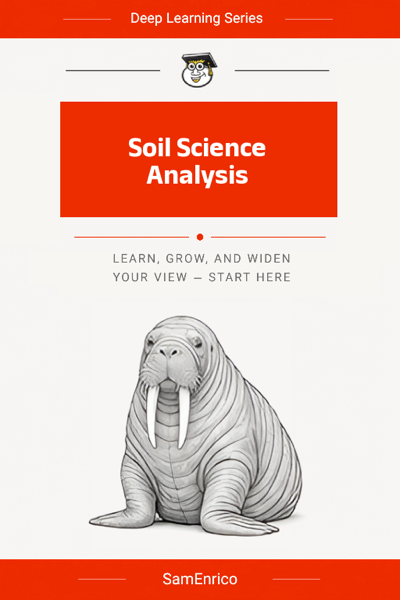
Non-FictionInformativeEducational
Soil Science Analysis eBook
A Coursebook on Soil Science Analysis
A Coursebook on Soil Science Analysis
Formats
Free sample
Chapter 1: Beyond Ordinary Dirt--–- The first mistake most beginners make is treating soil like a simple growing medium – a passive, inert substance that merely holds plants upright while providing a few dissolved nutrients. This misconception leads to failed experiments, misinterpreted data, and costly field errors. The truth is far more complex and fascinating. Soil is a living, breathing, three-dimensional biogeochemical system that responds dynamically to management, climate, and time. Before you can analyze soil, you must understand what soil actually is and why your analytical approach matters as much as your analytical technique.This opening chapter establishes the philosophical and methodological foundation for every procedure in this book.
Without grasping the principles presented here, you cannot trust a single soil test result you produce or interpret. You will learn to think like a soil scientist – someone who sees beyond the surface, questions every measurement, and understands that quality control begins long before the sample reaches the laboratory bench.What Soil Really Is: A Living System Soil is not dirt. The term "dirt" implies something out of place, something to be cleaned away. Soil, by contrast, is a natural body formed through the complex interaction of five factors: parent material, climate, organisms, topography, and time. These factors, first systematized by the Russian scientist Vasily Dokuchaev in the late nineteenth century, produce soil horizons – distinct layers that develop parallel to the Earth's surface.A mature soil profile typically contains three major horizons.
The A horizon, or topsoil, is rich in organic matter and supports most biological activity. The B horizon, or subsoil, accumulates clay, iron, and aluminum leached from above. The C horizon consists of partially weathered parent material. Below that lies bedrock in most landscapes. Understanding this vertical structure is essential because sampling depth dramatically affects analytical results.
Surface organic matter tells you about recent management; deep subsoil reveals leaching patterns and parent material influences.Soil performs five critical ecosystem services that sustain human civilization. It serves as the medium for plant growth, providing physical support, water, and nutrients. It regulates the hydrologic cycle, storing and filtering water while reducing flood risk. It recycles organic wastes and dead organisms, transforming death into life. It provides habitat for a quarter of Earth's biodiversity.
And it serves as the foundation for virtually all human infrastructure – buildings, roads, pipelines, and septic systems. When you analyze soil, you are evaluating the performance of this remarkable natural system.The Four Major Purposes of Soil Analysis Why do you need to analyze soil? The answer depends on your professional context. This book organizes soil analysis around four primary objectives, each with distinct methods and interpretive frameworks.Agricultural fertility analysis is the most common application. Farmers, agronomists, and home gardeners test soil to determine nutrient status, lime requirements, and salinity levels.
The goal is to optimize crop production while minimizing environmental impact and input costs. Agricultural soil tests typically focus on the plow layer – the top fifteen to twenty centimeters – where most plant roots forage for nutrients and water. Mobile nutrients like nitrate and sulfate require deeper sampling to assess leaching risk, while immobile nutrients like phosphorus are evaluated in the surface layer where they remain.Environmental contamination assessment has grown dramatically in importance over the past three decades. Environmental consultants, regulatory agencies, and land developers test soil for heavy metals, petroleum hydrocarbons, pesticides, and industrial chemicals. The goal is to protect human health and ecosystem function.
Environmental sampling often extends to greater depths than agricultural sampling – sometimes several meters – to evaluate the vertical extent of contamination and assess risks to groundwater. Sample handling requirements are much stricter for environmental analysis, including chain-of-custody documentation to support potential legal proceedings.Geotechnical engineering analysis serves civil engineers, construction firms, and transportation departments. Soil properties like bearing strength, shrink-swell potential, corrosivity, and compaction characteristics determine whether a site can support a building, road, or pipeline. Geotechnical sampling requires intact, undisturbed cores that preserve the natural structure and density of the soil. This is why geotechnical engineers use special sampling tubes and careful extraction techniques that would be unnecessarily expensive for agricultural fertility testing.Soil classification and taxonomy is the fourth major application.
Soil scientists map and classify soils to support land-use planning, natural resource inventory, and scientific research. The USDA Soil Taxonomy system classifies soils into twelve orders based on diagnostic horizons, temperature regimes, moisture regimes, and other measurable properties. Classification analysis requires a full suite of physical, chemical, and sometimes mineralogical data from multiple depths. This is the most comprehensive form of soil analysis, and it serves as the foundation for extrapolating agricultural and environmental interpretations from studied soils to unstudied ones.Throughout this book, you will encounter methods and interpretive frameworks for all four applications. The same physical property – bulk density, for example – is measured differently and interpreted for different purposes depending on whether you are a farmer concerned about root restriction or a geotechnical engineer calculating settlement potential.The Scientific Method Applied to Soil Soil analysis is not merely a collection of recipes for producing numbers.
It is a scientific discipline that requires hypothesis testing, experimental design, and statistical reasoning. The scientific method provides the framework that transforms data into knowledge.A good soil investigation begins with a clear question. For a farmer, the question might be: "Will applying forty kilograms of nitrogen per hectare increase my corn yield relative to no nitrogen?" For an environmental consultant: "Does the lead concentration in this former orchard exceed the state residential soil standard?" For a geotechnical engineer: "Will this clay soil shrink sufficiently to damage a foundation during a summer drought?"The question leads to a testable hypothesis – a specific prediction that can be confirmed or refuted by data. The corn farmer's null hypothesis might be: "Nitrogen application has no effect on yield." The alternative hypothesis: "Nitrogen application increases yield."Designing a defensible experiment requires attention to replication, randomization, and control. Replication means measuring multiple independent samples from each treatment group.
A single soil core from a fertilized plot tells you almost nothing; twenty cores provide statistical power to detect a real difference. Randomization means assigning treatments to plots in a way that avoids systematic bias. If you apply nitrogen only to the field's south side, you cannot distinguish fertilizer effects from inherent differences in soil or drainage. Controls provide a baseline for comparison. In agronomic experiments, untreated check plots reveal what would have happened without the intervention.Observational studies – where you cannot control treatments – require different design considerations.
Mapping soil carbon across a forested watershed, for example, involves systematic sampling along transects or grids to capture spatial variability without manipulating anything. The statistical tools differ, but the underlying principle remains: collect data in a way that allows valid inference about the population you care about.Precision, Accuracy, and the Sources of Error Two concepts form the foundation of analytical quality control: precision and accuracy. They are not the same thing, and confusing them leads to serious misinterpretation.Precision refers to the repeatability of a measurement. If you analyze the same well-mixed soil sample ten times, do you get nearly the same result each time? High precision means low random error – the scatter around the mean is small.
Precision is necessary but not sufficient for good science.Accuracy refers to how close your measurement is to the true value.…
This is the end of the free sample. Get the eBook to keep going. Buy now
About this book
Details
- Author
- Briscoe Allegra
- Publisher
- SamEnrico
- Language
- English
- Genre
- Non-Fiction, Informative, Educational
- Released
- 2026-05-09
- Pages (approx.)
- 146
- Available as
- eBook, Audiobook

Read better in the ZLOADR app
Your eBooks on your phone or tablet. Sign in with your SamEnrico account and start reading.
More by Briscoe Allegra
 Sobriety Without Shame: A Recovery PrimerBriscoe Allegra$11.99
 Healthcare Burnout GuideBriscoe Allegra$11.99
 Workaholism and Substance AbuseBriscoe Allegra$11.99
 Term Loan B Structures GuideBriscoe Allegra$11.99
 Tangaroa and Hina: The Ocean’s Forbidden LoveBriscoe Allegra$11.99
 How to Produce Aircraft Parts and AccessoriesBriscoe Allegra$11.99
 How to Become a Mainspring Winder And OilerBriscoe Allegra$11.99
 Virtual Account Management WorkbookBriscoe Allegra$12.99
You may also like
 Hong Kong Handover 1997Dunn Johnnie$11.99
 Zumba For Postnatal Recovery CourseNeal Christian$11.99
 Zumba for BeginnersLadner Nikia$11.99
 YouTube Comment Mining GuideHumes Pandora$12.99
 Worry Box MeditationCarlin Rudy$11.99
 Workplace Stress MeditationNguyen Lynn$11.99
 Workplace Stress and Sleep RepairHawley Ivory$11.99
 Workplace Perfectionism CureDelaney Jeffry$11.99
 Workplace Injustice Anger GuideWallen Isabelle$11.99
 Work Addiction and Burnout LinkGreenwood Ester$11.99
 Women in Yoga and WellnessBeattie Galina$11.99
 Women in Stand Up ComedyChun Evangeline$11.99