
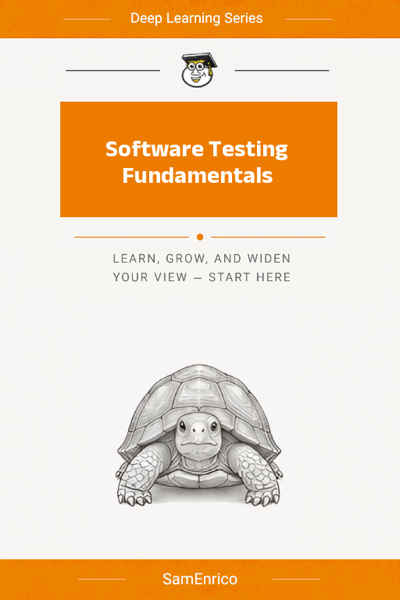
Software Testing Fundamentals eBook
A Coursebook on Software Testing Fundamentals
by Shea Mitsue
A Coursebook on Software Testing Fundamentals
Formats
Free sample
Chapter 1: The Unseen Avalanche--– The year was 1999. NASA’s Mars Climate Orbiter, a $327 million spacecraft the size of a small car, fired its thrusters to enter orbit. Engineers at mission control watched their screens in disbelief as the probe dipped too low, plunged into the Martian atmosphere, and disintegrated. The cause? A mismatch between metric units (newton-seconds) and imperial units (pound-force seconds).
One team used metric. Another used imperial. No test had ever checked the assumption that all units aligned. The orbiter didn’t have a bug in its code. It had a bug in its thinking.
And that bug cost more than a quarter of a billion dollars.If you take only one thing from this chapter, let it be this: Testing is not about finding bugs. It is about asking the right questions before the answers cost you everything.Welcome to Software Testing Fundamentals. Most people believe testing is a technical chore—something you do at the end of a project to catch mistakes before customers see them. That view is not just incomplete. It is dangerous.
It leads to failed launches, security breaches, ruined reputations, and, in extreme cases, loss of life. Therac-25 radiation overdoses. Toyota’s unintended acceleration. The Heartbleed security vulnerability. Every one of these disasters had one thing in common: someone assumed something that was never tested.This chapter rewires how you think about testing.
You will learn why verification and validation are two different universes. You will discover why “quality” is not what you think it is—and why preventing failure is cheaper than fixing it. You will understand that testing is fundamentally about risk, not defects. You will face the uncomfortable truth that you can never test everything, so you must choose where to focus. And you will see through the most expensive myths in software: that testing slows delivery, that developers can test their own work, that passing tests guarantee quality, and that automation will save you.By the end of this chapter, you will never again say “testing finds bugs.” Instead, you will say: “Testing reveals information about risk so we can make better decisions.” That shift in language is a shift in power.
Let us begin.The Two Questions That Separate Beginners from Experts Every test you will ever write answers one of two questions. Most testers never stop to ask which one.Verification: Are we building the product right?Validation: Are we building the right product?These sound similar. They are not.Verification asks whether the software matches its specification. If the requirements say “the login button turns blue when clicked,” verification checks that the button actually turns blue. It is a conformity check.
It assumes the specification is correct.Validation asks whether the software solves the user’s actual problem. Validation might discover that users do not want a blue button—they want no button at all because they prefer keyboard shortcuts. Validation challenges the specification itself.Here is the painful truth most organizations discover too late: You can perfectly verify the wrong product.The Mars Climate Orbiter was perfectly verified against its internal specifications. Each team built exactly what they were asked to build. The problem was that no one validated the interface between the teams—the assumption that units of measurement were consistent.
Verification passed. Validation failed. The orbiter burned.In your career, you will see this pattern repeat endlessly. A team spends months building a feature exactly to spec. They write thousands of passing tests.
They launch. Customers hate it. The team says, “But we built what you asked for!” The business says, “But it’s not what we needed.”The solution is not more verification. The solution is to ask validation questions early: “Is this the right problem to solve? Does this solution fit how people actually work?
What assumptions are we making that could be wrong?”Throughout this book, you will learn techniques for both. Black-box testing (Chapter 3) and white-box testing (Chapter 4) are largely verification tools. Exploratory testing (Chapter 5) and Agile testing practices (Chapter 9) are where validation lives. But the distinction starts here, in your mind, with every test you design.The Economics of Quality: Why Prevention Beats Inspection Every software organization makes a silent economic decision about quality. Most never realize they have made it.The Cost of Quality (Co Q) framework divides quality-related costs into four categories:Prevention costs – Training, requirements reviews, design reviews, test planning, process improvement.
These happen before any code is written. They are invisible because nothing has failed yet. They are also the cheapest.Appraisal costs – Testing, code reviews, static analysis, inspections. These happen during development. They find problems before customers do.Internal failure costs – Debugging, rework, regression testing, documentation updates.
These happen after you find a bug but before the customer sees it.External failure costs – Customer support, emergency patches, lost sales, contract penalties, reputation damage, lawsuits, regulatory fines. These happen after the customer finds the bug.Here is the economic law of software quality: Prevention costs 1.Appraisalcosts1. Appraisal costs 1.Appraisalcosts10. Internal failure costs 100.Externalfailurecosts100. External failure costs 100.Externalfailurecosts1,000 or more.These ratios are not exact, but the exponential curve is real.
A requirements review that catches a missing edge case costs an hour of meeting time. Fixing that same edge case after coding costs a day of development and testing. Fixing it after release costs a week of emergency patches, customer support, and lost trust. Fixing it after a security breach costs millions.Consider the Cost of Poor Quality (Co PQ) – the sum of internal and external failure costs. Many organizations track only appraisal costs (“we run 5,000 tests”) and ignore failure costs (“we spent three weeks fixing regression bugs”).
This is like measuring how many times you check your parachute while ignoring that you keep packing it incorrectly.The most successful testing organizations do something counterintuitive: they spend more on prevention and appraisal to spend much less on failure. They invest in testable requirements, risk-based planning, and developer-testing skills. They know that a dollar spent finding a requirements gap saves a hundred dollars of emergency production fixes.You will learn how to implement these practices in Chapter 7 (test planning and estimation) and Chapter 8 (defect management). For now, internalize this: Testing is not a cost center. It is an investment in avoiding exponential losses.Testing as Risk Mitigation: The Mindset Shift Imagine you are the quality lead for a medical device that delivers insulin.
The device has 47 different alarm conditions. You have six weeks before regulatory submission. You cannot test all 47 alarms exhaustively because each alarm has multiple timing variations, user responses, and hardware states.How do you choose what to test?This is not a technical question. It is a risk question.Risk is the combination of two things: the probability that something goes wrong and the impact if it does. The highest-priority tests are those where probability × impact is largest.In the insulin pump example:A missed alarm for low battery (high probability, low impact – user sees a warning on screen) might be low priority.A missed alarm for occlusion (blocked tube, medium probability, catastrophic impact – patient receives no insulin) must be tested exhaustively.A cosmetic alarm text typo (very low probability of harm) might…
This is the end of the free sample. Get the eBook to keep going. Buy now
About this book
Details
- Author
- Shea Mitsue
- Publisher
- SamEnrico
- Language
- English
- Genre
- Non-Fiction, Informative, Educational
- Released
- 2026-05-06
- Pages (approx.)
- 159
- Available as
- eBook, Audiobook

Read better in the ZLOADR app
Your eBooks on your phone or tablet. Sign in with your SamEnrico account and start reading.
More by Shea Mitsue
 Remote Worker Self AssessmentShea Mitsue$11.99
 Navigating Parent Loss First YearShea Mitsue$11.99
 Napping Environment SetupShea Mitsue$11.99
 Microbiome Autoimmune MarkersShea Mitsue$11.99
 Coping With Wage GarnishmentShea Mitsue$11.99
 Boundary for CodependentsShea Mitsue$11.99
 Thyroid MistakesShea Mitsue$11.99
 Menopause Sleep MemoryShea Mitsue$11.99
 Key Executive Departure GuideShea Mitsue$11.99
 The Lionesses of Shanghai: How Women’s Football Roared to Life in 1920s AsiaShea Mitsue$11.99
 The Wolf and the Rose: A Viking Love Among the Flames of LindisfarneShea Mitsue$11.99
 The Pink Panther Heist: The 1972 Monaco Caper That Shocked the WorldShea Mitsue$11.99